Nanotechnology Lecture Invitation

On Tuesday I am participating in a lecture about nanotechnology at the Bocconi University in Milan.

Nanotechnology Lecture Poster

Nanotechnology Lecture Poster

This is not a subject that is new to this website as a quick search demonstrates. In May of 2011 Hayley asked the question of whether nanotechnology research is safe. It is a well written and commented post that raises some critical questions about the ethics and practices surrounding technology that is already changing our lives and has incredible potential in many walks of life.

Hayley continued her thread in January of this year with an article about nanobots, the future of nanotechnology. Here she describes the bottom up approach that the technology is taking on, underlining the importance of self replication.

In March I followed up on these articles with a post about how nanotechnology procedures are regulated, based upon the National Research Council’s report of the same month. Many similar issues are raised in the report about environmental damage, possible risks to health and governance.

On a lighter note in April I posted about nano-art and again in May about how nanotechnology is making waterproof electronics a reality.

So all of this leads me on to Tuesday’s lecture. The main speaker is Michael Bruch, the Head of R&D and Risk Consulting at Allianz Global Corporate (the insurance company). He is going to talk about the role of insurance in innovative technologies, with a focus upon nanotechnology.

If we read the articles linked above we understand that this research is fraught with risk, and so development companies have to take out insurance against losses, but how can the level of risk be calculated with such an unknown and potentially powerful product? What might the implications be for the global financial system if something goes catastrophically wrong?

Well if anybody can tell you Mr Bruch can.

The proceedings will be streamed live through the Bassetti Foundation website, but I am travelling half way round the world to be there in person. It will also be available later on podcast, and I think will be a very interesting debate.

I will let you know next week how it all goes. Invitation enclosed.
Mistaken Identity

A couple of months ago I wanted to buy a new sofa. I found something that looked great in my local online sales paper, so I had to decide whether to go and see it. This involves hiring a car or taking a train and bus, because it was not close to my house and I don’t have a car of my own here in the US. Another possibility was just to hire a van, go and see it and buy it on the spot, a slightly riskier option.

So I did what many do, I looked up the seller via Google to see who he was. He turned out to be the CEO of a local business, so I made my decision. I hired a van and drove out, bought it on the spot, a lovely piece. I based the decision on the seller’s Linkedin profile, presuming that I had the right person from the name, and all went well.

The BBC recently broadcast a program on the World Service Outlook program along the same lines, but with a different outcome. It is available on Podcast here, but I would like to outline the story for you all.

In 2009 Iran saw street protests following the disputed presidential elections. Violence flared and a young woman was shot dead. Her name was Neda Agha-Soltan. Journalists from the international press soon picked up on the story, and rather like me searched Facebook and other sites for a photo of the victim. They found one and published it.

The next day Neda Soltan, a university professor saw her photos in the press. They had the wrong person. Obviously this may have caused some distress for her friends and family, so she contacted the press institutions and told them of their mistakes. They however continued to use her photo, and soon it was appearing on leaflets and became the face that distinguished the protests.

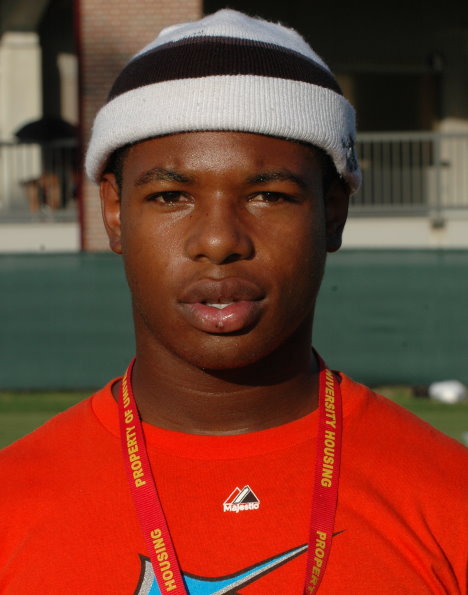
Johnny Hankins, is it me?

Johnny Hankins, American Footballer.

A few days later government secret service officers turned up at the professor’s house. They wanted to prove that the rumours of the death were all false, a CIA or EU plot to discredit the government, and they had proof that Neda was still alive. They wanted her to come forward and display to the world that she was still with us.

When she refused she was arrested. Upon her temporary release her friends managed to smuggle her out of the country, into Turkey and on to Germany where she claimed political asylum. She is currently in the US but has not seen her family and cannot return to Iran.

Jonny hankins again

The Internet has given journalists incredible tools and access to information, but here a mistake has ruined somebody’s life. The first thing people do when they want to learn about a person is type their name into their favourite search engine. Facebook is like a CV, but contains far more intimate and possibly compromising information, but users seem not to take this into consideration.

Another Johnny hankins

Another Johnny hankins

In the case above there seems to be no recourse to the law, and anyway it would not help. A bit of responsibility wouldn’t go amiss  on both sides though!

Commercial Drones and Privacy

A couple of years ago I wrote an article on the Bassetti Foundation website about the use of drones and other robot devices in warfare. Times have moved on however, and now drones are much smaller and cheaper, so you do not need a multi-billion dollar budget to buy one.

a quadcopter drone

A commercial quadcopter drone

To give you an idea, $600 US will buy you this quadcopter. Perfect for the beginner, plate already mounted for the camera and can also carry a small payload.

If you want something that resembles an aeroplane why not take a look at  the CropCam (before it takes a look at you). $6999 I grant you but a fine machine. Hand launched it is guided by its GPS navigation system, automatically lands and takes pictures, flies at 60 Km an hour and can be fitted with a video. You set up the GPS and the autopilot does the rest.

As the name suggests, this vehicle is aimed at the commercial market, look at your crops, find your animals and catch your daughter in a haystack with the boy next door.

The haystack incident might sound like a joke but it is really a serious problem. There are no regulations about where you fly your new machine in the USA. The market for Unmanned Aircraft Systems (UAS) is in massive expansion as farmers, security companies, private detectives, news organizations, traffic and transport management companies and many others see the potential in such snooping power. The machines can be fitted with face recognition software, thermal imaging and license plate readers, and many see this as problematic.

A couple of months ago the Association for Unmanned Vehicle Systems International (AUVSI) launched a code of conduct for the industry, in the light of a new law in the USA that allows anyone to operate one of these systems (see the Federal Aviation Administration Modernization and Reform Act of 2012).

Privacy groups are up in arms however, claiming that the mass use of this type of technology will lead to massive infringements upon personal liberty, and they take no comfort from the code of conduct. Voluntary as it is, the code is extremely general, has no enforcement mandate, contains no discussion at all about the myriad potential privacy and safety issues raised by unrestricted drone use over U.S. airspace, and there is nothing about the intended audience or user.

One US Senator however is trying to take action. Sen. Rand Paul has introduced a bill that aims at protecting Americans against unwanted drone surveillance. Read about it here.

The present regulations state that 400 feet above your house you enter neutral territory, a bit like international waters off the coast, so anyone has the right to fly their drone 401 feet over your house. These machines are small so you probably wouldn’t notice it, but as we know cameras are good nowadays. At a few hundred dollars for a vehicle they are becoming available to almost anyone, and certainly any business or organization.

Do you think this could become a problem? Is it yet another invasion of privacy or a justified use of technology? I am all ears.