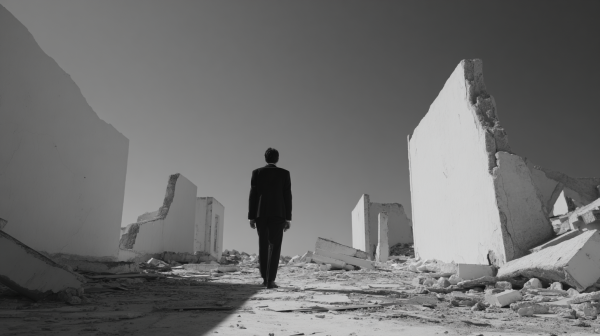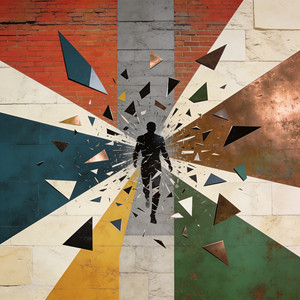
On 8 April 2026 Steward.exe released their first album Humanwear Cuts, free to listen to here and across all streaming platforms. Readers in the UK can see them live as the play their first UK date on 31 May. As regular readers will know, this is a project that I am involved in myself, both as a drummer and percussionist and philosophical investigator.
Together with Luca Severino (and with live performance from Lisa Mos), we have been experimenting on ourselves and with AI, firstly exploring the technicalities of using generative AI to produce sounds and music while in parallel reflecting upon the experience.
AI is used across the board in the music industry today, not only in production and sound creation, but also during the development and execution of promotional materials and strategies. Steward is experimenting with using AI within the creative process. It is not AI generated music as we might imagine it though, but some of the source materials are AI products.
Once the sounds have been generated, they are treated in the same way that any other source might be treated. Sampled, manipulated, chopped and changed. They offer inspiration, rather than being an end product. Steward.exe uses its production skills to create from sources that may or not have been ‘artificially’ generated. Generated thanks to knowledge and technique that Steward possess.
The Steward.exe project aims to be a synthesis of sound research and ethical reflection in the age of artificial intelligence. What does it mean to use AI as part of the artistic production, rather than as a technical assistant? Can we speak of a sort of co-production? If a piece of music develops from a line that was created by AI, is it AI produced? Once the idea has been created by AI can it be forgotten? Or is the end result, regardless of the process, the ‘child’ of that first AI input?
The AI revolution is linguistic. Suno gives the possibility to anyone who wants to create their own music. They have to describe what they want, and the machinery generates music based upon the description. A movement from needing to learn how to play an instrument, to hold a note, to imagine a structure – to being able to describe what we want, to a machine that will then approximate what we are asking for. What about skill? Can we find it in the description? In the prompts? Or is that merely knowledge (or is that also not necessary)?
But reflection brings many questions. Could we see this as the democratization of music production? Who has the right to use its creation, to sell it, to gain from it? Whereas once musicians had the power to create, using their own experience and skills, anyone can now create a song. If anyone can create their own music (and market it and benefit from it) we must be witnessing change in the distribution of power, but is this a democratization or centralization? And is it detrimental to musicians? Or creativity?
And could AI agents do all of this for itself? Create its own music and its own power?
What role does professionality hold? Suno will produce a song from a few search terms, but can a user express professional knowledge and experience in those terms, and can we hear that in the resulting music? We are feeding knowledge into a machine, professional knowledge built from decades of experience. And the machine gains from our experience, it comes to embody our experience. How does this sit within ideas of professionality? And responsibility?
Can we ask similar questions of video production? I am sure we can. See this video for the Steward.exe single Blockroots Tar, AI production, complete with prompts.
Alongside raising these and many other questions, the music raises aims to show how established and experienced musicians can develop ideas that have been generated by AI. The finished product is not the product of AI, it is crafted by Luca Severino, you can hear his style in the music, it is not generic, a mash-up of previously digitized sounds, it is Luca’s sound. The rhythm reflects my style of playing, although I didn’t play it myself (with the odd exception) I can feel myself in the music. Check out the latest video here.
It’s a very personal interrogation. These AI systems have been trained on music whose intellectual property and copyright has not been respected. The black box is closed around even knowing how they have been trained, on which (whose) materials. Possibly including materials that myself and Luca have previously released. All without traceability, payment, or citation.
When we set knowledge down in book form, we acknowledge our sources. We extend previously made arguments, we do not take them as our own.