A Possible Breakthrough in Energy Storage?

The Institute of Mechanic Engineers says that turning air into liquid may provide a solution for energy storage. At present most energy is stored in batteries, but battery production and disposal is an extremely messy and polluting affair, and so experiments are underway to look into this alternative.

One of the problems particularly with renewable energy sources is that energy is produced at times when it is not needed. The system cannot just be turned on or off, so this excess energy must be stored. Scientists believe that with improvements the liquid energy solution could be 70% efficient, less than batteries but at a much lighter cost to the environment.

To give you an idea of how the process works, it follows a number of stages:

“Wrong-time electricity” is used to take in air, remove the CO2 and water vapour, which would otherwise freeze solid.

The remaining air, mostly nitrogen, is chilled to -190C (-310F) and turns to liquid – this provides a compact storage medium that can later draw energy in the form of heat from the environment.

The liquid air is held in a giant vacuum flask until it is needed.

When demand for power rises, the liquid is warmed to ambient temperature. As it vaporizes, the expanding gas drives a turbine to produce electricity – no combustion is involved.

One particularly interesting thing about this development is that it comes out of a garage in England.

Peter Dearman in his garage

Inventor Peter Dearman in his garage lab

Peter Dearman made the discovery while looking for a way to power his car using air. I have written about these types of experiments before in my Health of the Planet series. Take a look at this video on Youtube to see Dearman at work. Real Chitty Chitty Bang Bang stuff.

The BBC also has an article in its Science and Environment section that you can read here.

One conclusion to draw is that world changing technological innovation has to start somewhere, and it is not always in a sterile lab. Sometimes it is in a garage behind a house in Hertfordshire.

A Civil Rights Swiss Army Knife in your Phone

Last week I wrote about Apps for driving, and this week I would like to continue the theme, but with Apps that aim to protect the user from police harassment.

The first I would like to look at is called Stop and Frisk Watch, and has been developed with the help of the non-profit organization Make The Road New York. The App is designed so that the user can record both audio and video of police interactions in the community (with the screen black so that evidence is less likely to be destroyed), is alerted when other users are doing the same in the area, and has a direct reporting system so that any interaction can be reported in real time. Just shake the phone and the video is sent directly to a lawyer. It also contains a document that outlines an individual’s rights while recording the police in action.

Filming Police Brutality

Filming Police Brutality

The App is downloadable here through the New York Civil Liberties Union website.

The groups that are advocating the use of such Apps tend to be minority groups, who believe that they are treated differently from other members of society due to their race or religion, and hope that recording the police at work might help to address this issue. If we think back a few years to the Rodney King case in LA in 1991 we can see that video technology has held a place in these types of issues for some time. We should also remember that riots were triggered in which 53 people were killed when the police were acquitted and so this is not a technology without implications for all sides. If you watch the video of the beating though you can see why the acquittal caused so much anger.

UPDATE: I just want to clarify that 2 officers were later charged with civil rights violations related to the Rodney King case mentioned in the article and found guilty and imprisoned. Also readers should be aware that the use of these Apps to film the police may not be legal in certain states, a problem that I touched upon last week regarding radar tracking equipment in cars.

Also in New York the Sikh Coalition is making an App available called FlyRights. This App allows the user to file complaints about air travel discrimination in real time and directly to the correct authorities. If a user feels they have been profiled or are being searched because they are wearing religious dress such as a turban or veil they can report discrimination on the grounds of religion or race.

There are many other Apps like this, and supporters argue that they could become the base as a new civil rights movement, after all the phone is one of the few things that most people carry everywhere they go. A Swiss army knife for civil rights right there in your pocket for some, a dangerous tool for others, once more we are in a debatable position. In many states in the US it is illegal to film the police and action is taken against those who do, so an App that allows someone to do it without being noticed may be looked upon with suspicion.

Radar and Speed Camera Apps

20 years ago I worked above a garage in Manchester. The owner was a young man who liked fast cars, but in Britain the roads are monitored with cameras and speed traps making it easy to lose your license through the points deduction system.

My boy racer friend had a solution however, on the rear view mirror he had a radar detection system. These systems were illegal to use, but not to own, so although visible to a passing police officer there was little they could do about it.

20 years on the technology has improved. Now for 6 euros you can download Radardroid, it sits in your smartphone and informs you when you are getting close to a speed camera or radar. This App sends a visual and sonic signal to warn you, so you can slow down and avoid fines and potentially losing your license.

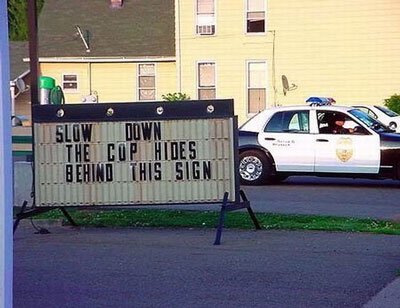
To think it used to be like this!

Modern technology means less places to hide

There are many systems available. Some like Radardroid are openly helping you to avoid abiding by the law, but others market themselves as driver help tools. They let you know when there is a traffic jam ahead, bad weather or a radar by describing them all as ‘risk zones’. These systems have even been endorsed by some European governments and car manufacturing companies are starting to put the technology directly into their cars.

One problem remains however, in some countries the use of this technology is prohibited. Germany and Switzerland enforce bans on such technology, something that was easy with older systems that could be spotted from outside the car. But what about if it sits within your phone. How can a sovereign state stop people driving on their territory with an App in their phone? Will they stop cars that are factory fitted with the technology from crossing their borders?

I doubt that enforcement will be possible, and this highlights just one of the problems of the management of a single market across different sovereign countries. Technology transcends geographic boundaries, as the internet buying of banned products has proved.

And this leads me to my final question, does this mean that people only abide by the law because they think that they might get into trouble if they don’t? What are the ethical implications of the marketing and endorsing of such products? If this process continues many laws will become obsolete as technology finds ways to avoid being caught.

In Italy you have to pay to use the motorways, so you get a ticket when you enter, that you present when you leave and pay. On some motorways they have introduced what they call a tutor. It is old school technology, the ticket has the time you enter stamped on it. When you leave the time is registered again. If you cover more distance than is possible while remaining within the speed limit you get a fine. A simple A to B calculation that has dramatically cut deaths on my local motorway.

If you are interested in reading more about ethics in technological innovation take a look at my work blog.