Nanobots – The future in Nanotechnology

This is Technology Bloggers 150th article 🙂
Well done and thank you to all our brilliant writers (Hayley included), as well as readers and commenters who have helped us get here!

A fraction of the ever-expanding field of nano-technology, nano-robots, a.k.a. nanobots, hold some of the most promising possibilities in the fields of technology, engineering and medicine. They also pose some of the most complex hurdles, such as automation, replication, control and finding viable energy sources to enable movement.

The Nano-Scale

Nanotechnology involves the study and micromanipulation of anatomic particles up to 1 nanometer, with scientists working to develop nanobots in fields less than 100 nanometers in size. Transmission electron (TEM), scanning electron (SEM), scanning tunneling (STM) and Atomic Force (ATM) microscopes are large, powerful machines that make all aspects of nanotechnology, including nano-robotics, possible.

Nano-microscopes allow researchers to isolate and observe single molecules, including chemical reactions that occur upon moving, eliminating and rearranging molecular structures. This base knowledge is essential to understanding, creating and ultimately finding solutions so that nanobot technology will reach its full potential.

Bottoms Up

Up until recent years, the development of nanotechnologies maintained “top-down” construction. The advent of “bottom up” creations on the nano-scale provide scientists the ability to create smaller objects; in addition, components can be “grown” to allow greater adaptation to specific environments or inclusion of specific properties.

Scientists are literally able to “grow” carbon nanotubes and “string” together nanowires, creating desired properties such as hastening conduction or reducing heat output – properties that make for tiny, efficient particles. In theory, by building a nanobot from the bottom up, scientists begin to find solutions that allow for greater control mechanisms and possibly self-replication of the nanobot.
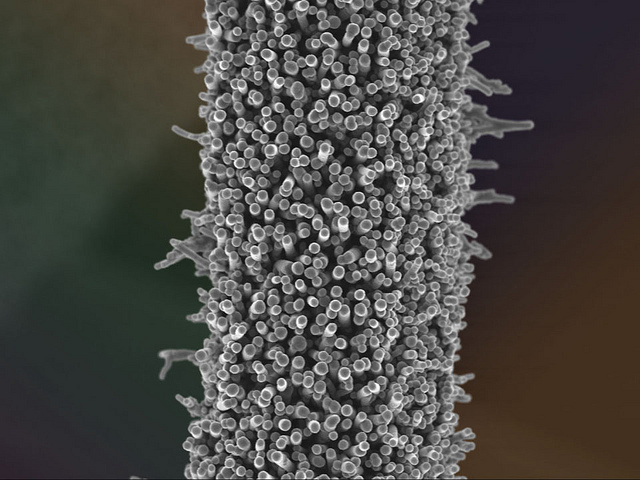
A carbon nanotube

Carbon nanotubes – building nanotechnology from the bottom up.

The greatest benefit of working bottom-up is that, rather than altering materials to work in a desired fashion, scientists build nanostructures and nanobots with proper compounds from the outset.

The Present

Although practical applications in medicine and technology have yet to be fully realized, nanobots are no longer figments of science-fiction imagination.

Lack of autonomy, largely associated with insufficient or unrealistic sources of energy, leaves a large barrier to the potential uses of nanobots. Batteries and solar sources are impractical due to size and, although a scientist can guide the nanobot with the use of magnets, they are not ideal. For example, a physician using a nanobot to treat a patient would need to maneuver the nanobot from outside the skin while also observing inner structures of the body.

Within the past year, scientists announced the creation of a nano “electric motor.” Utilizing principles of adsorption, a molecule attaches itself to the outside of a piece of copper; an STM probe focuses electrons onto the molecule, providing a source of energy and means to control direction. The large, cumbersome STM still makes this impractical in many ways; however, scientists are able to study this single motor and hypothesize ways to alter this and thus to apply it to nanobots.

In addition, micromanipulation made possible by electron microscopes allows for “DNA-walkers.” Essentially reprogramming a portion of a DNA strand, “molecular robots” or “spiders” walk autonomously; ultimately, scientists hope to further develop this technology, creating nanobots that fix genetic diseases.

The Future

Many scientists believe self-replication, most likely by programming the nanobot to micromanipulate surrounding atoms to create duplicates of its self, is essential to the realization of the many medical and technological applications.

In addition, a truly autonomous nanobot would be able to recognize, react and/or adjust to varying environmental conditions, including the presence of other nanobots; scientist could also program them for molecular assembly.

Many believe nanobots will allow for precise diagnostic capability and treatment of diseases such as cancer, as well as genetic disorders. Advances in communications, green energy, computer electronics and semi-conductors appear limitless.

Summary

Although still in its infancy, scientists across many fields hold much promise for nanobot technology. An autonomous nanobot, able to adapt its environment and self-replicate, could be the key to early detection and the cure of many diseases; in addition, nanobots will play an important role in sustainable or renewable energy sources, engineering and advancing computer technology. What do you think?

For further information check out the article on nanobots over at MicroscopeMaster. Links in my bio.

The benefits of remote working for SMEs over winter

In order to help small and medium enterprises (SMEs) continue to operate in severe weather conditions over winter, industry experts now advise small firms to consider implementing flexible remote working systems, allowing employees to work from home.

Business man's hand writing virtual private network concept

Remote working has grown to become an important element of business productivity for SMEs.

With the current technology available, firms now needn’t suspend their business in severe weather, with a combination of remote technologies and common sense allowing SMEs to continue trading.

Remote working can maintain productivity and reduce office costs over the winter months. Studies have found in the past that employees working away from the distractions of their desk and the surrounding office environment increased their productivity by a considerable margin.

What exactly is remote working?

Put simply, remote working is when people do their work at home or outside the workplace. With the current financial climate tighter than ever, businesses are always looking to bring down their running costs and remote working is one way of achieving this goal.

In many industries Virtual Private Networks (VPNs) are created to enable employees to login to a company network and access all the information they need to carry out their work, whether it is word documents, emails or project briefs. Remote working also enables businesses to employ and outsource work to people all over the world.

There are many other advantages of remote working for both small business owners and employees alike:

Advantages of remote working for SME owners

  • Fewer office costs – with staff able to use remote and cloud computing to access emails, files and any other necessary information, SMEs can cut costs such as printing, electricity and any other staff management charges.
  • Increased productivity and results – Instead of having to down tools and stop work on client projects, owners can allow staff to carry on their work from home. This is also an excellent employee incentive as staff can save money on travel to and from the office or studio.
  • Greener working – remote working can dramatically reduce a businesses’ impact on the environment by reducing the number of employees that commute to the office or studio.

Advantages of remote working for employees

  • Enhanced work-life balance – employees that are allowed to work remotely in severe weather naturally have an improved work-life balance, with the ability to spend more time with children and spouses.
  • Reduced stress levels – taking your employees away from the cut and thrust of the office environment can reduce stress levels. Remote working in more comfortable, homely surroundings can foster greater productivity.
  • Increased trust and responsibility – While SME owners must choose the right people to work remotely, those fortunate enough to be able to work from home will have their morale boosted by the extra trust and responsibility placed upon them by their employer.

The key challenge for SMEs is to ensure employees are disciplined enough to handle the freedom of remote working. Today an increasing number of small business owners appreciate the benefits working from home can bring to their company.

Does Security Have to be Technical?

I had been a software engineer for at least 3 years specializing in digital security. A month ago, I attended a small workshop which talked about IT Security for corporate and the speaker said this somewhere in the middle of the workshop:

“Security is a process. It does not have to be really technical and the most important part is the process.”

I stunned for a while and suddenly my mind wondered away from the workshop deeply thinking, what is the speaker trying to deliver? I started this serious thinking simply because it is not said by some non-technical or sales person. Instead, the person speaking in front of me is a Certified Ethical Hacker.

A padlock key on a keyboardAt the end of the workshop, I begin to understand what he is trying to deliver. After 3 years of writing programs for the benefit of security, I turned out saying that security is a process. Why would I say that? Look around us. All the tech that you need to protect yourself from cyber crime is there. Anti-virus, firewall, anti keylogger, parental control, password manager and many more are all available in the software market. There is no reason for us to say in terms of technology, we are not good enough in security.

What makes so many of us a victim of computer or internet threat is the lack of proper process in computer and internet security. Security is not a short process where you only apply if you need it. For instance, you don’t only apply security when you had just downloaded a file from an unknown site which required a security scan.

Security is an end to end process. This means that the moment your computer boots up, security should be applied until the time your computer shuts down. People usually failed to stay secure simply because they don’t apply security from the very start. Agree?

So what’s your view? Do you still think that security has to be something technical?