NanoArt

A couple of weeks ago whilst writing about nanotechnology and the associated risk involved in such engineering techniques I mentioned Nanoart.  This week I would like to expand and to present a gallery of examples.
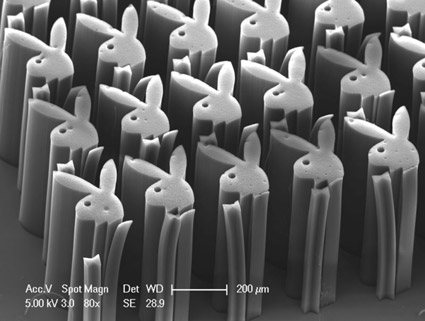
nano playboy logo

To quote Cris Orfescu, founder of Nanoart 21, “NanoArt is a new art discipline at the art-science-technology intersections. It features nanolandscapes (molecular and atomic landscapes which are natural structures of matter at molecular and atomic scales) and nanosculptures (structures created by scientists and artists by manipulating matter at molecular and atomic scales using chemical and physical processes). These structures are visualized with powerful research tools like scanning electron microscopes and atomic force microscopes and their scientific images are captured and further processed by using different artistic techniques to convert them into artworks showcased for large audiences.”

One of the issues raised during discussion in my previous posts was about the usefulness and point of such artistic expression, so here I quote the NanoArt 21 website:

“The purpose is to promote  NanoArt worldwide as a reflection of a technological movement… a more appealing and effective way to communicate with the general public and to inform people about the new technologies of the 21st Century. NanoArt is aimed to raise the public awareness of Nanotechnology and its impact on our lives”.

There are several organizations that promote this form of expression and at least one international competition that offers cash prizes for the best examples (NanoArt 21 have an international competition). The German Centre for Research and Innovation hosted an exhibition of their collection in New York in 2011 and the number of artist/scientists involved seems to be growing.

The following gallery should give you an idea of this particular art form. Also take a look at the Nanobama here. The image is of nanotubes made in the shape of President Obama’s face, similar in style to the playboy above.

a guitar

A guitar


self explanatory


extra planetary

in blue

A nano landscape

You can find many other examples online. Do you like them? I personally like the 3D effect. It seems more accentuated because the images are created by electrons (electrically charged particles) rather than photons (particles of light). The electrons penetrate deeper into the structure creating images with more depth.

Technology and the future of gaming

A few weeks ago I wrote an article about how technology is going to impact the way we work in the future. Now I am going to let you into some treat that may be in-store for us, sooner than you might think, in the world of gaming.

More Family Integration

Critics believe that in the future, despite popular belief, gaming will not be more individual, each of us in separate rooms, but more communal, with entire families uniting, in order to play together.

This is mainly due to the rapid developments in home entertainment systems based on competition, and also movement. In 2006 we saw this trend start to develop with the launch of the Nintendo Wii. This immediately pulled people together to game, more so than ever before. Games like Wii Play, and Mario Kart have brought families (and friends) together to play across the world.

In 2010, Kinetic for the Xbox 360, adding further elements of full body participation to gaming. Later this year, Kinetic will be available for computers too. Also later this year, we are going to see the release of the Wii U, the next model of the Wii.

The Wii U

A preview at Nintendo’s new Wii: the Wii U

It is devices like the Kinetic and Wii that are making gaming more social, with even more exciting and innovative devices coming out soon, also aimed at bringing us together.

Mind Control

You read right, mind controlled games are much closer than you might think. Thanks to the developments of advanced brainwave sensors, it is now possible to control things using your mind. All you need is to wearing a simple headband and earpiece with the advanced sensors attached, as brainwaves can be captured and interpreted on your scalp.

In the near future, we could potentially have ditched the controller, and be doing battle with our minds. Games where the the more you concentrate, the better you do, are a leap forward that has been made, and will be released to the mass market very soon.

Mind control could work with all sorts of games, however currently the technology works best with simple ones, like a game of tug of war (the harder you think you pull, the harder you pull!) and archery – focus on the bullseye, and you are more likely to hit it.

Mind control can help to create a much more personal experience, when gaming. This technology can also be applied to movies. Multiple scenes can be shot, and depending upon your emotions and how you are reacting to events, you could see different things. Sound cool hu?

More Interactive Experiences

I have already talked about things like the Wii, and Kinetic, but other systems, like the the Trixter Xdream are going to revolutionise the way we play, and the way we keep fit. The Wii let us play golf and tennis in our living rooms, but it didn’t feel all that real, did it? The Xdream accurately simulates riding a bike outside, using a computer display and a modified exercise bike.

Trixter Xdream Exercise Bike

The Trixter Xdream exercise bike

This means that you can feel like you are going for an outdoor workout, on a real bike, but becoming totally immersed in the experience, in the comfort of your own home – you may need to open some windows to create the draft effect! The bike is currently on sale for around £6,000 GBP, however in the future more and more of these devices (which will get cheaper and cheaper) are going to make their way into gyms around the country, and also even our homes.

TVs are set to get smarter soon too, with firms like Samsung and Google revolutionising the way we use our televisions.

3D

3D has been around for a while now, decades in fact, however there has always been the need to wear glasses. In the very near future, we could see glassesless 3D TV’s in our homes, providing us with 3D entertainment with no goofy glasses.

This technology will be able to offer gamers total 3D immersion, making the experience feel even more real. Match that with motion technology and the gap between fiction and reality narrows even further.

To Conclude

There are so many other revolutionary technologies and products that are set to change the way we have fun in the future. I have written about just a few to wet your appetite for what is going to be appearing on the high street within the next few years.

By all means research this further, and if you find anything interesting, let me know!

Gaming is set to change, quite radically and quite soon. The question is are we ready for it?

Google Fiber start laying optical fibre cable

On the 6th of February, Google announced that the company was “ready to lay fiber” in Kansas City (Kansas and Missouri), and restated the goal of getting customers up and running in the first quarter of 2012. The project is nothing short of revolutionary, both for Google and the broadband industry as a whole.

For Google, this is a major first foray into the consumer ISP and infrastructure side of the tech industry. It’s also an opportunity to offer and refine the company’s core online products – without the restrictions of scaling down to suit users’ limited bandwidth access.

An optical fibre broadband cable

Data can be transported at the speed of light through optical fibre cables

For the ISP industry as a whole, it’s potentially alarming. By the end of the year, many internet service providers may have a much higher standard to live up to, and many restless customers on their hands, due to the new competition. Everything depends on two basic questions: how much more bandwidth will Google be able to offer customers, and how much will they be charged for it?

How much speed can you get from optical fiber cables?

Google promises 1gb/s fiber connections. 1 gigabit per second is the same as 1,000 megabits per second – “more than 100 times faster than what most Americans have access to today.”

That’s so impressive that one can’t help being a little suspicious. After all, nearly all of the broadband companies claim a much higher speed than their service actually delivers; due to network overhead, distance from the node, ‘peak time’ traffic, and various other details, your average speed is probably only a fraction of what your ISP promises.

Google Fiber has one active trial in progress, a small community near Stanford University. A user posted a speed test not long ago showing a 151.68 mb/s download speed, giving a good real-world example of what day-to-day users can expect from Google Fiber.

Other fiber companies aren’t even claiming speeds like Google’s (let alone delivering them). The provide in current “fastest internet in the US”, Verizon’s FiOS, tops out at 150 mb/s (if your math skills are sleepy, that makes Google Fiber potentially over 660% faster). The runner-up is AT&T’s U-verse, which has a “Max Turbo” plan of 24 mb/s. In both cases, real-world data shows users getting a wide variety of results, from far worse to sometimes even better than quoted (especially when using the companies’ own speed tests. Hmm…).

How much will Google’s fiber optic speeds cost?

Google’s answer:

“It’s too early to say how much we plan to charge for service, but we do plan to set prices that are competitive to what people are currently paying for broadband access.”

Critically speaking, this could mean anything from around $40 to $200 per month.

The 150 mb/s FiOS plan mentioned above will currently set you back about $200 each month, while AT&T’s 24 mb/s is listed on the web site at $63. To be fair, the closest FiOS plan, at 25 mb/s, would cost about $70/month.

However, the most recent figures for US consumers put the average monthly cost for broadband at around $40. Admittedly, there’s a lack of up-to-date statistics in this area, but if there is a difference, our average cost is most likely a little higher now than in 2010-2011.

The Bottom Line

While Google Fiber looks incredible promising, it’s is still an unknown factor; the actual results and pricing plans are months away.

However, we know for a fact that higher speeds and lower costs go hand-in-hand else where in the world. We know that Google’s effect on the Kansas City tech industry and economy in general has been and will be very positive; and we know that – for whatever reason – many companies and media organizations have suddenly been much more interested than ever in pointing out Google’s flaws and changing public perception of the company.