Food, Wrapped Up

This week I would like to wrap up my series on food, and leave you with a little light reading and a film to watch.

Wrapped up Food

Wrapped up Food

My first post Technology in Food Production contained a general overview of how modern farming techniques are effecting our lives. Most of the comments made expressed surprise at the levels of GM organisms that are currently being farmed and the profits generated by the industry.

The following are taken from comments posted, from various different contributors:

“The statistics you cite are shocking. I had no idea GM was so widespread”.

“It is also scary to see the profits made by processed food companies matched with those made by agricultural businesses”.

“With so many farms producing GM foods and so much money behind it I really doubt anyone’s chances of keeping the products contained”.

The second post in the series was entitled What Actually is GM Food? In it I suggest that much of the population is unclear about what modification actually implies, and describe some of the most widespread techniques. Once more issues of money, safety and acceptance appeared throughout the comments.

The following is from Neil seems to sum up the debate quite beautifully:

“I can see the socio economic benefits of developing fast growing disease, herbicide and insect resistant crops. While on the other hand I worry about the potential long term effects on humans when we ingest the GM foods”.

And Christopher offered some thoughts on the pros versus cons debate that Neil touched upon above:

“I do however think that the reduction in pesticide, insecticide, fungicide and herbicide use is a good thing – as they all have proven negative externalities”.

The Processed Food and Bacteria Problem was the third post, and it addresses changes in our bodies caused my the consumption of processed foods and other changes in food consumption patterns.

Comments once more raised the issue of profits from processing and improved food security and opposing sides of the same debate:

“Processing has always being a big part of the packaged food. That is why the packaging services and suppliers make such big fortunes from their services. On the other end, processing is necessary for food items as it improves security and safety. Most of the packaged food is bacteria free and safe to use”.

Experts, Regulation and Food described the close ties between regulating bodies and the industries they regulate in the USA, and also referred to similar problems that may be arising in Europe. The focus is on seed companies and the regulation of GM products, but the argument is much broader than this in reality.

The perspective is that when an industry looks for experts to form a regulating body, they inevitably look within the industries, raising the question of conflicts of interests.

Once more Neil summarizes in the comments:

“It’s a tricky one as in most industries the people who know the most about the industry will always be the experts who are working within the industry. In an area like GM foods I would guess that it would be very difficult for an outsider to have the same degree of understanding”.

I am not sure that I agree with him though that there is such a need for experts. If we take the GM issue the result of non public participation in the debate and regulation surrounding their introduction lead to physical and destructive confrontation. This is not a good result for either side in the debate, but maybe if the public had been consulted during the process (and not just the so-called experts) the result might have been less violent.

The fifth post in the series is a book review and description of Alternative Food Provisioning Networks. These networks offer an alternative to mainstream participation in the global agricultural market, favouring local organic production and co-production.

It is written from experience as I am a member of one of these groups described in the book in Italy and now a similar group in the USA. Once more Neil commented on the ammount of money these groups move into the alternative economy:

“80 million Euro’s is no small amount. I guess it is a bit like reverting back to a village type structure without the village”.

GM, Blowing in the Wind is the sixth post in the series. It addresses various legal issues that have grown out of the fact that GM organisms become airborne and blow onto other people’s land and grow there. There are two different problems addressed, farmers whose land is “contaminated” who lose money, and farmers who risk legal action for patent infringement because GM seeds are found on their land. Once again issues of regulation come to the fore as I raise the question of how they effect the development of the field.

Last week’s post was Wasted Food, and it is about the amount of food that the current system produces that is not consumed. It is a harsh analysis, but I take my data from respected sources.

The post addresses ideas such as freeganism and other ways of using waste food products, and concludes with some questions about the real reason for hunger in the world. Once more Neil offers a closing comment:

“It would be interesting to see the wastage levels before and after the introduction of use by dates. Given that the producers need to have a reasonable margin for error it must have been one of the biggest contributors to the wastage.

Also, in the US you appear to have a dining culture where it is expected that you get more food than you can finish (hence the invention of the doggy bag) and people are disappointed by smaller portions. This must create a lot of waste at the catering level as well as all of the doggy bags thrown away a week or so later.

It is a shame that there is no way of redistributing that food to poorer nations”.

As a final thought I would like to recommend a film and an article, both of which add flesh to the argument that I hope to have introduced over the last couple of months.

Food.Inc is a documentary made in 2008 about the US food industry. It is available here. It goes into further depth on many of the topics I have raised through interviews and investigation. It is a great film but I warn you, it is not a comedy!

This article in New Yorker magazine tells the story of how a herbicide producer spent years trying to discredit a University of California Berkeley Professor who seemed to find side effects linked to the use of the herbicide. It is a disturbing story of how the agricultural industry (and the regulators to some degree) maintain control of information and findings published to the public. I was going to write a post about it but I wanted to finish on a more positive note.

I would like to thank everyone who read and/or commented upon the series. I hope it was informative and even maybe will go some way to doing some good in the world. A quote from the greatest of all:

The difference between what we do and what we are capable of doing would suffice to solve most of the world’s problems”.

Alternative Food Provisioning Networks

As a continuation of my food series, I would like to take a look at alternative food provisioning networks, via a review of Italian anthropologist Cristina Grasseni’s new book ‘Beyond Alternative Food Networks’. The book describes strategies used by groups to avoid interaction with the industrialized food mechanism, much of which I have debated in the other posts in the series.

Beyond Alternative Food Networks

Beyond Alternative Food Networks

Grasseni’s book gives an account of the inner workings of Italy’s solidarity purchase groups. These groups are informal collections of families, working together to procure food and other products from mainly local producers in order to reclaim sovereignty over their purchasing.

The model is extremely innovative, both in terms of its positive health and social benefits and financial implications. Groups make agreements with local farmers to buy their produce in return for guarantees regarding production processes (organic, tax paid, worker’s rights etc). The producer benefits because they can sell their produce directly to the consumer, and so is not held hostage by distributors and retailers. The consumer gains because they know who has produced their product, how, where and under which conditions. Group members can buy hygiene and baby products, detergents and a range of household goods through the network, offering a source of income to specialist socially and environmentally friendly producers.

Although this system might sound like a Utopian fringe, Grasseni points out that the groups spend about 80 million Euro a year in Italy alone (about $110 million), in effect moving this sum from the regular economy into this more direct exchange. The number of groups is in rapid expansion and has led to the creation of networks of groups, national conferences and organizations and even the creation of ‘districts of solidarity economies’.

The book argues that this alternative economics structure is trust based, with all parties within the transaction knowing and directly relating with the others. Several organizations work entirely within the structure providing goods only for the groups. The following examples of the dairy and the shoemaker really show the potential of the model.

In 2009 a local dairy farmer converted to organic production in order to supply these groups. This involved downsizing and specialization, but several years later the farm found itself in financial difficulty. Members of the groups ran an email campaign and in about a month raised 150 000 Euro (more than $200 000) to bail the dairy out. The money was passed on, the dairy survived and now produces milk and cheese for the very same groups that saved it. With the banks no longer involved, the farmer can sell the produce at retail prices directly to the groups and make enough money to live and repay the initial bailout loan.

The story of the shoemaker is similar. After being forced into downsizing the shoemaker was left with capability but little market. He withdrew from the mainstream economy and now provides made to measure shoes through the network. There is a traveling catalog, so once found you can choose a style and size and order your new shoes that then arrive through the post. They are also sold through a network of non profit organizations that have relationships with the groups.

This book certainly leads the reader into a new way of thinking about food production. The cover contains a quote from Peter Utting, Deputy Director of the united Nations Research Institute for Social Development. He states that “Grasseni provides fascinating insights into how alternative approaches to food provisioning can transform social and economic relationships in ways that bode well for contemporary global challenges of sustainability, social justice and rebuilding human relations built on trust”.

If you would like to learn more about these alternative approaches, take a look at the following links:

Rete Gas is the Italian national GAS network.

The Food Alergy and Anaphylaxis Network has a dedicated page.

The Grassroots Innovation website also has plenty of information.

Beyond Alternative Food Networks by Cristina Grasseni is published by Bloomsbury and available through Amazon via the link above.

I would like to add that although this review is not paid, I do know the author very well. I am also a GAS member.

Experts, Regulation, and Food

A few weeks ago I wrote a post on the Bassetti Foundation website called The Innovation Principle.

The post was a review of a letter sent by some of Europe’s largest corporations to the European Commission. The letter claims that regulation in the EU risks damaging development and the economy, they want a series of things to be taken into account within the regulation process.

It is easy to read and short and I recommend a look, it is free to download through the link above, but I would like to take one of their suggestions and apply it to food regulation, as part of my food series.

The letter calls for the “Full inclusion of relevant expertise”, and this sounds perfectly reasonable. But what does it actually mean in practical terms?

If we take the example of GM food development that I raised last week, it means finding experts in the field and putting them on committees to determine if proposals are safe. Now this means that you have to look to industry, because most of the experts work within the industry.

Now I believe that in all likelihood an expert working for a nuclear energy company will tell you that nuclear energy production is 100% safe, a nanotechnology researcher will paint a glowing picture of how the future is bright thanks to nano developments, and a GM food expert will do the same.

In the USA, the Federal Drug Administration is responsible for regulating the safety of GM crops that are eaten by humans or animals. According to a policy established in 1992, FDA considers most GM crops as “substantially equivalent” to non-GM crops. In such cases, GM crops are designated as “Generally Recognized as Safe” under the Federal Food, Drug, and Cosmetic Act (FFDCA) and do not require pre-market approval.

But here the waters start to murk and merge. As I said, experts in the field working or having worked for industries working with technology are likely to be positive about their products. And the FDA seems to contain several of these experts, and some of them may have helped to make the distinction above.

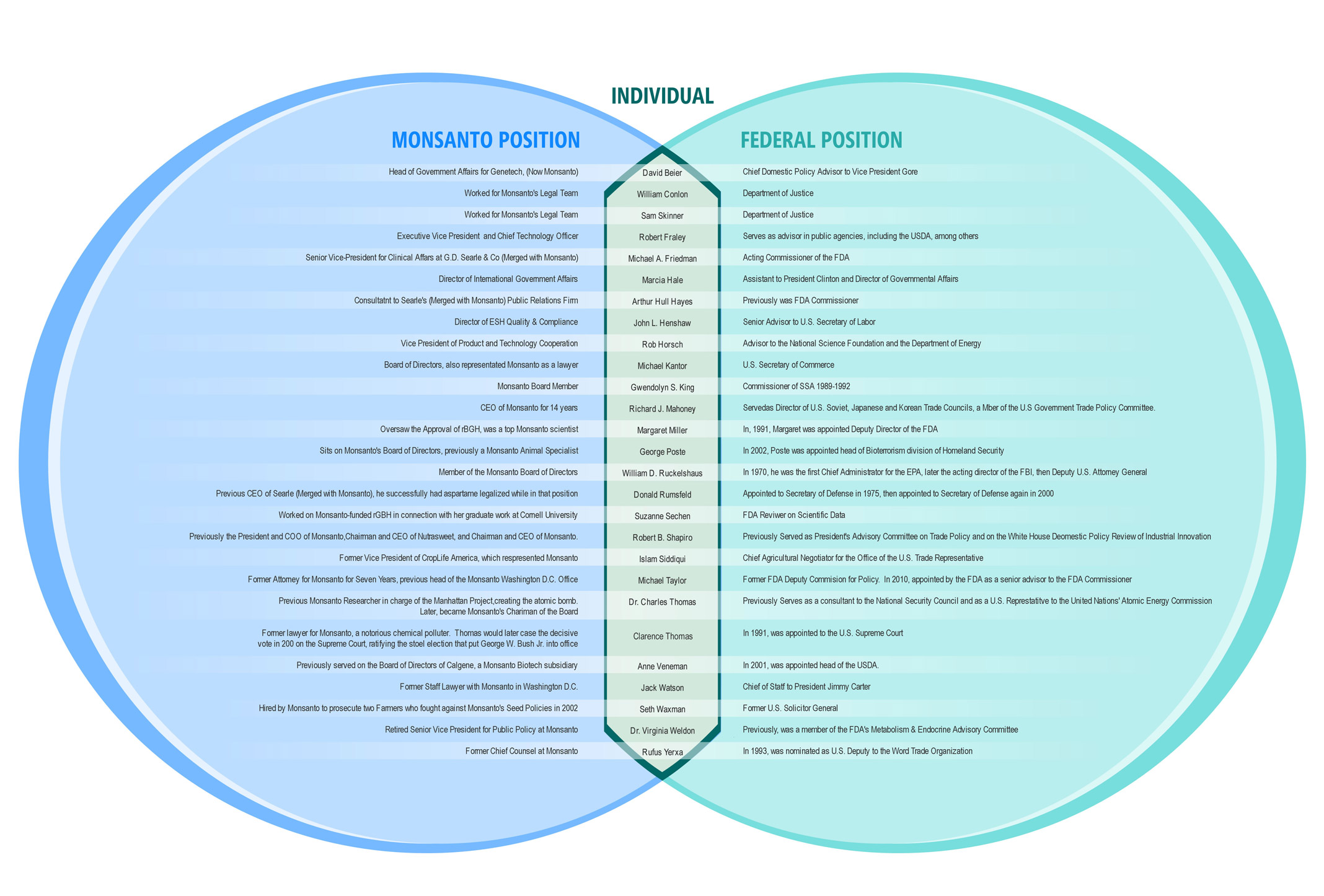
According to this IVN article, over the last decade at least 7 high ranking FDA officials have also held high positions in Monsanto, the largest producer of GM seeds in the world. This is generally accepted as true, and in fact Monsanto have several employees present or past that have held high ranking positions in other capacities in the US Government. This is known as the revolving door in the USA, and it is worthy of exploration.

Monsanto and US Government Employees

Monsanto and US Government Employees (click to enlarge)

The website states that “At the forefront of this controversy is Michael R. Taylor, currently the deputy commissioner of the Office of Foods. He was also the deputy commissioner for Policy within the FDA in the mid ’90s. However, between that position and his current FDA position, Mr. Taylor was employed by Monsanto as Vice President of Public Policy.

Other Monsanto alumni include Arthur Hayes, commissioner of the FDA from 1981 to 1983, and consultant to Searle’s public relations firm, which later merged with Monsanto. Michael A. Friedman, former acting commissioner of the FDA, later went on to become senior Vice President for Clinical Affairs at Searle, which is now a pharmaceutical division of Monsanto (Oh Donald Rumsfeld ex Secretary of Defense was also on the Board of Directors).  Virginia Weldon became a member of the FDA’s Endocrinologic and Metabolic Drugs Advisory Committee, after retiring as Vice President for Public Policy at Monsanto”.

Another controversy surrounded the appointment of Margaret Miller. The following is taken from Red Ice Creations website:

“In order for the FDA to determine if Monsanto’s rBGH growth hormones were safe or not, Monsanto was required to submit a scientific report on that topic. Margaret Miller, one of Monsanto’s researchers put the report together. Shortly before the report submission, Miller left Monsanto and was hired by the FDA. Her first job for the FDA was to determine whether or not to approve the report she wrote for Monsanto. In short, Monsanto approved its own report. Assisting Miller was another former Monsanto researcher, Susan Sechen”.

Obviously I am not in a position to determine whether these allegations are true, but a look at this article that appeared originally in the Observer newspaper might lead one to believe that there is a fine line being walked here.

The article states that “Monsanto received copies of the position papers of the EC Director General for Agriculture and Fisheries prior to a February 1998 meeting that approved milk from cows treated with BST.

Notes jotted down by a Canadian government researcher during a November 1997 phone call from Monsanto’s regulatory chief indicate that the company ‘received the [documents] package from Dr Nick Weber’, a researcher with the US Food and Drug Administration (FDA).
Sources noted that Weber’s supervisor at the US FDA is Dr Margaret Mitchell who, before joining the agency, directed a Monsanto laboratory working on the hormone.”

Oh and the hormone treatment made the cows sick, but you can read Robert Cohen’s reported testimony before the FDA on the subject of rBGH including the disclosure that, while at the FDA and in response to increasing sickness in cows treated with the hormones, Margaret Miller increased the amount of antibiotics that farmers can legally give cows by 100 times. Once again I cannot verify the transcription but it is widely reported on the web and was apparently shown on C-Span Congress TV live.

I am not suggesting that there is any collusion here, and as Monsanto argue people move jobs, taking jobs that suit their qualifications. A look at these people’s profiles show that they have many different positions, many of which we would say were undoubtedly working for public good. But some suggest that some of their positions might lead to conflicts of interests. But if you need experts where are you going to get them from? Here though I might simply suggest that you don’t need so many experts.

Within my life’s work of trying to promote responsible innovation I have come to the conclusion that a broader public involvement within decision-making process must be a good for society. Closed sessions full of experts deciding what is or is not safe for us may be efficient in terms of getting things done, but the public’s voice is not heard, and maybe that voice could lead to more responsible choices, or at very least some reflexivity in the decision-making process.

On a closing note, arguments are currently raging in the US about the labelling of GM foods, as currently there is no need to label it, something pushed for by many organizations. There is a counter movement that is arguing that as the FDA state that there is no fundamental difference, GM products that do not contain additives should be allowed to be labelled as “natural”, in the way organic vegetables are. This Common Dreams article presents a critical view of current practices that although strongly worded offers an insight into how a section of US society thinks about the issue.

The question remains however, who do we want to regulate our food and the technology used in its production?