Technology in Food Production

Over the coming weeks I am going to write a series of posts about technology and food production. Food is a topic that I have been interested in from a sociological perspective for several years, and I have a few topics that I would like to address, from GM, to regulation, sustainability and organic alternatives.

Technology plays a huge part in food production. If we just think about GM products, transport issues, industrial farming techniques and globalization in generic terms, it becomes immediately apparent that this sector is the largest in the world. According to these statistics agriculture accounts for between 14 and 24% of all global emissions of CO2, and 19 to 29% of total greenhouse pollutant emissions. An interesting point here is that in the so-called developed countries post-farm emissions are very high, so in the UK for example 50% of these emissions are produced after the food has left the farm, presumably through processing and transport techniques.

But it seems to me that processing is where the money is. According to Forbes, Pepsi for example made almost $45 billion in 2009 and Nestle’ made $110 billion, and these profits only refer to US sales. This year the sector is one of the very few that is still growing.

If you look at vegetables though they make less money. Dole is the largest producer of fruits and vegetables in the world, but in the same year made only $6.8 billion, leading me to conclude that the profit is in the processing and not in the actual foodstuffs themselves.

And this leads on to the question of what goes into these products. The answer is, largely, genetically modified (GM) organisms.

Genetic Modification

Genetic Modification

Yes if we look at the statistics that the US Department of Agriculture publish, we find the following:

93% of soybeans grown in the USA are GM

90% of all corn produced in the US is GM

95% of US sugar beat is GM

40% of all cropland in the US is used for Monsanto (the largest GM seed producer) production

40% of all global GM crops are produced in the US

35% of all the corn grown in the world is GM

81% of all the soybeans grown in the world are GM

I take some of my information from here, the Organic Consumers Association website and the rest from US government sources.

So as you can see it is big business. It is estimated that 70% of all the foods in our supermarkets contains GM organisms. 16.5 million people work in the industry in the US and it accounts for more than 10% of GDP.

And it is not just plants, there is a request for FDA approval for GM salmon. It grows at twice the speed of regular salmon.

The GM salmon, produced by AquaBounty Technologies contains a gene from a Chinook salmon that produces a growth hormone, and a genetic “on-switch” from an ocean pout (an eel-like fish) that keeps the growth hormone pumping out year round. The company state that GM salmon will consume 25 percent less feed, half of which can be plant protein.

Oh and in the US none of this is labeled, although currently 64 other countries do require labeling.

GM organisms have been found in many countries that do not allow their production however, Mexico comes to mind as the closest example to the USA. Seeds have blown across the borders from the US, over the mountains, across the seas, possibly even from Brazil and Argentina and landed and grown. Not to mention imports of contaminated produce. Read the scientific report here.

Corn is socially extremely important in Mexico, its cultivation all started there, and this contamination has caused some serious soul searching. In a related issue GM companies are currently trying to get permission for huge plantations in Mexico, as this Reuters article explains. We await the court’s decision.

For now I stop here, I think that is enough food for thought for this week (groan). Next week I shall delve once more into the murky waters of the global food industry however, and who knows what we might find. Comments please below.
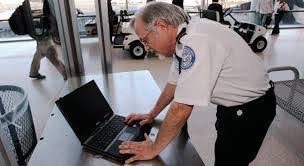
US Border Laptop Searches

This week in the US many news outlets are reporting a story that relates to how private the data on your computer, hard drive or mobile phone may be when passing national borders.

In a legal ruling a judge has in effect supported immigration officials’ rights to look inside your computer if you want to bring it in to the USA. The court ruling relates to an incident in 2010 when Pascal Abidor, a student crossing from Canada, had his laptop confiscated and searched.

A Laptop Search

A Laptop Search

The student claimed that this was unconstitutional as the 4th amendment states that “The right of the people to be secure in their persons, houses, papers, and effects, against unreasonable searches and seizures, shall not be violated….” The US has long held however that this amendment cannot be upheld when dealing with people entering the country.

The judge ruled however that “The agents certainly had reasonable suspicion supporting further inspection of Abidor’s electronic devices”. What is not widely reported is the circumstances that lead to this decision. Abidor has both French and US passports, and upon entering he chose to show the passport that did not contain Visas that demonstrated that he had visited Lebanon and Jordan,  giving officials the impression that he was trying to hide something.

Agents spent five hours searching his laptop and USB drives, and then demanded that he write down his passwords and hand over the laptop and storage media. The laptop was returned by post 11 days later.

There are rules about what the authorities must do with data seized in these cases. All data that is deemed innocent must be destroyed within 7 days of seizure unless permission is given to keep it for longer. Many blogs however cast doubt upon whether an unregulated and poorly reported system can actually enforce this however, an online search of the story gives many different perspectives. The Homeland securities News Wire has one of the most informative.

I presume that like me many of you keep a great deal of personal data on your laptops, from tax returns, bank details, love letters and personal photos, and all of these things may be accessed in a case like this. One issue that has come to the fore has been brought by researchers and reporters, who may not be able to reveal sources of information for ethical, security or legal reasons, but may unwittingly do so by leaving evidence of their informers’ identities on their computers.

The line is blurred here, as today smuggling must include information smuggling and authorities may need to search information media, but an individual must be aware that all information carried over an international border is open to search. This must have repercussions in terms of industrial as well as personal privacy.

Useful Christmas Gifts

In some parts of the world Christmas is well on the way, and shoppers are happily spending the bank’s money in shopping centres to buy presents for their loved ones.

In my family we have a different approach, and I would like readers to consider the model. It might possibly go some way to improving the welfare of many and the health of the global community at large.

The charity OXFAM offer a wonderful service called Oxfam Unwrapped. Why not buy a present for someone but have it delivered to someone who really needs it? I like this system, although I have some suggestions that I will make later.

So each year I buy my brother a set of school books for English language teaching through Oxfam. My brother speaks good English however, and so Oxfam send the books to a school in Malawi, where they serve a full class of bright and eager Malawian kids. My brother receives a card directly from Oxfam letting him know that his gift from me of 26 school books has been delivered by Santa to the school.

Everyone is happy.

The Unwrapped service offers all kinds of gifts, but I would stick to inanimate objects, project funding or education rather than live animals, although this is just a personal choice. The introduction of a live animal might cause problems to a family though (only my personal idea), as circumstances might not be ideal for their arrival.

I must admit that even living in affluent Cambridge Massachusetts, the arrival of a cow or even a couple of chickens or goats would not be too easy to manage, and I am sure that other situations exist that might not be improved, albeit through good will, by addition to the family. I am sure Oxfam know what they are doing though, they have been working in this field for many years.

Another possibility is to donate to research, projects or product development.

I like the idea of sending something to benefit others, and there are many ways of doing this. Just for a single example take a look at these coffee mugs. Each mug has the logo of the beneficiary printed on it, and 50% of the price is donated directly to the organizations.

Or donate to a project that is working to improve lives. The Liter of light project I wrote about earlier in the year is in need of funds, and there is another local project that is close to my heart that involves playing football (soccer).

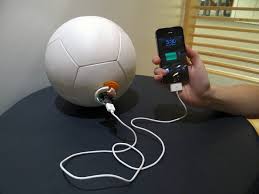
A group of Harvard University students (women) had an idea a few years ago that has finally come to fruition. They have designed a football that can convert the energy created as it is being used into electric power. So the ball has a small socket within its cover, an inductive coil mechanism turns the kinetic energy into enough power to run a light for 3 hours after just 15 minutes of play.

Socckett powering a light

Soccket powering a phone

After a full match the ref can charge his or her mobile phone.

Soccket, as the ball is called, is currently under trial in South Africa, and they could do with some advance orders to help its development. They are giving the balls away for free. You can buy one at the company website, and they will give it to someone on your behalf. They also have a skipping rope (jump rope) that works in the same way as the ball, so if football is not your sport of choice you can still join in the fun.

If we all diverted a portion of the money we spend this Christmas to projects whose goals are to improve lives, we could make a lot of difference. We could avoid battling other shoppers, buying needless things, creating thousands of tons of waste and modify an extremely wasteful and destructive economic system.

We could all do a little bit of good, and as William Shakespeare once said “How far that little candle throws his beams! So shines a good deed in a weary world”.