A series reviewing the Samsung Galaxy S4 Mini

The Samsung Galaxy S4 Mini was launched on the 1st of July 2013. Six days later (on Sunday the 7th of July) I bought the phone on a 24 month contract.

A Series

Having owned an S4 Mini for a few weeks now I have decided to write a series reviewing the phone.

In this series I will be looking at the phone as a whole, as well as comparing it to its brothers and cousins from Samsung’s Galaxy series. I will also be giving my verdict on various accessories and cases that I have tested.

The series will post every Tuesday.

Introduction over; lets get started!

Why S4 Mini?

Anyone who has chosen a smartphone will know that it isn’t an easy decision. Most people have a personal favourite brand, however there is a lot of choice which makes it difficult to decide which device is right for you.

I have to admit, I had been bitten by the Apple bug. Apple are very good at marketing, and my experience of their products had made me think they were the best.

However when visiting phone shops, I asked staff whether they would buy the Galaxy S4 or the iPhone 5, and every single one said the S4; most also agreed that the iPhone is overpriced for an inferior gadget.

Apple’s magical effect started to ware off and after asking my friends which phone they would have, I decided that I would be going for a Samsung device. I also considered Blackberry, HTC, Nokia and Google devices, but non really wowed me.

The thing I don’t like about the S4 is its size. I think a big screen is great, but the phone is huge! The S4 Mini is almost the same in terms of technical specifications, however is slightly less powerful and much smaller. The S4 Mini is pretty much exactly the same size as the iPhone 5.

Samsung's S4 Mini, S4 and S3 Mini

I feel that Samsung’s slogan for the S4 Mini perfectly describes the phone ‘Minimalism Maximised‘. It is a super powerful, high spec phone, packed into a pretty small case. The S4 Mini has the spec of the S3, but the functionality of the S4.

Android

In the past Android had a reputation for being an over complicated operating system for the technically minded, however major advancements in the last few years mean that now it couldn’t be easier to use.

Something I love about Android is the home screen. Apple’s iOS only lets you store app shortcuts on your home screen, which is a huge limitation when you consider the features Android offers. On my home screen I have the weather, a handful of apps, and a search box. Scroll to the left and I have the news and to the right my calendar. No need to open anything, it’s just there; one of the reasons why I love Android.

The fact that it is open source really shines through, as everything is built with users in mind. For example, with iOS, you have to stop every app individually, however with Android you can close all your apps at once. Weather, news, your diary, alarms, music, messages and loads more are right their on Android, without you having to load anything. Data usage, battery status, free memory, you name it, Android will tell you. I think you get the picture: I love Android!

Next Time

Next week I will be looking at a FlexiShield Case for the S4 Mini.
Goodbye CommentLuv

“…blogging has changed, and the blog itself is no-longer where many people read and interact. Read in the feed and comment on social media. Blogging is still there, but I think comments are slowly dying…

A feed and social profile were luxuries years ago, however now it seems they are part of blogging itself – if you don’t have them do you have a blog at all?”

That is a quote from a comment I left in June this year.

Digital media explorer Ari Herzog has noted how blog comments are evolving, and he now offers his readers the ability to leave a comment via the standard (vanilla) WordPress commenting system, as well as via Facebook and Google Plus.

Blogging is still very much alive, however as my opening quote suggests, the way authors go about publishing content and how readers then go abut digesting and debating this, has changed significantly in recent times.

CommentLuv

Just over two years ago I wrote a post detailing why you should use the CommentLuv plugin. Today very few 0f the reasons I state still hold true.

I have now deactivated CommentLuv on Technology Bloggers for these simple reasons:

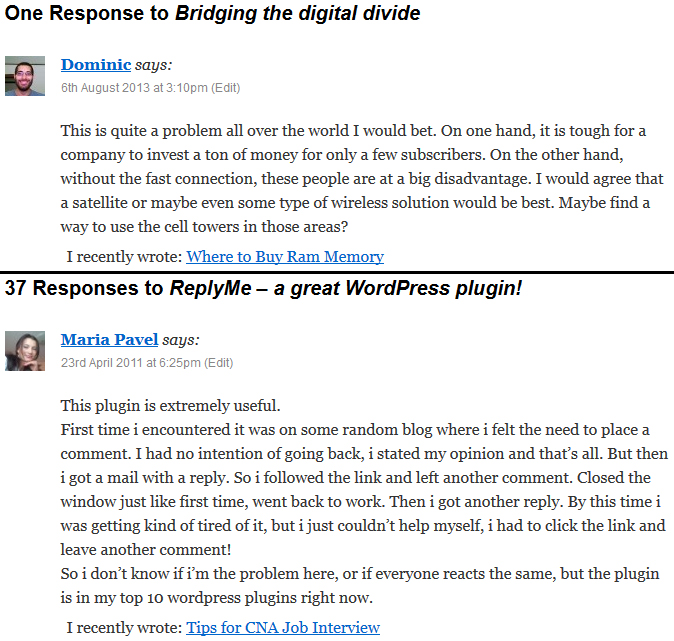
Two comments with CommentLuv links

Two great comments with irrelevant CommentLuv links.

  • CommentLuv looks messy – take a look at the two comments to the right. They are both great comments, but they are followed by an untidy, irrelevant link. If someone is interesting in your site, they will check it out anyway.
  • CommentLuv promotes spam – having looked through our comments, very few of our genuine visitors actually take advantage of CommentLuv, yet almost all the spam comments we get include a CommentLuv link.
  • CommentLuv increases load time – you know how obsessed I am with speed, so much so, any plugin which significantly impacts load time is now under scrutiny. CommentLuv is quite a heavy plugin which I have found has a big impact on page load time, and that extra lag isn’t justifiable for what it offers.
  • CommentLuv is bad for SEO – one of the key things Google has been clamping down on of late is irrelevant links. If you run a site about lawnmowers, and you have a large number of links coming from a technology website, it probably doesn’t do you any favours. Similarly, if I have written an article on something tech related, comments with random links introducing irrelevant keywords, dilute the content and probably don’t do my article any favours.
Google SEO chart

CommentLuv is arguable bad for SEO.

CommentLuv was once a great plugin, but its time has passed. The web is changing, blogging more so than ever, so it is time to say goodbye to CommentLuv.

Protecting Our Coral Reefs

Last month the US military announced that they had dropped four unarmed bombs into Australia’s Great Barrier Reef Marine Park last week during a training exercise that went wrong. Two aircraft dropped two bombs each, one an inert practice bomb but the other an unarmed lazer guided explosive bomb into the World Heritage marine park. The bombs fell into an area away from the coral and the military report that they did not explode.

The action obviously caused outrage within the environmentalist and marine protection community, and it led me into looking into the state of our reefs today.

According to Global Coral Reef Monitoring Network we have lost 20% of the planet’s coral reef in the last 20 years. They also sate that a further 35% is in serious danger. We are talking about an area in total of 284,800 square kilometres of the seabed that is currently inhabited by coral.

A Coral Reef

A Coral Reef

Anyone who has ever been to the Great Barrier Reef will have seen the effects that mass tourism had on the reef in the past, before it became better regulated. Large parts of the reef lie dead. Overfishing is also one of the major causes for concern, as is climate change, the change in sea levels and the ever growing problem of rubbish (particularly plastics) that float around the reefs.

Recently however scientists at the University of Marche in Italy have discovered that some of the substances used in suncream could damage both the reefs and other maritime life. This presents another serious problem, as millions of us splash it on before going into the sea, washing zinc, various nanoparticles and petroleum derivatives into the water and over the reefs.

We could call it involuntary pollution, and we can debate the risk factor (risk to my skin versus risk to ocean life), but you will be pleased to hear that some cosmetic companies have started to produce a more ecologically sound form of suncream.

%CODEVIMEO1%

The UK based company Aethic for example produce an Eco-compatible suncream called Sôvée, and they are working with King’s College London to develop a suncream that mimics the capacity that coral naturally has to protect itself from the sun’s rays.

Any development could have multiple uses, and at least help to remove one of the dangers that are threatening these structures.