E-Waste and Computer Recycling

I am by no means a ‘techie’ as Christopher calls himself, but a quick look round my house reveals a quite astounding history. In various cupboards I find an HP desktop computer from about 10 years ago, very rarely if ever used, another obsolete Hitachi desktop from 15 years ago, my last Chinese laptop (the lid broke off), an IBM Thinkpad, an HP laptop, an old Vaio and even an Ollivetti laptop from 20 years ago.

I have never thrown them out for various reasons, one being security, another being that one day I might need my undergraduate dissertation for something and the third being that I want to know what happens to them when they are taken away.

Recently I have learned that all is not quite what it seems with recycling of computers too, and this makes my quandary all the more difficult.
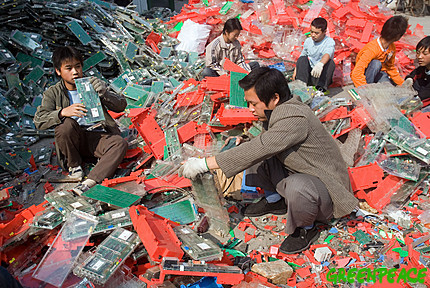
Chinese workers take apart electronic trash on the street in Guiyu, China.

Several companies offer to recycle your old computer for you, and an enormous industry has grown up around the trade in old technology. In China entire cities have been born that specialize in taking our old stuff, but I feel that recycling is a bit of a big word to use for the ensuing process, as it has positive connotations. The computers are dismantled and all of the re usable pieces taken away, then the rest is dumped in a large pile. People from the surrounding areas scratch a living by doing a bit of home made scavenging, be that boiling components on their cooker at home or dipping cables in acid baths to extract the tiny bits of semi precious metals that they contain. Obviously this is done without regulation, and the results are often poisoning for those involved and the surrounding areas. See this photo essay about the city of Guiyu pictured above, probably the largest e-dumping ground on Earth today, and where a large portion of the products in question end up.

Another possibility is that the computers are shipped as donations to the Third World. These donations come in containers, not packaged in cardboard however but just thrown in, so although some do work, the majority don’t. The recipients have to unload them and try each one to see if it is usable. Those that don’t have to be dumped, and can be found piled up in heaps or abandoned by the roadside outside the larger African Cities, again to poison the ground etc.

This video from Ghana goes into greater detail.

India has some recycling sites and used to import waste for processing but now the problem is that the country itself is now a major producer of waste as it becomes one of the most technology saturated countries on the planet. And India is not alone, consumer societies all over the ex developing world are hungry for new technology, and obsolescence is just round the corner. This short article in Time expands upon the argument.

Large sums of money are involved as we would imagine, but the industry is practically non-regulated in real terms. Government regulation does exist but with the majority of the work carried out in the informal economy it is not adhered to, and dirty job as it may be it provides income for hundreds of thousands of poor migrant labourers.

And we are speaking about a problem that can only get worse. I personally don’t think it has to or should be like this however, it is not fair and it is exploitation, and so my question is ‘what can be done about it?’ Or more correctly ‘what can we do about it?’ We are the guilty party after all.

Win 1 of 10 Monitive accounts with Technology Bloggers!

Technology Bloggers has been growing for over a year now, and today marks the announcement and launch of its first ever competition!

We have been approached by a few firms in the past offering to give us prizes for giveaways, and have never really got round to launching  a competition. However now thanks to a new widget/bit of software I have discovered called Rafflecopter, we are able to run competitions with relative ease!

If this competition is a success, then I hope that we can run more in the near future! 🙂

The Prizes

So, to the prizes! We are very lucky to be able to give away 3 Monitive Premium Accounts and 7 Monitive Basic Accounts. Check out their pricing plan page for more info on the accounts.

Monitive

The kind sponsor of this contest is Monitive, who provide site monitoring services, so you know if your website goes offline. Many people have written on Technology Bloggers how site uptime is a vital part of a hosting package, as customers could be lost, and your site could lose rankings, if it goes down.

With a Monitive account you get weekly emails, which let you know if your site has gone down. With basic, pro and premium level accounts (all but the free) you can have it check your site as frequently as up to once every minute, and if it ever finds your site is down, it can email you, text (SMS) you, and it even offers Twitter DM alerts.

Does your site go down on a regular basis, maybe at a time you are not ever online? Well without a Monitive account, you probably don’t know! If your host regularly takes your site down at night, and you don’t know, it could seriously affect your overseas traffic – especially traffic from the other side of the world.

If your website, blog, forum, search engine etc. goes down, it isn’t good. That is why Monitive offer to check it is up, by sending regular (as regular as you choose) requests from servers all around the world.

International servers checking Technology Bloggers uptimeWith a free account you can monitor one website, and get 4 free introductory texts. With a basic account, you can monitor five websites, and get 10 free introductory texts. Pro accounts get to monitor 10 services, and get 10 free text messages every month. If you have a premium account you can monitor up to 30 websites, DNS’s, FTP servers, MySQL databases, POP3’s etc. and you get 30 text messages every month, so if a single site, server, FTP etc. goes down, you know – fast.

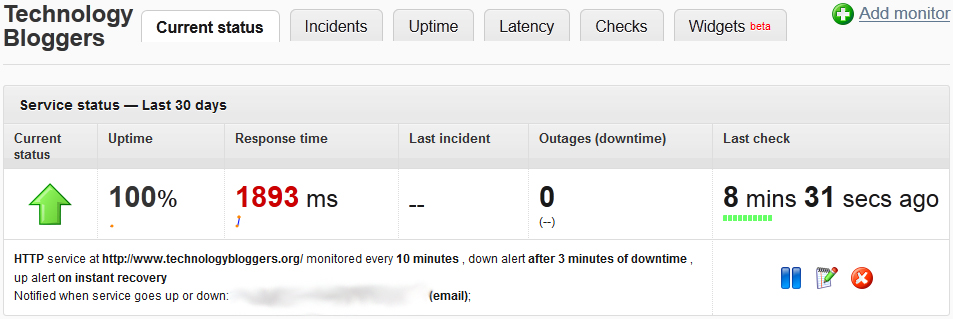
Technology Bloggers server status - MonitiveI have been using the service for around a week now, and it works really well. It is easy to use and has all the data you want to see.

How to Win!

I want to make it as easy as possible for you to enter, and I want to make it so that everyone can enter, as we are a community blog, which means everyone should be able to benefit.

To enter is really easy, you only need to do a few things, but the more you choose to do, the more entries you will get.

The first thing you must do is sign up for a ‘Free’ Monitive account. Once you have done this, you can start entering.

Sign in to the Rafflecopter widget below, however you like, Facebook or email. The first thing you must do is tell us the email address you used to set up the account, as we will need this to upgrade your account if you win. After that, do as many or few of the options which become available to you, the more you do, the more entries you get!

Rafflecopter

The Rafflecopter widget loads below this text, it seems to be taking its time (at least when this article went live it was) so be patient, it should load in after a few seconds – and it doesn’t load on some pages, so make sure you go to the giveaway page to get it to work.

a Rafflecopter giveaway

Winners

This competition will end at 12.00 am on Saturday the 19th of May. Winners will be announced within the following week, and then their accounts upgraded accordingly.

Best of luck to everyone!

I hereby declare Technology Bloggers first ever competition, live!

Advantages of working for a startup

Ask any recent college graduate today what their number one worry is and it will no doubt be “getting a job”. Today we are bombarded with the discussion of a failing economy, record unemployment, and the impossibilities of landing a job.

It’s a terrifying thing to face when the past four years your life has consisted of all night study sessions in the library, drunken weekends, and the endless hopefulness of a soon-to-be college graduate.

Graduation papers and a graduation hat

Graduation doesn't guarantee a job

While landing a job is no doubt extremely difficult in today’s society for any individual, there are numerous opportunities available out there for young graduates.

One idea is to apply for jobs at startups and SMEs, rather than applying to those cushy jobs at the major corporations, which are in high demand.

Here are three reasons working for a startup company might be a better choice than that corporate office high-rise.

More Responsibility

Yes, more responsibility means more work, which can also mean more opportunities. Responsibility is a good thing in the working world. Not only will job functions and demands that require more responsibility look better on a resume, it will also make your daily work more interesting and rewarding.

One thing about working in an ‘entry level’ job at a big corporation that can be really discouraging, is how little control and say you often have in the operations of things. At a startup company you will likely be working with a small, close-knit group of individuals.

Startups look for individuals with specific skill sets and drive, that are unique and useful for their specific job description. This means that you will be unique among your peers. You will have a voice within the group that wants to be heard. Much of this has to do with the mere scale of the operations.

At a startup company, operations are small and groups are small – every voice and idea is important. More responsibility means more work, but more work means more experience and more experience means greater rewards – potentially money. The bottom line is that it is easier to move up and forward in a small startup than it is in an established corporate office.

That said, startups often have flatter organisational structures, so there are less chances for promotion than in larger firms.

The Startup Atmosphere

If you’re looking for buttoned down corporate America, a startup is most likely not the right path for you. Due to their size and calibre, most startup companies exude an extremely relaxed atmosphere.

You won’t have to go out immediately after graduation and spend a small fortune on business attire. Typically, jeans and casual wear will cut it at a startup company. Of course, this casual atmosphere isn’t always the case and it will depend on the type of business the startup is involved in. You do get big corporations that have similar relaxed or non existent dress codes too, but it is usually more common among SMEs.

Furthermore, in a startup, the offices are typically small, young, and cohesive, hence the atmosphere in the office is more relaxed. I’m not saying you should count on this and this should not be your sole reason for seeking a job at a startup company, but it certainly can be a perk for a recent college graduate, or anyone who doesn’t like the idea of always having to wear a suit and tie.

Work Will Be Recognized (Good and Bad)

One of the most common complaints you hear from those in the working world is that their constant hard work goes unnoticed. This can be an extremely difficult thing to deal with. Feeling like you are putting in your greatest effort and doing a good job at it, but getting no recognition in return can be extremely disheartening. It seems that big corporations are the biggest offenders for this.

Of course, it can be nearly impossible to give your employees due credit for the hard work when you have hundreds (if not more) of them to oversee.

At a startup company, because numbers are so small and every ounce of work really matters, it is nearly impossible for hard work to go unnoticed. Typically startup employees work in small teams where every task completed is essential and credit is given. Your coworkers and boss know what projects you’ve contributed to.

This is a great way to feel that your work is being recognized and is a wonderful way to stay motivated to do the absolute best job that you can.

If things are noticed when everything goes right, things are certainly noticed when they go wrong as well. This will keep you on your toes, so that you produce work that both you and your employer are proud of.

There are also advantages for working for big corporations, however your personality and preference will determine which you are best suited to work for. Don’t think startups are the answer, but don’t rule them out either!