Last week an American Venture called Planetary Resources, Inc unveiled a plan to send a fleet of spaceship into near space to review the possibility of mining on asteroids.
Apparently there are thousands of asteroids close enough to make them attractive as they hold treasures worth fortunes in the form of platinum and other metals of the same group.
This one is mine!
Precious metals are not the only riches available however, and strangely enough plans are afoot to look for water. Water is an important material in space flight, because it can be used to produce the hydrogen and oxygen needed to power rockets, so an asteroid could represent a kind of modern day re-fueling station. This could make space travel cheaper because once rockets had left the atmosphere they could be refueled in space, eliminating the need to carry the excess weight during lift off.
All of this is in the future of course, but the project has plenty of backing from among others Larry Page of Google and filmmaker James Cameron.
These unfolding events bring some tricky questions however regarding the exploitation rights of near space objects. At the moment there is actually a subsection of international law called Space Law, governed by the Outer Space Treaty that was signed in 1967.
The writers did not envisage such monumental strides in technological advancement however and although the treaty makes clear that States cannot take celestial bodies as their own, they do retain jurisdiction and control over the object if they are the first to land on it.
A precedent has already been set as articles collected in Space have already been sold to private bidders by the Russian government. An article in this week’s wired goes into much greater detail.
It all looks a bit far fetched at times but supporters claim that the idea is no stranger than deep sea drilling for oil. It reminds me somewhat of the great gold rush events in the US of covered wagons and horses, only this time the means of transport differ and the digging is done by machine. Or maybe they will bring back entire asteroids and break them up on Earth, we will just have to wait and see. This article offers a glimpse at some possibilities.
There are obviously plenty of technological improvements required before any of this becomes concrete, but also a lot of legal and ethical issues need to be addressed. As ever one thing is certain, there’s big money in it for someone if it can be done!
I don’t think enough people know about Gravatar and the what it does, so as a result I have chosen to write an article about it, to help you get more out of the web.
What is Gravatar?
The best way to describe what Gravatar is is the same way that it is described on Gravatar.com: A Globally Recognized Avatar. But what does that mean?
“Your Gravatar is an image that follows you from site to site appearing beside your name when you do things like comment or post on a blog. Avatars help identify your posts on blogs and web forums, so why not on any site?” – Gravatar.com
How better can I explain that? A Gravatar is an image that you can be associated with across the web. Any Gravatar compatible site – like most WordPress blogs, and many other forums, blogs and websites across the net – that you put your email into will display your unique image, whenever you write a post or leave a comment.
When you finish reading this article, cast your eye at my avatar, you can see it on the left of the writer bio box.
Until recently I had been using the Technology Bloggers logo as my avatar, however I have chosen to change to using my own website logo – the iconic blue ‘C’.
When you sign up for Gravatar, you also get your very own profile page. Here you can link to your website and write a short bi-line for the world to see. Everyone has a custom URL, and until today I didn’t realise that mine was actually my name! Okay, by default it is, but I was the first person with my name to register with Gravatar, which means that I must have had one for a pretty long time!
If you scroll down the ‘our writers‘ page you will see that some of our writers have chosen to add a Gravatar to their email address, so that when they post, their customised image comes up. I then take this image and post it next to their profile on the our writers page. Some people don’t send us an avatar, and don’t have one linked to their email, so they have a randomly generated image associated with them.
The default image if you do not have a Gravatar - the Gravatar logo
If you look down the list you will see some of each. Which do you think looks better? Personally I believe that having an image of your choosing that follows you everywhere on the web is a great idea.
How to Get a Gravatar Avatar
Linking your email(s) to your chosen image(s) really could not be easier.
Step 2: Click ‘Sign Up’ – this can be found on the top bar
Step 3: Enter your email address
Step 4: Check your emails and click the confirm link
Step 5: Upload the image you want to follow you everywhere on the web
Step 6: Voila! Any time you comment on Technology Bloggers of any of the other ‘kajillion’ blogs, websites or services that support Gravatar, your image will be associated with you
You can add more email addresses if you use different ones for different sites, and can even add more pictures, so you can comment on one site with one picture and on another site you have a different one!
Once you have an account you can also set up your Gravatar profile page, where you can tell the world about yourself, and link to sites you love.
Gravatar makes you identifiable across the web as a unique individual, not just another faceless/anonymous name.
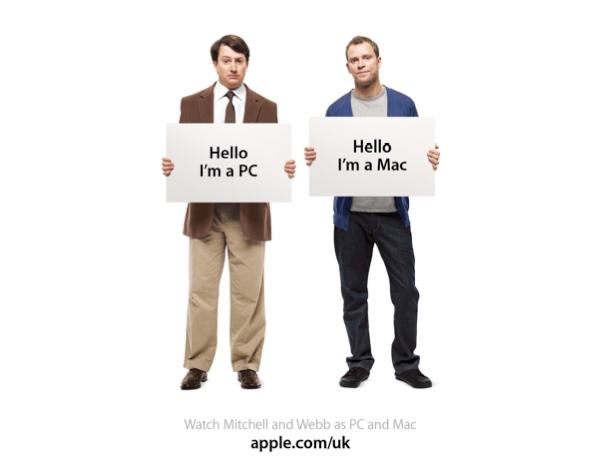
I image that you have probably seen the Apple ads which are based around the two characters: Mac man and PC man. They have been released in various different countries with different actors playing PC and Mac.
The campaign which was known as the ‘Get a Mac campaign‘ was broadcast in North-America, the UK and in Japan, as well as on the web. In the USA Mac was played by Justin Long, whilst PC was played by John Hodgman. In the UK, comedy duo David Mitchell (PC) and Robert Webb (Mac) took the role.
Not sure what I am on about? Check out the video below:
Apple have now removed the ads from their site, but they can still be found all over the internet. If you do a YouTube search for ‘Get A Mac’ or ‘Mac vs PC’ you get hundreds of results.
The interesting thing is, Mac only own about 7% of the computing market at the moment, that’s only around 2% up on four years ago.
Windows however owns more than 90% of the computing market, meaning that most of us have a Microsoft PC.
So why is is then that if you scroll down past almost any of the Mac vs PC ads on YouTube you see that the ratio of likes to dislikes is usually around 5:1. This means that if 1,000 people like the ad, just 200 dislike it. So despite most of us choosing to use a PC, we seem to support Apple, rather than Microsoft.
The Battle of the Giants
The computing industry was once dominated by the Apple-Microsoft rivalry, however in the last 5 years, Google has become a serious contender, making it a three way battle. Google is not only a more viable contender because of its new chrome operating system, but also because its search and other services are so popular.
Google has the most websites within the top 100 most visited online of any company in the world. Google.com, Google.co.in, Google.de, Google.com.hk, Google.co.jp and Google.co.uk all ranking among the top 25 most visited sites on the net. Google hold 6 of the 25 most visited sites, whilst Microsoft have just one (MSN.com) and Apple don’t have any.
Microsoft’s Ads
Microsoft have recently tried to mimic Apple’s hugely successful ads, but in order to attack Google. Google is one of Microsoft’s biggest competitors, if not its biggest, so after being ‘slagged off’ in Apple’s ads, it would appear that Microsoft hoped to produce the same effect, but this time with Google in the loosing position.
Below I have included one of their ads, entitled Googlighting.
UPDATE: Seems like Microsoft realised the ad didn’t quite work… it’s been taken down from their official YouTube channel, however there are a few others still hosting it if you search around.
Now I don’t know about you, but I don’t really like that ad. I think it looks like more of a pathetic dig at Google, rather than a cleverly designed way to boost one companies brand, whilst demoting the competitions – as Apple’s ads did.
It turns out I am not the only one who didn’t find that ad all that amusing, the ad is published on Microsoft’s own YouTube Channel, and yet has received just 5,117 likes, but a staggering 12,734 dislikes. That is a 5:13 ratio against Microsoft’s ad.
So we will stand by Apple when they attack Microsoft, but when Microsoft try to attack Google, we stand by Google. Why? Is it because we see Apple and Google as two trendy, current companies, and Microsoft as an outdated one, which we are loyal to out of convenience not choice? I like Windows 7, but I don’t like Bing, Google has to win for me. iPad vs a Windows tablet, iPhone vs Windows phone, I think I would prefer the iDevice.
Google’s Ads
I thought I should give Google’s ads a mention too. Google hasn’t yet (to the best of my knowledge) made any ads aimed at attacking the competition. Google show very few ads on television, and largely rely on their online dominance to help them promote their products.
Something I have found about both Google and Apple’s ads is that they often appear to be very well thought out, and the more modern ones are often extremely well recorded/directed and are very clean. Microsoft’s ads aren’t quite so chic, so is that where their downfall lies?
Who Do You Stick By?
Personally, I would rather say that I am a Googlite, or loyal to Apple, than say I am loyal to Microsoft.
UPDATE: I’m not so sure that I am loyal to Google or Apple anymore – and haven’t developed any more a loyalty to any other competitor either. Use the service which provides the best solution to your needs at the time.
Even though I am annoyed at Google, as it hit Technology Bloggers in the Penguin update quite badly, and as far as I am aware (and I have asked in the Webmaster Central forums) we, as a blog have done nothing wrong. In fact we have been doing what Google want, creating great, original content, look at some of the articles Jonny is producing to see awesome, original content, all our writers do, but he is really outstanding at the moment.
“We want people doing white hat search engine optimization (or even no search engine optimization at all) to be free to focus on creating amazing, compelling web sites.” – Google Webmasters Central Blog
I am sure we will soon recover, and will continue to strive to be an outstanding blog. Despite being (unfairly) hit, I am still loyal to Google, I believe that in the most part it is a very good, ethical company.
UPDATE: I am not quite so loyal to Google anymore, and am less convinced that it is all that ethical. A new philosophy: choose the best device/search engine/browser etc. for the time, loyalty doesn’t seem to pay dividends in the world of technology.
What about you though? Who do you stick by? Anyone, or everyone?