The end of Anonymity?

Over recent years many people have had their DNA analysed and results posted online. The results have been anonymised, but the vast spread of information on the web calls into doubt the possibility of really making information untraceable.

Last week the Boston Globe ran a story reporting an article published in the journal Science, in which researchers demonstrate how they correctly identified individual identities of the owners of some of this DNA.

DNA

DNA, a personal business

Scientists at the Whitehead Institute for Biomedical Research wanted to identify the owners of anonymous DNA samples that are available for research purposes online. They did not have any high technology, using ancestor tracing websites and freely available public documents.

We are not talking about hackers or expensive programs, we are talking about people with every-day computers and the same understanding of how they work as you or I.

It took a single researcher with an Internet connection about three to seven hours per person, and all in all the identities of more than 50 participants were discovered.

This raises several issues. What about all of those people who gave materials for research who find themselves posted and traceable on the Internet? What obligations do commercial companies such as 23andMe have towards their customers, operating in a more or less unregulated environment? (see here for posts about their organization). Can there be real guarantees of anonymity in modern life? Given the obvious advantages of data gathering how can it better be shared in order to protect individual owners?

The very scientists who conducted the research argue that the privacy problem needs to be completely re-analysed, with some scientists dubious that privacy to any extent can be guaranteed.

Problems related to this are both practical and philosophical. In the US the GINA legislation was set up to protect individuals from the effects of their DNA codes (and analysis of it) falling into the ‘wrong hands’. The wrong hands in this case are those of health insurance companies, that might not want to insure a person (or may want to charge more) because they have one particular gene mutation or another.

There are shortcomings however, the GINA legislation does not allow health insurance companies to discriminate on the basis of DNA testing, but other insurance companies are not legislated against. Life insurance and long term care insurance is not covered under the document, so in theory they would be free to decline cover on the basis of DNA analysis. This is particularly important as long term care is extremely expensive and is not covered through health insurance.

Given that anyone who has given their DNA for research purposes risks being identified, they may also risk discrimination.

Freedom of Information or Criminals?

In this post I would like to tell the stories of two young gentlemen, Aaran Swartz and Bradley Manning.

Many of you will know these names. Aaron is unfortunately all over the web this week due to his recent suicide, and here in Boston there is a lot of soul searching going on.

Aaron Swarz

Aaron Swartz

Aaron started young, at the age of 14 he was part of a working group that developed the RSS system. He was co-owner of Reddit, having been owner of Infogami, a company that merged to form the Reddit that we know today. He was most importantly an online activist, fighting for open access and against the Stop Online Piracy Act.

His activism got him into trouble with the police however. In the first instance he was investigated for publishing documents managed by the Administrative Office of the US Courts. These were public documents but the administrative office charged per page for individuals to see them. Aaron did not believe that this was fair so decided to take the chosen course of action. After an investigation he was not charged however, so no case was ever brought.

His second brush with the law went rather differently however. In 2011 he was arrested and charged (amongst other things) with fraud and unlawfully taking information from a computer. He had allegedly walked into the MIT library, attached his laptop to the system and downloaded 4 million academic articles.

His complaint was that the database holding the articles (JSTOR) were unfairly paying royalties to article publishers and not authors, and in doing so and charging for their service they were restricting public access. JSTOR did not push for charges and made no complaint, but Massachusetts Attorneys did, stating that “stealing is stealing, whether you use a computer command or a crowbar, and whether you take documents, data or dollars”.

The charges carried a possible prison term of 35 years and a 1 million dollar fine.

After Aaron’s death his family criticized both MIT for not behaving responsibly when the activity was discovered and the US attorneys for disproportionately pursuing criminal charges. Some people argue that the problem lies in the law however, because it does not differentiate between taking things for profit and for other reasons. In effect stealing money from the bank is the same as stealing articles, even if the aim of stealing the articles is not to make money from the crime.

The BBC has a collection of messages from many of the best known architects of the cyber world and they really demonstrate the great esteem that the entire community held for Aaron. We do not know and will never know why he chose to take his own life, nor if the possible 35 years in prison played on his mind and pushed him into it, but as I stated at the beginning there is a lot of soul searching here about how the entire event was handled.

To Bradley Manning. Bradley is another young man who got on the wrong side of the authorities. He is a soldier who worked in intelligence, not high ranking but with access to a certain amount of low level classified data. He was arrested in Iraq in 2010 on suspicion of passing data to Wikileaks and is currently in a military prison awaiting trial.

Bradley Manning

Bradley Manning

Before his arrest Bradley was possibly not in the best frame of mind. Life in Iraq is not easy, he was taunted for his presumed homosexuality and self acknowledged gender difficulties and had outbursts of anger and self reclusion. He was not transferred though, nor his access to classified information revoked.

At some point Manning allegedly forwarded what were later to be known as the Iraq War Logs and Afghan War logs to Wikileaks, a crime that prosecutors say he admitted to in online chats.

He was charged with Aiding the enemy, a crime that carries the death penalty, although prosecutors have stated that they would only ask for life in prison without parole. An offer was made for a guilty plea in return for 16 years in prison but Manning maintained his not guilty stance.

Once again Manning’s presumed crime was not committed for profit but in order to give the public information that he believed they had a right to. The most known of all of the materials is the killing of the 2 Reuters journalists by a US helicopter crew, a sickening thing to watch.

Manning was very unhappy about the type of war he saw and felt that the general public needed to see what he had seen, and referring to the helicopter killing video said something in one of his chats that I believe expresses his motivation; “well what would you have done if you had seen it?”

Rolling out Fibre Optic Broadband

This week the China Daily newspaper is carrying a story that has been picked up by many international news agencies. The paper states that the Ministry of Industry and Information Technology is ordering all newly built residences to install fiber optic connections in any city or county “where a public fiber optic telecom network is available.”

An ambitious project, particularly when put alongside the government’s hopes that 40 million families will be connected by fibre optic technology by 2015. These kinds of goals and regulations may seem impossible to those of us that live in the old world, but I would not be too sceptical about their interests and possibilities in China.

Here in the US we are a long long way from even getting broadband to large swathes of the country. The National Broadband map is a great source of information about how well connected we are, the maps are interactive and offer loads of information. Broadband coverage in general gets thinner on the ground as you move West, with much of the rural West and mid West still showing very little access. If you look at the map of fibre optic to home availability though you will see that we are talking about a very small number of providers and although it represents 17% of services it is extremely localized, with the vast majority of the country having no service.

Are you connected?

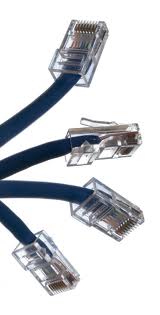
Internet cables

3.7% of the population have no high speed service at all, and although this seems like a small percentage, in a country the size of the USA it represents (by my calculation) about 13 million people.

Some analysts here are asking if the China intervention might be another Sputnik moment. The launch of the Sputnik pushed the US into the space race, fuelling investment and technological breakthrough. The question is whether the same will happen here.

If you are interested in how the world is connected, this article in the Global Finance magazine offers a table that shows the percentages of internet users divided into different countries. Some show a recent explosion is use, Albania going from 1% to 50% in 10 years, some are at above 90%, and some show little growth and remain in the 20’s or 30’s.

Given the importance for business the upgrading of existing infrastructure is of political interest. Both the US and UK governments have made broadband speed and distribution improvement a named priority. The UK government is putting in 530 million Pounds to roll out high speed internet to rural areas and in the US government has a similar plan, once more fueled by recent bad press about the quality of services offered across the country.

The Indian government is also pushing broadband extension. In a recent report increase in GDP is directly linked to broadband access, with failures on the parts of telecom companies blamed for losses in earnings and growth. India is expected to be the largest internet base on the planet by 2015, moving to above 300 million users and overtaking the US. With an extremely technology savvy society and better and wider infrastructure this must represent a great opportunity to the country.

So politics plays an important role in creating infrastructure. In an article last year on the innovation Excellence blog I wrote about how the FIFA World Cup had lead to the introduction of fibre optic technology to Africa (with a few hiccups) so large international events also play a part in creating infrastructure and generating opportunities.

So how good are the providers where you are?