Top 10 Emerging Technologies

A couple of weeks ago the World Economic Forum published a document on its blog called “The top 10 emerging technologies for 2013”. I thought it might be interesting to have a look at what they say. The article can be read here. The comments are my own interpretation however.

World Economic Forum

1. Online Electric Vehicles.

About 100 years ago a scientist called Tesla demonstrated that electricity could be provided wirelessly. Today there is an idea that electric cars could drive while being recharged from electromagnetic fields created from cables under the road. The cars would need much smaller batteries of course.

The problem with this technology seems to be that it is difficult to measure how much power is taken, so difficult to bill for, nothing more than that. Take a look at this article about other ways of cutting pollution from transport systems.

2. 3D printing and remote manufacturing.

Much has been written and the technology undoubtedly carries advantages, but did you read my post about 3D printers potentially being used to make gun parts?

3. Self Healing Materials.

A great idea but this and other uses of nanotechnology and its production practices need to be regulated, as does the disposal of such materials. We don’t know enough about the effects upon human health as the recent report cited in another post on this blog demonstrates.

4. Energy Efficient Water Purification.

Must be a good thing. Some of Christopher’s thoughts on the issue here.

5. Carbon Dioxide conversion and use.

Geo-engineering offers the possibility of drawing carbon dioxide from the air and storing it underground, but this technology is extremely controversial. This article entitled Engineering a Solution to Global Warming gives an idea of some of the ethical debate surrounding such processes.

6. Enhanced nutrition to drive health.

Genetic modification of plants to make them more nutritional. Much has been written about the GM issue, it is certainly not as simple as it may sound. Great commercial interests are involved, as are problems of cross fertilization and non-reproducibility. See this article on the Bassetti Foundation website about the Vatican and its interests in the problem.

7. Remote sensing.

The buzz-phrase Smart City is all over nowadays. Have a look at this article for some ideas of how using sensors might improve urban life.

8. Precise drug delivery through nanoscale engineering.

Medicine is the area in which nanotechnology research shows its greatest potential. The problems of regulation still exist as brought up in the article above, but the possible advantages for society make this type of research extremely valuable.

9. Organic electronics and photovoltaics.

This article mentions solar panels made using fruit and vegetable juice instead of silicon, and the printing of circuits using organic materials is already a reality. Silicon is more efficient at the moment, but expensive, polluting and will eventually run out, but if scale is not a problem these solutions work well.

10. Fourth generation nuclear reactors and waste recycling.

Making nuclear energy cleaner and better is the goal. The questions of safety and sustainability as well as real cost are not raised however, again not an argument that can be expanded upon too much as it is extremely polarized, but there are cleaner and safer ways to produce electricity as the article about electricity generation cited above shows.

Well it looks like we got most of it covered at Technology Bloggers anyway, cutting edge as we are.

Touchscreen Problems (Zombie Finger)

iPad zombie finger - Touchscreen ProblemsOver the last couple of weeks I have flown from the USA to Britain, then to Italy, and back finally to the USA. I flew on some lovely new Airbus aircraft, but had a constantly recurring problem with the on-board entertainment systems.

The problem is that in the seat above me there is a fantastic touchscreen entertainments system, but my fingers do not work. My son who was sitting next to me has good fingers, he touches the volume section and can turn the sound up or down, but I cannot because the slider does not seem to recognize my body.

So it must be my screen I think, my son leans over and it works perfectly well for him. We swap places, now mine works for him but I still cannot change the volume, this time on a different machine.

It must be me I conclude, but why? Long ago I gave up using anything touchy for this reason. I try licking my hands, warming them up, cleaning the screen but I do not make any progress. So I started looking around the web for some answers to find that I am not the only one, hurrah. There is even a recognized name for the problem in some fields, Zombie Finger!

Touch screens operate in many different ways. At Walker Mobile you can download a free PDF that explains how the different technologies work, but the vast majority of application that we know use one of two approaches. They can be described as Resistive Touch and Projective Capacitance.

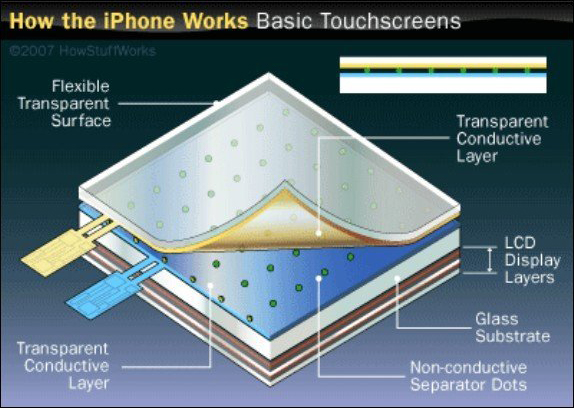
Resistive touch is old school analogue. Two surfaces are together, typically one of glass with a thin film over it. You push down on the film and it makes a circuit using a grid of electrical conductors. The system is cheap but being mechanical liable to damage and wear, and it is thick.

Projective Capacitance has no moving parts however, and some of its advantages mean that it is rapidly taking over the market. It is a system that works on capacitance, which is the thing that gives you a shock when you walk over a synthetic carpet and then touch the brass door handle in the hotel that you are staying in.

iPhone touch screen technology

How iPhone touch screens work.

Again there are two layers, both charged but to a different extent. When you touch the screen some of the charge is released into your finger, and this tiny change can be measured. And here lies a variable, because the nail will not carry a charge, gloves stop the action and so I wonder if even the state of the skin at the end of the fingers might effect usability. Do I type too much? No charge transfer means no volume.

For a fuller explanation of these 2 competing systems see this article, it is short but extremely informative. I would just like to know if anyone else has issues with touch screens, and if so if they have been able to address the issue in some way. As technology advances this interface is becoming the norm, and we wouldn’t want to leave people with particular skin types behind now, would we?

Asteroid Hunting

Many of you will have seen the video of the meteor that exploded into the atmosphere above Russia last week, and I would just like to offer an overview of the event from a practical scientific prespective.

The meteor was about 15 metres across, and as such too small to detect. As we all saw though a meteor of this size can do extensive damage. It weighed about 7000 metric tonnes, travelling at 18 Km per second and exploded at a height of between 15 and 20 Km. This is pretty close to the ground if you think that an aeroplane flies at about 10Km and we are certainly not dealing with somewhere where nothing happens.

The force of the explosion was about 30 times that of the Hiroshima bomb, a pretty devastating blow by all counts. We should think ourselves lucky that it did not happen over a major city.

Trees blown over after the 1908 impact

Trees blown over after the 1908 meteor impact

In 1908 in Tunguska also in Russia a much larger meteor hit. This one was about the size of the DA14 meteor that flew past Earth later on the same day last week, and it blew trees down over an area of about 2000 square Km. Once again it hit over Siberia so less damage than could have occurred, but if you think that the event of last week over Russia only threw out about 5% of the force of this one than we don’t need much imagination to envisage the possible catastrophe. Several photos are available around the net and I offer one above. There are also plenty of huge craters to see.

NASA have the Near Earth Program, and they have the mission of monitoring the many things that fly close to Earth.

It is not an easy job though as you might imagine, they use ground based telescopes so can only see something that is big enough to reflect enough light, and last week’s hit came directly in line with the sun, so practically impossible to see.

NASA has managed to identify 90% of near Earth asteroids that are more than 1 Km across, and something of this size might threaten life on Earth itself if it hit. There are more than a million near Earth asteroids however that are 20 metres across or more but  very few of these have been identified and mapped.

The B612 Project is hoping to put a telescope into Space before 2018 that will be able to spot something of that size, but until then they will go largely unseen.

Keeping on a related topic last May I put a post up about asteroid mining, and recently the BBC has carried some updates on this project.

It is currently a 2 horse race, but it seems very speculative. And I remember a song about horses of this type.