Tor, An Ethical Dilema

tor

Over the summer I have been following reporting surrounding the TOR project. I have learnt some interesting things. I must admit that I tried to download the browser but I couldn’t work out how to get it up and running, but that is probably more due to my own incompetence than anything else.

Tor has some serious issues as far as ethics goes, because it is designed to help people to remain anonymous as they use the net. This may to some seem perfectly justified given that Google and their friends are monitoring our every move and storing it all for resale later, but it is also great for criminal activity.

Recently reports emerged from Russia that the head of the Federal Security Service (FSB) has personally ordered preparations for laws that would block the Tor anonymity network from the entire Russian sector of the Internet. Obviously his aim is not to stop people from anonymously using the Internet, but to fight crime. The agency initiated the move as internet anonymizers were used by weapon traffickers, drug dealers and credit card fraudsters, giving the FSB an obvious interest in limiting the use of such software.

Other reports claim that not all of Russian law enforcement are in agreement, because criminals tend to overestimate the protection provided by the Undernet, act recklessly and allow themselves to get caught. Here the so-called Undernet is the key though, as anonymity is difficult to police.

Other reports state that “Security experts have accused US law enforcement of taking advantage of a flaw in the Firefox Internet browser then exploiting it to identify and potentially monitor subscribers to Tor”. It appears that the malware comes from the USA, but nobody is admitting to creating it, and as the Russians accuse the FBI and vice versa, any truth will be difficult to find.

One truth is however that Tor allows for the proliferation of various forms of criminality and exploitation that I would rather not go into here. The problem remains though, do we have the right to online anonymity? If not who has the right to stop us?

To return to following the news, I read that workers at the NSA and GCHQ in the UK have been accused of leaking information that they have regarding flaws in the workings of Tor. These two organizations are extremely interested in the browser for the obvious reasons above, but there is more that you might expect here. According to the BBC “The BBC understands, however, that GCHQ does attempt to monitor a range of anonymisation services in order to identify and track down suspects involved in…….crimes”.

But! Tor was originally designed by the US Naval Research Laboratory, and continues to receive funding from the US State Department. It is used by the military, activists, businesses and others to keep communications confidential and aid free speech.

And it turns out that the investigating agency rely on Tor for their own work, to keep themselves safe and anonymous, so they seem to be in a bit of a contradictory position to say the least.

So there appear to be many unanswered questions about the level of anonymity achieved, who has access, who works to destroy and who works to aid the project, and once more I find myself looking into a murky world.

Blind Date (More Unauthorized Online Experimenting)

blind-date

Following up from news a couple of weeks ago about Facebook manipulating its users, this week news abounds regarding a dating agency that has been conducting some experiments on its users.

The New York Times reports that the online dating agency OK Cupid has been manipulating the data it gives to its clients, to find out how compatibility and looks effect the dating process. The company conducted 3 different experiments, in one it hid profile pictures, in another, it hid profile text to see how it affected personality ratings, and in a third, it told some hopeful daters that they were a better or worse potential match with someone than the company’s software actually determined.

So as we might imagine they came up with a series of findings, that we could loosely interpret as the following:

1. If you are told that the person is more compatible you are more likely to contact them.

2. Users are likely to equate “looks” with “personality,” even in profiles that featured attractive photos and little if any substantive profile information

3. When the site obscured all profile photos one day, users engaged in more meaningful conversations, exchanged more contact details and responded to first messages more often. They got to know each other. But when pictures were reintroduced on the site, many of those conversations stopped cold.

Well as far as I can see number 1 is pretty self evident. If you send me a note saying that a person is not compatible then I probably won’t bother them with my personal issues., 2 is quite interesting, if I like the looks of someone I am more likely to think that they are an interesting person, may be fun and without doubt the perfect match for me. And also the third is quite obvious, if I don’t know what a person looks like I might imagine their looks and would be more likely to want to get to know them.

The OK Cupid blog will fill you in on the details.

One interesting line from the blog states that “guess what, everybody: if you use the Internet, you’re the subject of hundreds of experiments at any given time, on every site. That’s how websites work”. Wise words, but I wonder if everybody realizes that. And what power they wield!

Now I would like to raise the issue of how someone can design an algorithm to measure my compatibility with another person. What will make us more compatible? Height? Interests? Worldview (and if so how can you put that into numbers)?

There is an interesting book by Hubert Dreyfus called “What Computers Can’t Do”, and in it he argues that there are some areas and situations that cannot fully function. A computer program is based on expertise, on experience that can be categorized. If there are subject matters that are impossible to completely formalise, then they are impossible to formalize in computer programs (such as the one they use to find my perfect partner if they exist).

As a human I think we make decisions based upon generalizations of a situation. Characteristics are judged based upon experiences, I once knew someone with those characteristics and they were great, or stubborn, or nasty, etc. Research suggests that we play games such as chess in this way. We do not think about a long series of possible moves in the way a computer plays, but we see a situation, it reminds us of another situation that we have confronted in the past, and we act according to our experience of action in similar situations.

I am sure some readers have experience in this field, and I would be very happy to get some comments and expand my understanding.

Smart Canes for the Blind

smartcane

Last week I wrote about Martina Caironi and prosthetic limbs. Today I want to sort of continue the theme by looking at technological aids for the blind or visually impaired. Many readers will have smartphones in their hands and smartmeters in their homes, but I would like to introduce you all to the world of smart-canes.

A cane offers a lot of information to a blind user, but it tends to concentrate on the floor or at best below knee level. Users can avoid objects that are attached to the floor, but overhanging tree branches and other free standing objects are much more difficult to detect. I would like to take a look at two possible solutions, one produced in India and relatively low cost, and the other produced in the UK and relatively high cost.

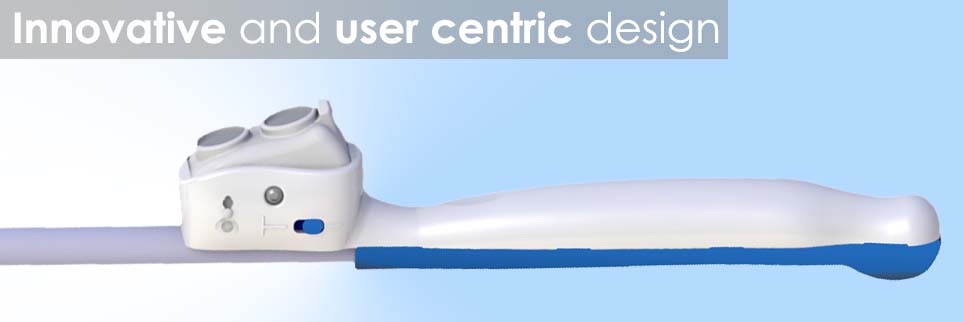
The Smartcane is the Indian solution, see the photo above. It costs about $50 US, and its designers say it is innovative and user centric. It detects obstacles using sonic waves and the presence of obstacles is conveyed through intuitive vibratory patterns. It is powered using a rechargeable Li–ion battery, and is seperate from the cane, so the user attaches the technology to their existing cane.

The Specs (as taken from the website):

Adjustable detection range: User can switch between long (3 metre) and short (1.8 metre) range mode depending on the usage scenarios such as outdoor, indoor or crowded places.
Ergonomic grip for comfortable holding and cane tapping: Can be held by different gripping styles, allowing users to use their natural cane holding and mobility techniques.
High detection sensitivity: The sensors can detect a 3 centimetre wide pipe from 3 metres distance, ensuring reliable detection of objects in the detection range.
Four intuitive and distinctive vibration patterns indicating obstacle distance.
Vibrations are uniformly produced on the entire grip: Non-localized vibration feedback allows user to conveniently grip the device.
Does not interfere with the auditory environment surrounding the user Vibrations allow discreet continuous use without making the user conscious or creating annoyance to others
Adjustable sensor orientation: Allows people of different heights and with different cane holding styles to direct the sensors appropriately.
In-built rechargeable battery with a long battery back-up: Removing of batteries for charging is not required.
Fully accessible user interface: Simple and distinguishable beeps to convey the battery charge status, low battery warning and charging status.
Failure detection of key components: Users informed immediately on failure of sensors and/ or vibrator through special alarm signals.
Detects fast approaching objects in the detection range: Especially helpful in detection of reversing vehicles.
Easy attachment / detachment from a white cane: Allows for compatible white cane replacement by the user himself.
Multiple colour options: Available in two non- flashy and elegant colours
Robust design: Can withstand accidental fall
Splash proof: Prevents damage during light rain
Conforms to international quality standards

Sounds like a deal to me!
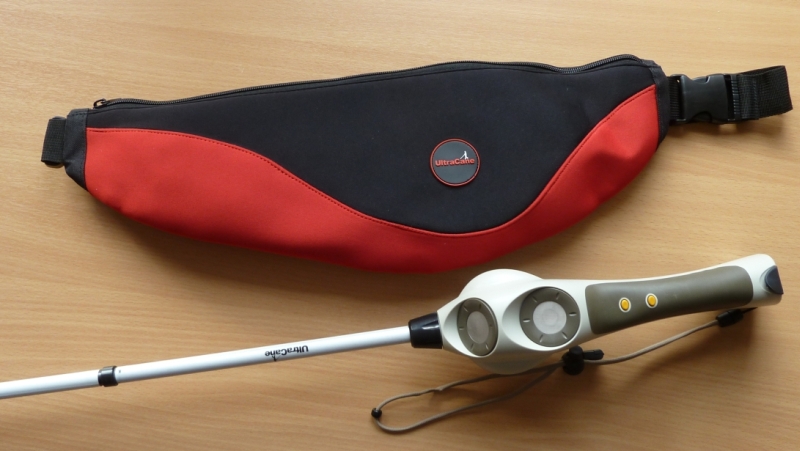
In the UK users can order the above or splash out on another product called Ultracane. The Ultracane works in a similar way to the Smartcane, but it is a single piece of equipment. You order the cane by length. It boasts more or less the same technical specs as the above, but the batteries are interchangeable (so it does not look as if they are rechargeable in situ), it has a strap to aid in holding it, it is foldable and has a replaceable tip. It works over 4 mtrs in front (further than the Smartcane) and 1.6 mtrs in an upward direction. It also has a twin range, choice of tip, is shower-proof, and is available in any colour you like as long as it’s white.

UltraCane

UltraCane

It costs somewhere in the region of $900 in the UK, has a 12 month guarantee and there is a service centre in case of accidents.

I am sure that much of the difference in price is due to development expenses, the Ultracane was very much on its own when it was developed, and has been on the market for several years. The website hosts many happy testimonials. I am pleased to see the development in India though, as it may give many in the developing world access to the kinds of aids that we in Europe have. Ultracane has also developed the Ultrabike, giving the partially sighted the chance to take to the bike paths in safety.

Check out the websites linked above for more information.