Nanofoods

This week I want to put two of my little pets together. Nanotechnology and food might sound like two very different topics, like a cat and a gerbil to use the pet metaphor, but you would be surprised. Many products in fact have manufactured nanoparticles in them, and we eat them.

Now we might ask if this is safe, and some would say of course it is. Some have great reservations about it, and some point to the fact that there has been little research done into the matter and that it might be better not to eat them anyway.

Friends of the Earth US have recently published a report entitled Tiny Ingredients, Big Risks, and it is free to download here.

To give you a flavour of what is on offer, I just take a few lines from the report:

A ten fold increase in unregulated and unlabeled nanofoods over the last 6 years

Nanomaterials are found in a broad aray of everyday food (cheese, chocolate, breakfast cereals etc)

Major food companies are investing billions in nanofood and packaging

An increasingly large body of peer reviewed evidence indicates that nanomaterials may harm human health and the environment

Nano agrochemicals are now being used on farms so entering the environment

US regulation is wholly inadequate

Public involvement in decision-making regarding these problems is necessary

The products containing unlabeled nano-ingredients range from Kraft American Singles to Hershey’s chocolate. They are made by major companies including Kraft (KRFT), General Mills (GIS), Hershey (HSY), Nestle (NSRGY), Mars, Unilever (UL), Smucker’s (SJM) and Albertsons. But due to a lack of labeling and disclosure, a far greater  number of food products with undisclosed nanomaterials are likely currently on the market.

To give you an idea we are talking about silver, titanium dioxide, zink and zink oxide, silicon and copper, as well as the traditional carbon nano tubes that are found in food packaging and freshness labelling technologies.

The report documents 85 food and beverage products on the market known to contain nanomaterials — including brand name products, and points out that the nanofood industry will soon be worth $20 billion.

This is a detailed report, it lists the products that have been found to contain these materials, the health problems associated with ingestion of such materials in animals and calls for action. It does not make for light reading, but it appears to me to be a technology that is being sneaked in through the back door, and soon like genetic modification will be difficult to avoid.

Take a look back at my food series for more tasty stuff.
Discover a New Planet

super_crash_planet_game_l

The days of discovering planets by pointing a telescope at the skies are long gone. If you are interested in discovery you can join the Galaxy Zoo project.

The Galaxy Zoo project has been running for several years, and involves hundreds of thousands of people. One of the problems for scientists today is the analysis of the enormous amounts of scientific data generated. This example is that of The Hubble telescope. It captures such a large amount of images that they risk never being studied, but one way of getting round this problem is to invite non scientists to view the pictures online and classify what they see. The tutorial on their website is simple to follow and in a few minutes you are away and participating in scientific discovery.
There is always the possibility of finding something new too, as in the example of the dutch primary school teacher Hanny Van Arkel who now has an object known as “Hanny’s Voorwerp” named after her, an object that would probably never have been noted had it not been for Ms Arkel’s lay interest in star gazing.

When looking for planets and other objects scientists rely on mathematics to determine where they may be located. Incredibly enough they have been doing it for many years too, and Neptune was in fact discovered after its position was mathematically predicted.

The planet Neptune was mathematically predicted by Urbain Le Verrier, with telescopic observations confirming the existence of a major planet made on the night of September 23–24, 1846, working from Le Verrier’s calculations. It was a sensational moment of 19th century science and dramatic confirmation of Newtonian gravitational theory.
By 1846 the planet Uranus had completed nearly one full orbit since its discovery by William Herschel in 1781, and astronomers had detected a series of irregularities in its path which could not be entirely explained by Newton’s law of gravitation. These irregularities could, however, be resolved if the gravity of a farther, unknown planet were disturbing its path around the Sun.

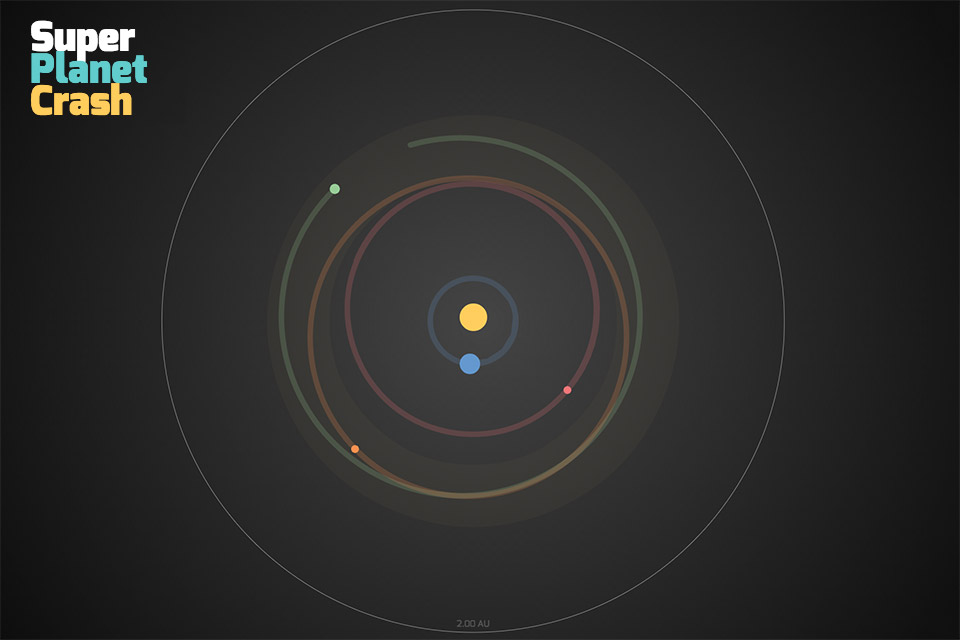
So nowadays there is an algorithm that helps us of course, and an educational game, and you can play with it if you like. It is fantastically titled Super planet crash. The site that hosts this game is a portal to an entire series of worlds. Planet exploration worlds.

But back to the game. Using Newton’s laws of gravity the game allows you to place planets in orbit around a sun. Each planet has its correct gravitational pull (they are different sizes of course) and this pull effects the orbits of the other planets. The objective is to build a solar system that functions for 500 years without the planets crashing into each other or falling out of orbit.

Once you get involved in putting large planets into orbit the game gets quite difficult. It’s fun for kids and adults and educational, and might lead you into becoming a discoverer yourself.

I don’t speak Dutch (yet)

Dutch Humour

Ik spreek niet Netherlands.

This week I moved to the Netherlands after 3 years in the USA. It is not the first time I go to live in a country where the population speaks another language however. In 2000 I moved to Italy.

I must admit that I sometimes fail to see my own limitations. I was under the impression that after a year or so I would be able to speak Italian. It would just soak in through the skin, like osmosis, and come out in perfettamentally formed sentences.

Alas after a year I was just about able to order a cappuccino at the bar, so I had to ditch the osmosis strategy.

I enrolled in a school for foreigners wanting to learn Italian. 6 hours a week. I continued for 4 years, and became remarkably good. 3 years in the USA and my Italian is now a little rusty but I can still speak very well, and at least me English ain’t as pour as it were thanks to an American education.

So 3 days in and how is the Dutch learning plan unfolding you may ask. Well experience taught me something, because I tend to only make the same mistake about 50 or 60 times before I learn, so I am not going to try osmosis. I took some lessons in the US before coming, and I was going to enrol on a course.

That was until I discovered Skype and their new toy, the voice translator.

Now this technology may be still under development, but Microsoft CEO Satya Nadella and Gurdeep Pall (the vice president in charge of Skype), demonstrated the technology last week. Watch the video here. There is a demo and an explanation of how the technology learns, including a description of its brain like capacity to relate one language to another, improving both.

It’s quite an incredible demonstration. Until the end of the conversation when a couple of errors creep in to the translation I was sure it was all a fake. Given the fact that so many of us work via computer today, a reality that is sure to expand even more, I think this technology could be a real breakthrough.

Now early stages in technological development means a 15 year history in this case, far longer than my foray into foreign languages. And technology develops quickly, the translator may even be on the market by the end of the year. My brain is not so quick, I will still be on chapter 3 of the first book by the end of the year. And I am sure that within a year of its release the technology will become completely mobile, I will be able to buy a battery operated portable translator and wear it like a fake moustache under my Google Glasses, by next summer I will be fluent!

The development of this technology may however also have the downside that it might help people avoid learning another language, and lead to a reliance on technology that might then make face to face interaction more difficult. Also we may miss out on the great advantages that speaking more than one language brings to an individual, the respect that other people have for you if you learn their language, the ability to appreciate a wider perspective and even more importantly, understanding the Dutch sense of humour.