Blind Date (More Unauthorized Online Experimenting)

blind-date

Following up from news a couple of weeks ago about Facebook manipulating its users, this week news abounds regarding a dating agency that has been conducting some experiments on its users.

The New York Times reports that the online dating agency OK Cupid has been manipulating the data it gives to its clients, to find out how compatibility and looks effect the dating process. The company conducted 3 different experiments, in one it hid profile pictures, in another, it hid profile text to see how it affected personality ratings, and in a third, it told some hopeful daters that they were a better or worse potential match with someone than the company’s software actually determined.

So as we might imagine they came up with a series of findings, that we could loosely interpret as the following:

1. If you are told that the person is more compatible you are more likely to contact them.

2. Users are likely to equate “looks” with “personality,” even in profiles that featured attractive photos and little if any substantive profile information

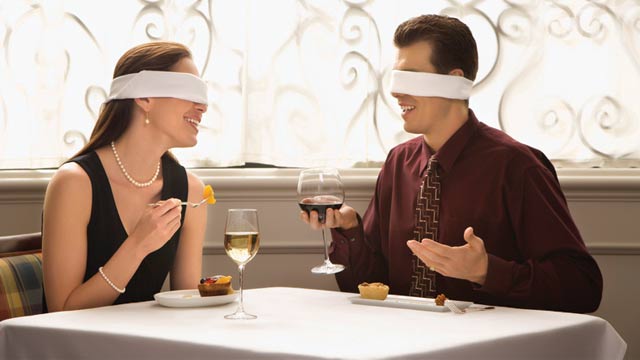
3. When the site obscured all profile photos one day, users engaged in more meaningful conversations, exchanged more contact details and responded to first messages more often. They got to know each other. But when pictures were reintroduced on the site, many of those conversations stopped cold.

Well as far as I can see number 1 is pretty self evident. If you send me a note saying that a person is not compatible then I probably won’t bother them with my personal issues., 2 is quite interesting, if I like the looks of someone I am more likely to think that they are an interesting person, may be fun and without doubt the perfect match for me. And also the third is quite obvious, if I don’t know what a person looks like I might imagine their looks and would be more likely to want to get to know them.

The OK Cupid blog will fill you in on the details.

One interesting line from the blog states that “guess what, everybody: if you use the Internet, you’re the subject of hundreds of experiments at any given time, on every site. That’s how websites work”. Wise words, but I wonder if everybody realizes that. And what power they wield!

Now I would like to raise the issue of how someone can design an algorithm to measure my compatibility with another person. What will make us more compatible? Height? Interests? Worldview (and if so how can you put that into numbers)?

There is an interesting book by Hubert Dreyfus called “What Computers Can’t Do”, and in it he argues that there are some areas and situations that cannot fully function. A computer program is based on expertise, on experience that can be categorized. If there are subject matters that are impossible to completely formalise, then they are impossible to formalize in computer programs (such as the one they use to find my perfect partner if they exist).

As a human I think we make decisions based upon generalizations of a situation. Characteristics are judged based upon experiences, I once knew someone with those characteristics and they were great, or stubborn, or nasty, etc. Research suggests that we play games such as chess in this way. We do not think about a long series of possible moves in the way a computer plays, but we see a situation, it reminds us of another situation that we have confronted in the past, and we act according to our experience of action in similar situations.

I am sure some readers have experience in this field, and I would be very happy to get some comments and expand my understanding.
Smart Canes for the Blind

smartcane

Last week I wrote about Martina Caironi and prosthetic limbs. Today I want to sort of continue the theme by looking at technological aids for the blind or visually impaired. Many readers will have smartphones in their hands and smartmeters in their homes, but I would like to introduce you all to the world of smart-canes.

A cane offers a lot of information to a blind user, but it tends to concentrate on the floor or at best below knee level. Users can avoid objects that are attached to the floor, but overhanging tree branches and other free standing objects are much more difficult to detect. I would like to take a look at two possible solutions, one produced in India and relatively low cost, and the other produced in the UK and relatively high cost.

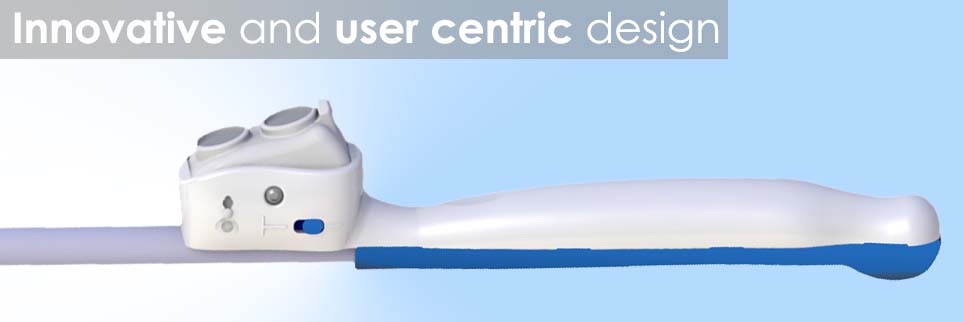
The Smartcane is the Indian solution, see the photo above. It costs about $50 US, and its designers say it is innovative and user centric. It detects obstacles using sonic waves and the presence of obstacles is conveyed through intuitive vibratory patterns. It is powered using a rechargeable Li–ion battery, and is seperate from the cane, so the user attaches the technology to their existing cane.

The Specs (as taken from the website):

Adjustable detection range: User can switch between long (3 metre) and short (1.8 metre) range mode depending on the usage scenarios such as outdoor, indoor or crowded places.
Ergonomic grip for comfortable holding and cane tapping: Can be held by different gripping styles, allowing users to use their natural cane holding and mobility techniques.
High detection sensitivity: The sensors can detect a 3 centimetre wide pipe from 3 metres distance, ensuring reliable detection of objects in the detection range.
Four intuitive and distinctive vibration patterns indicating obstacle distance.
Vibrations are uniformly produced on the entire grip: Non-localized vibration feedback allows user to conveniently grip the device.
Does not interfere with the auditory environment surrounding the user Vibrations allow discreet continuous use without making the user conscious or creating annoyance to others
Adjustable sensor orientation: Allows people of different heights and with different cane holding styles to direct the sensors appropriately.
In-built rechargeable battery with a long battery back-up: Removing of batteries for charging is not required.
Fully accessible user interface: Simple and distinguishable beeps to convey the battery charge status, low battery warning and charging status.
Failure detection of key components: Users informed immediately on failure of sensors and/ or vibrator through special alarm signals.
Detects fast approaching objects in the detection range: Especially helpful in detection of reversing vehicles.
Easy attachment / detachment from a white cane: Allows for compatible white cane replacement by the user himself.
Multiple colour options: Available in two non- flashy and elegant colours
Robust design: Can withstand accidental fall
Splash proof: Prevents damage during light rain
Conforms to international quality standards

Sounds like a deal to me!
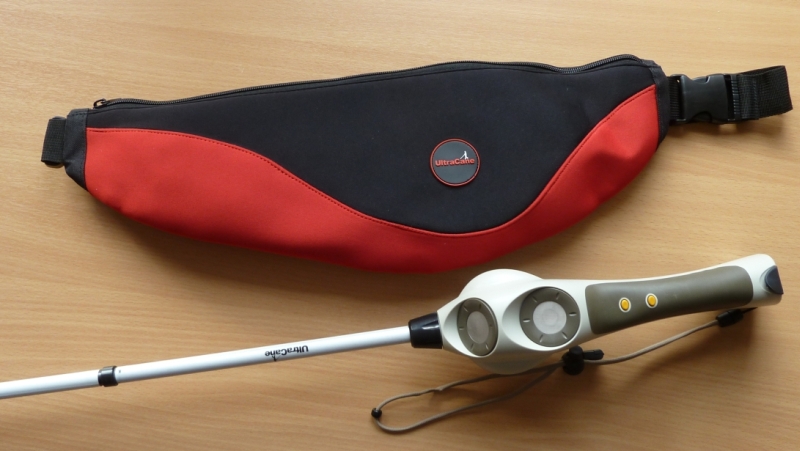
In the UK users can order the above or splash out on another product called Ultracane. The Ultracane works in a similar way to the Smartcane, but it is a single piece of equipment. You order the cane by length. It boasts more or less the same technical specs as the above, but the batteries are interchangeable (so it does not look as if they are rechargeable in situ), it has a strap to aid in holding it, it is foldable and has a replaceable tip. It works over 4 mtrs in front (further than the Smartcane) and 1.6 mtrs in an upward direction. It also has a twin range, choice of tip, is shower-proof, and is available in any colour you like as long as it’s white.

UltraCane

UltraCane

It costs somewhere in the region of $900 in the UK, has a 12 month guarantee and there is a service centre in case of accidents.

I am sure that much of the difference in price is due to development expenses, the Ultracane was very much on its own when it was developed, and has been on the market for several years. The website hosts many happy testimonials. I am pleased to see the development in India though, as it may give many in the developing world access to the kinds of aids that we in Europe have. Ultracane has also developed the Ultrabike, giving the partially sighted the chance to take to the bike paths in safety.

Check out the websites linked above for more information.

Martina Caironi, Paralympians and prosthetics

martinacaironi

Last weekend I had the pleasure of talking to the Italian paralympian Martina Caironi. For those of you who might not know her, she won a Gold Medal in London in the 100 mtr T42 category in a new World Record time, Gold in the World Championships in the long jump and again in the 100 mtrs, and just last month took the World Record over 200 mtrs. This is her in the photo above, she is the fastest para-athletic woman on Earth.

I have long had an interest in prosthetics and the borderline between human and machine. Readers might remember the review of the film Fixed that I wrote last year, and some may even remember my first post here about elective amputation in favour of prosthetics.

So as you might imagine I had a lot to ask. Regarding where the human body ends and the prosthetic begins, Martina told me that the question is very much down to your own point of view. She said that she knows where her prosthesis is without looking, so it seems very much an extension of her body. She can stand on one leg. You would not even realize she was wearing it if you saw her walk across the street.

I wonder whether it actually becomes part of your body though, but I am not sure that this is the case. She explained that you have to learn how to use it, how much you can push without causing injury, and a great deal is down to the quality of the prosthesis. It definitely seems to be an instrument for her.

We also talked about parity between para and non para athletes. She said that in the UK there is parity, and the races have prizes. This is not however the case in all countries, and she gave me some examples where the race organizers “don’t even pay your hotel bill”. This was a debate that really took off in the UK after the London Olympics and Paraolympics. It was noted that gold medal winners in the Olympics go on to make a lot of money through sponsorship, but that paralympians do not always have the same opportunities.

If you search the Internet you find many examples of countries that offer the same prizes to both sets of athletes, but you also find articles that explain that paralympians are paid less because the governing bodies find it difficult to raise the same amount of sponsorship. I am pleased to say that Martina makes a living from her athletics today, and rightly so given her dedication.

If you would like to watch Martina winning her gold medal here it is.

I should tell you that I have known Martina for some years, she was one of my students when I was an English teacher in Italy. She lost the bottom half of one leg in a scooter accident, and for a while was on crutches as the wound healed and the prosthetic was prepared. The fitting process took some time, and was uncomfortable when it was not quite right, so we are dealing with a precise instrument that has to be well fitted. While running she uses a blade, if you are interested in learning how they work take a look here.

Most of Martina’s interviews that we find on the web are in Italian, which doesn’t say much for her charlatan English teacher, but one of the things that she maintains is that sport gives people who have lost some mobility the chance to push their limits. Instead of accepting limitations, it pushes the athlete into going ever further, acting as a positive force for well-being. It has given her the possibility of experiencing things that many of us might dream of, with the fortune of having access to such technology through a fine center of excellence here in Italy.

Readers might also want to take a look at the Robohand website. They use 3D printers to make prosthetics, and recently unveiled a project that aims to commercialize a prosthetic leg. I think this type of technology could bring vast improvements to the prosthetics world.

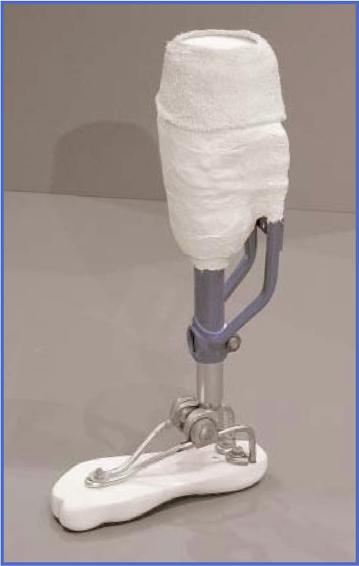
I also urge you to read this article by Erin Strait that is a free download. It describes the development of artificial legs in developing countries, the materials used and the costs. Some solutions are ingenious and not costly. See below for an artificial leg made from used bike parts, they cost less than a dollar each to make.

bike foot