What is Synthetic Biology?

In my work I write about nanotechnology and synthetic biology and over the next couple of weeks I would like to describe what is happening in these high technology fields. I start with synthetic biology. I am not a scientist and cannot give any form of technical description of how they do what they do. I can present a kind of sketch though of what they are doing and their aims.

The first question then must be what is synthetic biology? Well it is something that can be described as engineering, biology, genetics or nanotechnology, the most common description is that of applying the concept of engineering to biological organisms. But what does that actually mean?

Well, synthetic biology aims to design and engineer biologically based parts, novel devices and systems as well as redesigning existing, natural biological systems. Practitioners use a systems approach, an organism is seen as a whole, or a system, and can therefore be engineered, very much like a machine.

you see, kid's stuff

The system is reduced to biological parts (bioparts) whose function is expressed in terms of input/output characteristics. Once these parts have been described in terms of their function, isolated, standardised and syntheticaly reproduced, they can then be combined to from new organisms, very much in the way that an engineer would build a machine using standard devices built from standard parts. It is just that they are parts of a living organism.

These standard parts are defined by their DNA, and this can be manipulated in order to make the perfect part for the perfect device. Parts of the DNA can be removed and synthetic pieces used to replace them. Create the right part that does the right job, put in it a carrier cell (known as chassis) and Bob’s your Uncle, you can start to construct your organism.

The Biobricks Foundation is a not for profit organization that aims to keep a register of these standard parts, maintaining open access and promoting technical standardization, something that is seen as holding the key to the further development of synthetic biology.

Obviously to do all of the above you require technical expertise, the process requires computational modeling in order to analyze the complexities of biological entities and to predict system performance. You require DNA sequencing in order to describe the genome and then of course DNA synthesis, to re-produce either part of or the entire genome itself.

But what are the potential areas of application for this technology, and what can they actually do now?

One of the main fields is undoubtedly medicine. Drugs can be produced that are more effective or have fewer or even no side effects, as the genomes of their active components can be adjusted and synthesized. An example is the development of a synthetic version of the anti-malarial drug Artermisinin that could be industrially and cheaply mass produced, and in the near future antibiotics could become much more efficient.

Another existing application is water that changes colour when in contact with different polluting agents making them instantly recognizable. Switches already exist that react to certain types of input. An example could be a cell that is part of a person’s body that reacts to the stimulus of a certain chemical that in turn stimulates the production of another. Imagine for example a device that reacts to a chemical produced by a cancerous cell. This input causes a reaction that produces another chemical to counteract this presence. All working naturally using the body’s energy to function.

Other developments involve the energy sector, the production of plants for bio mass that are not as wasteful as those used today and even the development of synthetic aviation fuels.

In other fields a synthetic form of the silk produced by the Golden Orb spider is under development. This is an extremely strong, fine and lightweight material that could lead the way towards new specialist engineering materials.

They are even working on living computer memory, and  this article describes breakthroughs and results in DNA computing.

Well this is nothing but reasonable, my memory lives in my brain and the memory of my ancestors in my DNA, and now they have the technology to read it and even change it, so why not use it in a computer?

I have written several articles on this and other related topics on the Bassetti Foundation website, and as I said I am no scientist, so all comments and criticism invited and accepted.

Technology and the future of gaming

A few weeks ago I wrote an article about how technology is going to impact the way we work in the future. Now I am going to let you into some treat that may be in-store for us, sooner than you might think, in the world of gaming.

More Family Integration

Critics believe that in the future, despite popular belief, gaming will not be more individual, each of us in separate rooms, but more communal, with entire families uniting, in order to play together.

This is mainly due to the rapid developments in home entertainment systems based on competition, and also movement. In 2006 we saw this trend start to develop with the launch of the Nintendo Wii. This immediately pulled people together to game, more so than ever before. Games like Wii Play, and Mario Kart have brought families (and friends) together to play across the world.

In 2010, Kinetic for the Xbox 360, adding further elements of full body participation to gaming. Later this year, Kinetic will be available for computers too. Also later this year, we are going to see the release of the Wii U, the next model of the Wii.

The Wii U

A preview at Nintendo’s new Wii: the Wii U

It is devices like the Kinetic and Wii that are making gaming more social, with even more exciting and innovative devices coming out soon, also aimed at bringing us together.

Mind Control

You read right, mind controlled games are much closer than you might think. Thanks to the developments of advanced brainwave sensors, it is now possible to control things using your mind. All you need is to wearing a simple headband and earpiece with the advanced sensors attached, as brainwaves can be captured and interpreted on your scalp.

In the near future, we could potentially have ditched the controller, and be doing battle with our minds. Games where the the more you concentrate, the better you do, are a leap forward that has been made, and will be released to the mass market very soon.

Mind control could work with all sorts of games, however currently the technology works best with simple ones, like a game of tug of war (the harder you think you pull, the harder you pull!) and archery – focus on the bullseye, and you are more likely to hit it.

Mind control can help to create a much more personal experience, when gaming. This technology can also be applied to movies. Multiple scenes can be shot, and depending upon your emotions and how you are reacting to events, you could see different things. Sound cool hu?

More Interactive Experiences

I have already talked about things like the Wii, and Kinetic, but other systems, like the the Trixter Xdream are going to revolutionise the way we play, and the way we keep fit. The Wii let us play golf and tennis in our living rooms, but it didn’t feel all that real, did it? The Xdream accurately simulates riding a bike outside, using a computer display and a modified exercise bike.

Trixter Xdream Exercise Bike

The Trixter Xdream exercise bike

This means that you can feel like you are going for an outdoor workout, on a real bike, but becoming totally immersed in the experience, in the comfort of your own home – you may need to open some windows to create the draft effect! The bike is currently on sale for around £6,000 GBP, however in the future more and more of these devices (which will get cheaper and cheaper) are going to make their way into gyms around the country, and also even our homes.

TVs are set to get smarter soon too, with firms like Samsung and Google revolutionising the way we use our televisions.

3D

3D has been around for a while now, decades in fact, however there has always been the need to wear glasses. In the very near future, we could see glassesless 3D TV’s in our homes, providing us with 3D entertainment with no goofy glasses.

This technology will be able to offer gamers total 3D immersion, making the experience feel even more real. Match that with motion technology and the gap between fiction and reality narrows even further.

To Conclude

There are so many other revolutionary technologies and products that are set to change the way we have fun in the future. I have written about just a few to wet your appetite for what is going to be appearing on the high street within the next few years.

By all means research this further, and if you find anything interesting, let me know!

Gaming is set to change, quite radically and quite soon. The question is are we ready for it?

SD10 Bluetooth Stereo Headset – Review

Previously I have reviewed the Pocket Boom, a cool little device which can turn virtually any device into a speaker. Recently the same people asked if I wanted to review a SoundWear SD10 Bluetooth Stereo Headset, so here I go!

Please note, like with the Pocket Boom Review, all the opinions in this article are mine, and are completely honest – I am not being paid to write this review.

The SoundWear SD10 Bluetooth Stereo Headset is a device which provides wireless headphones, which can synchronise with almost any Bluetooth device. This means that when you are out and about, you can take calls, and listen to music, without the limits of wires.

SoundWear SD10 Bluetooth Headset in packaging

Ergonomics

The headset very cleverly folds away quite neatly, which does mean that they can fit into your pocket without much of a problem, meaning they are portable, like you need them to be.


SoundWear SD10 Bluetooth Headset folded away

The headphones when they are folded up would fit in your pocket

So, are the headphones comfortable to wear? My answer would be it depends who you are. I have tried them on, and I have got other members of the team and some of my friends to try them on, and the responses you get are mixed. Some people have no trouble whatsoever, the headset fits snugly onto their head, and are very comfortable to ware. Other people have tried them on, and they do fit, they are just a bit more awkward. Maybe that’s something you might want to consider – especially as they are not retractable/adjustable.

Ease of Use

Like with the Pocket Boom, if you don’t read the instructions, you aren’t going anywhere very fast! Read what the small A5 (ish) sheet of paper tells you, and things become pretty simple.

With some phones you need to fiddle with some settings either with Bluetooth, or on audio tracks to get them to work properly with calls and music, but it does work!

Sound Quality

Obviously one of the most important things with all headphones is the sound quality. You can get the most amazing headset, but if it has poor sound quality, then there is little point to it.

So what about the quality of the audio stream produced by the SD10 Bluetooth headset? Well it is actually very good! The headphones fit very snugly around your ears, reducing any noise interference, and the audio quality is very respectable.

Obviously noise cancelling headphones, or recording studio ones would be better, but the quality is very respectable, especially as it is coming from a wireless stream. For the average music listener, I don’t think there is any need to worry about poor sound quality.

Instructions

The headphones do come with instructions, which are clear, and just require a small amount of common sense and logic to use. They are helpful, but could contain a little more info – possibly room for an FAQ’s section.

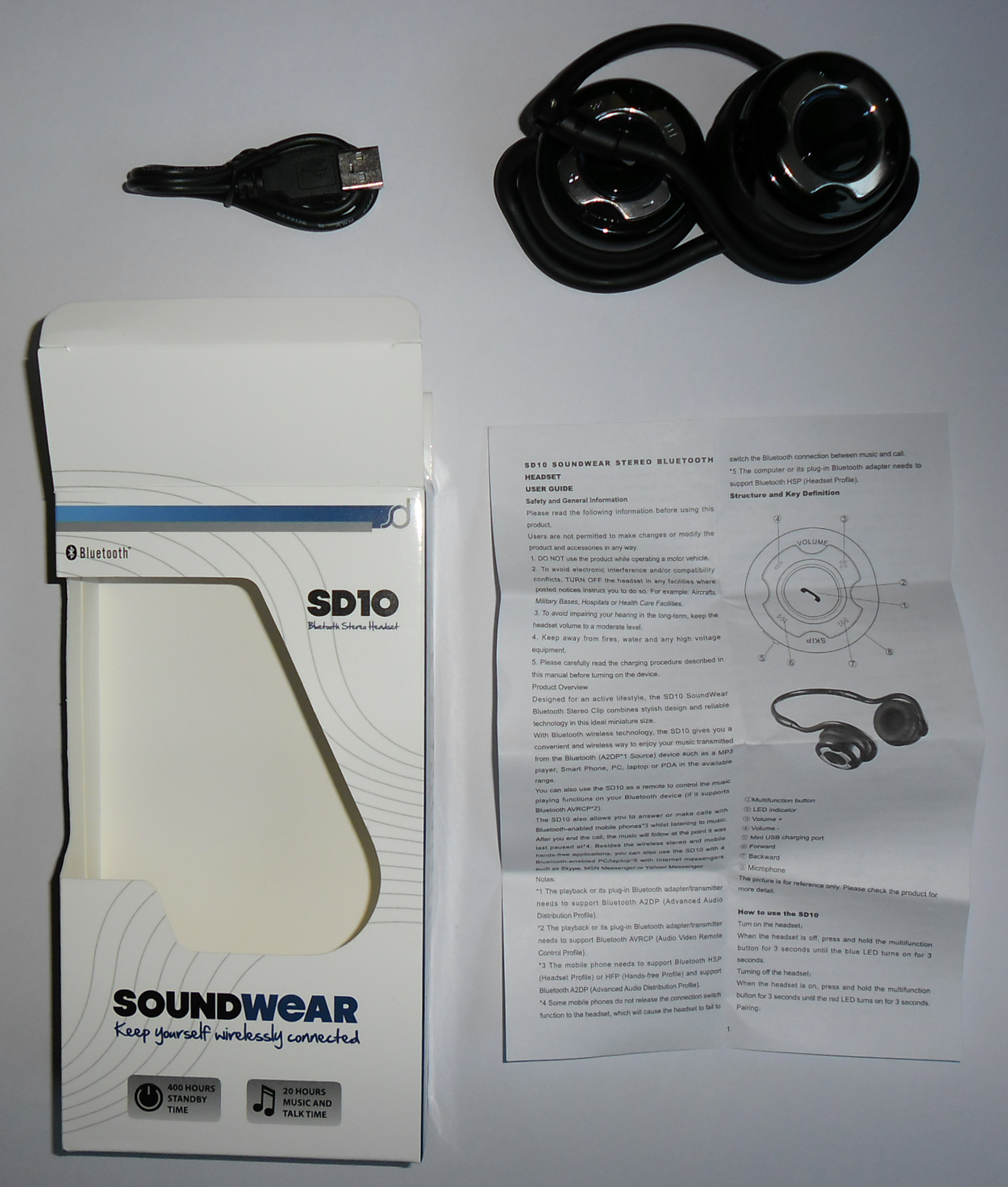
The SoundWear SD10 Bluetooth Headset packaging, instructions USB cable and headphones

The headset, along with packaging, instructions and USB lead

Power

From what I have seen of the headset, it seems to last a reasonable amount of time between charges. You don’t start listening to a tune, and then a call comes in, by which time the headset has given up and is needing a charge. The battery life seems to be pretty good, so no need to worry about that.

The issue I have with power is the way you charge the headset – via USB. You can only charge it via USB, and there is no alternative, no batteries you can replace etc. This can be a little inconvenient, especially as it doesn’t come with a USB plug adaptor, but I am sure it will work okay with the one I use for my iPod, or the one I use for my camera. Don’t take my word for that, I wouldn’t want to blow your headset – if you have one or are getting one!

Value for Money?

Here comes the killer question: is the SoundWear SD10 Bluetooth Stereo Headset value for money? I try to evaluate every product I review using value for money, so it is a good test. The headset retails at £24.99, which is reasonable, but I think it depends what you need it for. If you are going to be making calls wireless and listening to music, go for it. If you just want to listen to music (like me) then I am not so sure. There are different headphones more suited to music listeners, but this set does give you the added bonus of being able to make calls.

SoundWear SD10 Bluetooth HeadphonesInterested in buying a set, or just want to read a bit more? Check out the SoundWear SD10 Bluetooth Stereo Headset on Mobile Fun’s website.

As I said at the beginning of the article, this product has been sent to Technology Bloggers to review. Our thanks to Mobile Fun who provided us with the headset.