Are bionic suits a thing of fantasy or the future?

This is Technology Bloggers 100th article!
Well done and thank you to our 16 fantastic writers who have made this possible. Also thanks to all our readers and commenters for your support.
Lets aim for 1,000 now!
🙂

So, to the article! Everyone has heard of Iron Man – well I would think they have. The idea that such a suit could become a reality, is well… fiction. Until now!

A technology company called Raytheon has developed an exoskeleton, designed to effectively act as a bionic/robotic suit. The suit is designed to perfectly mimic and aid human actions, so the wearer can feel normal whilst performing tasks that they could never achieve without the aid of the suit.


One way of thinking about how it feels is to think of the power steering in a car. Without the power steering it can be really tough to turn the wheel, activate the power steering however and the car still feels normal and responds in the same way, the difference is, minimal effort is required to do a rather demanding task.

Doing press-ups in a bionic suit with ease

Performing everyday tasks is easy when wearing a bionic exoskeleton!

The suite has the potential to be fitted with some sort of amour plating, to protect the individual form attack – assuming it were to be used in a war-zone, and not in industry! D3O could actually make it a pretty invincible suit!

The suite can help the wearer lift up to 17 times what they could normally life, making tasks 17 times easier! A massive positive is that it doesn’t restrict the wearers range of motion, meaning that they can more freely and normally.

There is a problem though. The suit has to be attached to an external power source, as it guzzles power like crazy. Current batteries are either too weak, or too dangerous. For example, lithium-ion batteries can’t be strapped to a human, as they are prone to explosion if they get damaged!

A lack of power makes the suit extremely heavy, meaning that every movement becomes more difficult. This means that if there is a loss of power, the suit is hindering, rather than helping the occupant.

Aside from the lack of power, the main difference between the suit Raytheon have developed and Tony Stark’s suit is that Tony Stark’s can fly. Stark’s suit is also loaded with flairs, missiles and weapons galore, and has Stark’s supercomputer Jarvis running the interface. Raytheon’s suit is still in the early stages though, and no doubt will soon catch up 😉

Four Iron Man Suits

Tony Stark’s collection of Iron Man suits

If you want to know more about this super cool invention read CNN’s article about it.
Online Gamers as Scientists

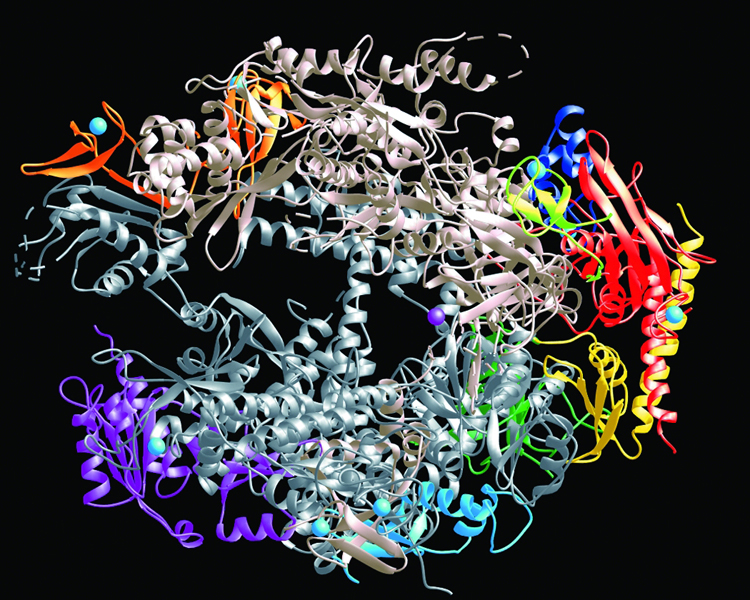
If you thought that online gamers were just a load of geeks, incapable of socializing with the outside world, and living within the confines of their own in their bedrooms, you might like to have a look this website called Foldit. Foldit is a game, but its aim is to solve puzzles for science, and players have recently made some remarkable inroads into the world of protein modelling. Below is a model of an Amino Acid, and it is this type of thing that gamers manipulate.
An Amino Acid Protein MoleculeThis article that explains the process is in the online journal Nature, Structure and Molecular Biology, and begins with the following statement:

“Following the failure of a wide range of attempts to solve the crystal structure of M-PMV retroviral protease by molecular replacement, we challenged players of the protein folding game Foldit to produce accurate models of the protein. Remarkably, Foldit players were able to generate models of sufficient quality for successful molecular replacement and subsequent structure determination. The refined structure provides new insights for the design of antiretroviral drugs.”

The fold it game has existed for a couple of years now. Players create protein structures, with the most stable and low energy structures scoring the most points.

The gamers in general are not scientists and they manually manipulate the model from a base form that is provided to them at the start of the operation. They have a variety of tools but the most important thing is that they have better spatial reasoning skills than computers. Computer models had tried to solve the problem cited above for 10 years without success, gamers produced an adequate model that was then refined by scientists in just 3 weeks.

We could draw similarities to citizen science, having seen posts on this blog discussing loaning out some of your computer’s spare hard disk space and memory to solve scientific problems, and the now common use of similar set ups in astronomy.

Just this week the Astronomy and Telescope journal is entitled Citizen Science, and addresses the issue of amateurs classifying high definition photos of far off galaxies. They say that it is the future of astronomic discovery. See my post on The Bassetti Foundation website for a lay explanation.

The gaming process is an interesting innovation though, as it uses skills that may not be particularly associated with science, but reveal themselves to be extremely important.

The world’s most powerful radio telescope is now functioning!

One of the best places to put a telescope is in the Atacama Desert, which is on the boarder of Chile and Peru – currently there are around 20 telescopes (both radio and optical) functioning in the area.

The Alma telescope

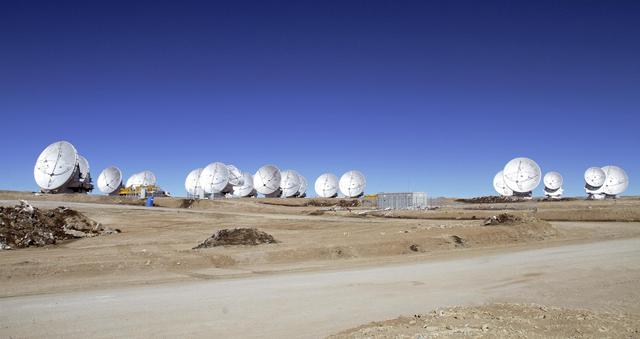
In the last few days, the world’s largest radio telescope, the Alma telescope, has began to function. Currently the telescope is made up of around 20 massive antenna dishes, which work in harmony to produce amazingly detailed pictures of outer space.

The project has input from all around the world, with Europe, North America, East Asia and the Republic of Chile forming a partnership, all doing their bit to add more antenna dishes and improve the telescope.

The ALMA Telescope

The antenna dishes that currently make up the telescope ALMA Telescope

When the project is completed, (hopefully within the next 20 years if all goes to plan) the telescope will have a whopping 66 dishes at its disposal, all of which it can use to gaze at the stars in fantastic detail!

Why the Atacama Desert?

You are probably wondering why the Atacama Desert is such a hotspot for telescope activity. Well there are a number of reasons, but the main ones are that it has clear skies almost all the time, in addition to very dry air – meaning that its hard for humans to breath there due to low oxygen levels, but for the telescopes, that means very little interference from anything in the space above.

Furthermore, the desert has many high flat areas, meaning that telescopes can be closer to the atmosphere, meaning even less interference. In addition to this, because the Atacama is a desert, it has virtually no light pollution. Basically it is an astronomer’s dream location!

Is it working?

The project has only been live for less than a week now, but already some stunning high detailed pictures of space area already beginning to emerge. Below is one of these great pictures:

ALMA Telescope deep space picture

A picture of deep space made possible by the ALMA Telescope

Because the light we can see here on earth is often millions, if not billions of years old, we are able to see into the past when looking up at the sky, using super powerful telescopes like the Alma one.

Scientists believe that we will be able to see events that happened just 400 million years after the big bang, due to the light delay, hence enabling us to understand better than ever before the formation of the early universe.

The Alma telescope is just one small cog in our planets fascinating scientific road of discovery, however one thing’s for sure: this ‘small cog’ should be able to help us understand a lot more about the universe than ever before!