How does wireless charging work?

This is my two hundred and fiftieth (writing it out in full looks better than 250th) article on Technology Bloggers! It’s taken nearly four and a quarter years to get this far, but here I am, still blogging away. 🙂
That’s an average of 5 posts per month!

Not that anyone’s keeping score, but Jonny is hot on my heals now with 165 – just 85 behind me!

Finally, wireless charging on a mainstream mobile phone has arrived. Samsung’s Galaxy S6, S6 Edge and S6 Active all come wireless charging ready. Unfortunately we aren’t yet at the stage where your phone can wirelessly charge in your pocket, you do have to buy a wireless charging pad and have it sit on that, but it’s a step further than we have ever been before. This article gives an incite into the technology behind wireless charging, and then in my next article I’m going to review Samsung’s official wireless charging pad.

Wireless Charging Technology
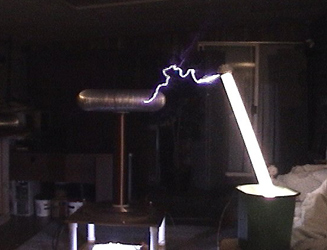
Tesla coil wireless power

A Tesla Coil being used to wirelessly power a light bulb

The capability to power things wirelessly is not a new phenomenon. Way back in the late 1800s, Nikola Tesla was using his Tesla Coil to power things from across the room. You might have done a similar experiment in science lessons at school, using a Tesla Coil to light up a light bulb.

The reason it’s taken so long for wireless charging to become mass market is because compared to wired charging, it is hugely inefficient. Wireless charging wastes a lot of energy as heat, meaning less is used to actually power the device. Wireless charging also takes longer than wired power, and as such is much more expensive.

Plugging my phone (the Galaxy S6) into a standard micro USB port will charge it from flat in around 2 hours. Plugging it into a fast charger takes just over an hour for a full charge. Charging wirelessly from flat takes over 3 hours. That’s 3 hours of electricity being used, compared to 1 in a fast charger.

Wireless charging has also taken a while to become mainstream because of problems with proximity. Tesla could power a light bulb from across the room, but that wasn’t controllable. If he had 2 light bulbs and only wanted to power one, he had no way of stopping power reaching the other. With so many different devices and radio frequencies about today, it is essential that wireless charging works without interfering with any other signals – for example your mobiles 4G signal. As such wireless charging has a very low proximity range. My S6 quite literally has to be on or within an inch or two of the pad to charge. A range of 1 meter would be fantastic, however that could fry other bits of tech, or ruin the magnetic strip on my credit cards.

Despite over 100 years in the making, wireless charging is still in reasonable early stages of development. It is a great idea, and when it works, it is super convenient and very useful, but still has a long way to go.

If you want to find out more about how wireless charging works, I recommend this YouTube video as a good place to start.


WAVE

wave_copertina

Wave in Milan

This month Milan is hosting WAVE, an event that promotes the idea of frugal innovation in all of its different facets. I must say before beginning that the Bassetti Foundation (who employ me) are co-sponsors of the event, so I am a little partisan. It is however from any point of view an interesting project and concept.

The event includes an exhibition open to visitors and free of charge from 7 a.m. to 7 p.m. in Piazza San Fedele, Milan until 3 July, alongside a series of lectures and other events. The full program is here. There is a huge variety of stuff to see and hear, including debate about sustainability, smart city technology, citizen science and editing the human genome.

The WAVE Project

I take the following form the WAVE website. It gives a nice idea of what the project is all about:

At a time when the entire planet is facing tremendous economic, social and environmental challenges, a multitude of initiatives from around the world prove that solutions exist for doing more with less. The common ingredient in all this creative ferment? Collective ingenuity.
Being flexible, keeping it simple, seizing opportunities, thinking differently: in an unstable world, the ingenious innovator develops a state of mind that’s agile enough to turn obstacles into opportunities.
We live on a small planet where everything is interdependent. This is not a time for divisions, but for concerted action: citizens, associations, NGOs, local authorities, and companies both large and small are implementing new ideas for a better world. Driven by the digital revolution, most of these initiatives rely on social media. Some of them fall within the commercial sphere, others do not. But all of them demonstrate new ways of innovating together, differently.
A wave of collective ingenuity is sweeping across the world. Drawing on a wide range of concrete examples, the WAVE exhibition explores the major currents on every continent: co-creation, the sharing economy, the maker movement, the inclusive economy, and the circular economy. These examples feature people from all walks of life who share a positive vision of the world of tomorrow.

So as we see, WAVE as a concept is traveling the world. It started in France, now Milan before moving on to Senegal, USA and then India. It looks like an interesting series of events to me, and next week I am off to Milan to check it out in person.


The Online GM Foods Debate

gm-picGM Experiences

A few weeks ago I was invited to Vienna to participate in a 2 day workshop on Responsible Research and Innovation in the Context of GMO. Obviously, these two topics being my main interests in life, I accepted, and off I went with my extremely stylish new laptop/overnight bag to an equally stylish country hotel.

It was a really interesting weekend. The other participants were scientists, members of regulatory bodies and governmental institutions, professors and other professionals from across Europe. I should say that this weekend was part of a much larger project called RES-AGORA, which is funded by the European Commission. You can read all about it here.

If that tickles your fancy here is the 60 page long Stakeholders Report.

But anyway back to the experience of a Luddite blogger in a posh hotel. I learned a lot about genetic modification, legislation, the problems of getting seeds to test, companies not making life easy for those testing or reporting, property rights and their effects over publication possibilities, loopholes in laws in different countries that allow people to legally buy seeds without a contract with the manufacturers (oh don’t get me started), and it got me thinking about writing an article.

So I did, and got it published here, in an Italian online academic journal.

Writing Skills

Now why is this of interest to you I hear you ask. Well I wrote this article basing much of it on the food series that I wrote here  on Technology Bloggers last year. In writing the series I unearthed a real underbelly of food production, and a little organization and rewriting, updating, selecting and expanding, and I had an academic article. You can download it for free here if you like.

The article raises the issue of how the GM debate is played out online. The problem it seems (to me) is that there is no forum for constructive debate about GM, and this leads to a polarization of positions. So we can imagine a scenario in which website “A” points out as many problems as the author can think of, ethical issues, exploitation, altering nature, global takeover of seed production, and other nasties. In the same scenario website “B” is glossy and tells us that only GM will be able to produce enough food to feed an ever growing population, that it is all safe, that they are spending money on research just to help us out….

The problem is that in all scenarios website C is the same as website A, and D is the same as B and so on. There is little room for debate about GM in organic fuel production, or any other possible uses. It is the goodies against the baddies, and the baddies have more money, friends and power. The goodies however don’t seem to have a broad enough base to attack from.

Now the article looks nothing like the blog series I grant you, nor does this 2 paragraph description above, and I have to say that a lot of work went into the article. But having done all of the research for the series gave me a really good grounding. Now I am sure that many readers have written blogs that follow long and intricate lines of argument, but I wonder how many have thought about writing an article for a journal, newspaper or magazine and submitting it? It certainly broadens your writing capabilities, and if you feel you have something important to say it gives access to different readerships.

And it looks good in the portfolio and on the CV!