Coach Guitar App Review

Coach Guitar enables users to learn guitar without any music theory or tablature. The animated black fret-board represents a guitar and the fingers are marked with different colors to specify the positions efficiently for both hands use. The colored dots signify the different chords of an acoustic guitar to be strummed. These instructions are available in Help menu on the start screen.

When you open this app, the page shows options such as My Lessons, Library, Help and finally Settings. After going through the Help option, you need to start with My Lessons where there are few popular songs pre-loaded. Then, you have to choose one among them and proceed for the coaching sequences. Just like a true professional, this app provides a step by step teaching facility which helps the users to play each verse of the song with perfection.
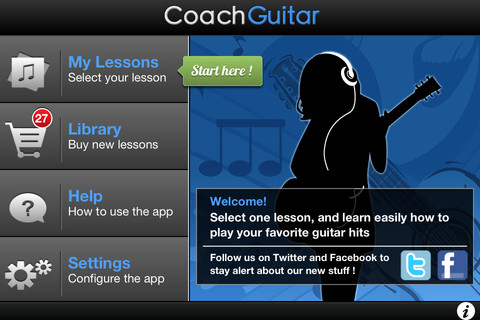
Coach Guitar Navigation

This version also contains two amazing songs for free- Stairway to Heaven by Led Zeppelin and secondly, Wake me up when September ends by Green Day. Another interesting aspect of this app is the availability of video lessons in HD. You can watch and learn in no time. In the Library, you can buy and store your favorite tracks available which you want to learn. The Library is updated quite frequently for the convenience of users. Also, the developers have provided the settings option to configure this app as per your wish.

The appearance of Library is quite similar to that of a normal playlist in your phone only with a single modification of the price tag on the extreme right of the songs. This can be considered one of the flaws of this virtual guitar teaching concept. You have to pay a certain amount for adding up your favorite tracks further. The customers have complained about this attribute and rightfully so.

Looking at all the pros and cons of this guitar teaching app, I am pretty much satisfied by its functioning. This app skillfully acknowledges its name and acquires relevant features to teach users how to play a guitar. Coach Guitar version 1.7.3 requires only 13.2 MB of phone memory. With the presence of a large display screen in iPhone and iPads, the working of Coach Guitar becomes easier.

Selling second hand items online

The world is caught up in a massive credit crunch which has turned every consumer into a spendthrift. Maximizing resources has been declared one of the most predominant consumer trends in 2012. Popular auctioning sites have become playgrounds for shoppers and sellers alike. Re-purposed goods have created such a massive niche that recommence is now a part of first world culture.

Spendthrift Nation

Second hand childrens toys

A jumble sale of second hand toys

The economic climate has had a lot to do with the boom in recommence, but the benefits of selling and buying re-purposed goods has lasted as long as it has on the strength of its other benefits. In the past, selling second hand items was inconvenient, demanding that consumers use stores that bought at low prices to create space for further mark ups. The internet has cut out profit hunting middlemen, allowing you to sell your second hand items online directly from home. Today it takes little more than a five minute registration process to re-purpose old items.

One Man’s Meat is Another Man’s Poison

Regardless of how unusable an old item may seem to its owner, the global marketplace offers up a massive consumer group bound to include at least one buyer who will find value in another person’s junk. The World Wide Web has extended the contacts list of the average consumer, introducing a myriad of potential buyers.

Security and Convenience

Online auction sites have made resale a streamlined process by offering shipping and packaging services for consumers who want to profit effortlessly from their old items. Secure online banking services ensure that buyers and sellers are kept safe from the penny pinching public.

One Stop Shopping

In a brick and mortar environment, it can take months to find a buyer. The traditional garage sale demanded that you invite strangers into your own home over weekends that would be better spent elsewhere. Today’s online vendors separate consumers into groups according to indexed categories, sending sellers a whittled down group of appropriate buyers. A single site may act as a retailer for products as diverse as fashion, décor, gadgets and tools, so you need visit only one vendor to sell a closet full of unwanted widgets.

Global Economies

The sheer size of the global marketplace means that low value items can be bartered up to produce often startling returns. A fourth edition novel from the Eighties might sell for a few dollars at a brick and mortar store. When you place items on sale, the internet gives you the potential to find buyers who overvalue items and are thus willing to pay far more for them. A buyer who attaches sentimental value to that second hand book is generally willing to part with a significant chunk of income in exchange for personal value. The online marketplace operates according to its own economy, where demand is directly proportionate to the unique personal value individuals place on niche products.

Scarcity is another predominant force that pushes price tags well beyond real world worth.

Taxes on Internet shopping

Here in the US the Senate just passed the Marketplace Fairness Act, and it is causing a great deal of debate on all sides.

I want you to pay taxes

Pay more taxes on your online goods

In the USA each state can levy its own sales tax. The rate is not equal across the states, for example here in Massachusetts I pay 6.25% sales tax on my new fridge, but if I drive to New Hampshire I do not pay anything. You can check out the differences on this interactive tax map.

The legislation described above aims to make Internet sellers collect the taxes due to the buyer’s state, something they are not currently required to do. At the moment I order my fridge from a New Hampshire based Internet retailer and I don’t pay any tax. In theory I should go and pay the state myself, but with online sales worth billions there is no enforcement and no queues (lines) outside the tax office.

Retail outlets argue that this gives online sellers an unfair advantage, but they in turn argue that the collecting and payment of state taxes under the new proposed regime would be expensive and extremely complicated. If they sell me the fridge here it costs a certain amount, they have to collect the tax and pay it to Massachusetts, but my friend in Florida pays a different amount and the tax is paid to the state there. Now this might not be too complicated a system for Amazon to manage, but a small Internet based retailer might not have the technical expertise or personnel to carry it out.

The proposed bill does exclude traders who sell under a million dollars of goods, but in today’s world that could still be a very small organization.

The technical difficulties of collecting the taxes through any other means seem insurmountable though, and the problem is very much related to the idea that borders can be controlled. States have different laws about selling many things, but if these things can be bought on the Internet and shipped to an individual house I cannot see how these rules can be adequately enforced. Is it a form of smuggling to buy something that you cannot get in your own state?

The result of the bill (if it passes although it does have bi-partisan support) will be that local sales tax will be levied at source and so the fridge will cost more. Maybe this is just and fair, maybe it will choke some smaller businesses, who knows?

What do you think?