Global Information Technology report 2013

The World Economic Forum recently released its Global Information Technology Report 2013, and in this post I would like to have a quick look at it.

It is a long document, so I will just try to take a few highlights to give an idea of the findings.

The report has a Network Readiness Index that aims to measure how prepared countries are to adopt and make the most of new technology. Factors such as investment in broadband and other telecommunications fields obviously enter, but so does the quality of the education system and regulatory powers.

Finland leads the world in embracing technology, followed by Singapore and Sweden. The UK is in 7th place, the USA in 9th and my present home Italy is well down at number 50.

World Economic Forum

The Nordic countries and the so-called Asian Tigers – Singapore, Taiwan (China), South Korea and Hong Kong SAR – dominate this year’s index thanks to their business-friendly approach, highly skilled populations and investments in infrastructure, among other strengths. Finland, which arguably has one of the best educational systems in the world, stands out as a digital innovation hub.

Southern Europe shows a massive lag in fact with the North, and this is a major problem.

The positioning is not only important for so called ‘techies’, but really important for the economy as a whole, and here in Italy (and in Southern Europe on the whole) we are in serious need of economic improvement.

Latin America, the Caribbean and sub-Saharan Africa also suffer from a serious lag despite infrastructure improvements, an expansion of coverage and a push into e-government. Weaknesses in the political and regulatory environment, the existence of large segments of the population with a low skills base and poor development of the innovation system are all factors hindering Latin America’s technological potential. In sub-Saharan Africa, costly access to technology, a low skills base and unfavourable business conditions are among the chief obstacles.

The report demonstrates that economic growth and technological readiness are tightly linked.
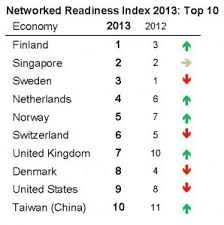
Top 10 countries for Network Rediness 2013/2012

A look at the top 10

An analysis by Booz & Company has found that ICT could help lift millions out of poverty.

Digitization has boosted world economic output by US$ 193 billion over the past two years and created 6 million jobs during that period, according to the study. Using a Digitization Index that ranks countries on a scale from zero to 100, Booz & Company found that an increase of 10% in a country’s digitization score fuels a 0.75% growth in its GDP per capita. That same 10% boost in digitization leads to a 1.02% drop in a state’s unemployment rate.

If emerging markets could double the Digitization Index score for their poorest citizens over the next 10 years, the result would be a global US$ 4.4 trillion gain in nominal GDP, according to the study. It would generate an extra US$ 930 billion in the cumulative household income for the poorest, and 64 million new jobs for today’s socially and economically most marginal groups. This would enable 580 million people to climb above the poverty line.

So investment is this area is extremely important, but in many places falling profits due to economic downturn (as is the case in Southern Europe and to some extent the USA) mean that less money is available, and this effects future growth scenarios.

Interestingly 3G growth is more important than general mobile telecommunication growth, we really do live in an information society that is based on Internet connectivity.

Medical care is also another area where benefits are net and easy to measure.

Southern Europe is in a particularly precarious position due to lack of investment capability. Rwanda on the other hand is following many other African countries in investing in expanding its fibre optic network and hopes to become a banking and finance hub, moving to being a knowledge based economy and away from agrarian in the next 7 years.

Colombia, Uruguay and Panama have become champions of e-government and connectivity. In Colombia, Internet connections have tripled to 6.2 million in the last 2.5 years. In Uruguay, small and medium-sized tech enterprises helped lift technology exports from US$ 50 million in 2000 to US$ 225 million in 2010.

Here in Italy there is little investment and a distinct lack in centralized planning, so we will soon be slipping below these countries on the scale and continue to suffer the related threats on economic development that this situation provokes.

The report is free to download here. It is as I said long and detailed, but the rankings are in chapter 1 if you just want to see where your own country sits.


The Third Industrial Revolution

Recently there has been a lot of talk about a third industrial revolution in the making. It is of course that involving 3D printing. Take a look at the other articles on the website for an overview.

The thing about these machines is that they can produce individual tailor made objects at low cost, something that was not really possible in the days of mass production, when multiples were cheap but individual one off projects very expensive.

It is a contentious technology though for several reason, the first being its versatility. A few months ago we had the first fully printed gun, the plans were put online for free before being removed but only after more than 100 000 people downloaded them.100 000 more unlicensed guns in the world possibly. Check out this article.

Another reason is that these machines will completely change manufacturing. The old days of heavy machinery in production lines might be numbered, and this means that the power and financial strength that the organizations that have control of these systems currently posess is about to be lost.

So where should somewhere like MIT here in Cambridge MA stand? They have to support new technology, it is their job, but in doing so they might be undermining their own foundations, rooted as they are in large scale US industry.

3D Printed Prosthetic Hand

3D Printed Prosthetic Hand

As well as the printable gun though there are obviously a million good uses for this technology. Two weeks ago I mentioned an engineering company that is testing an aeroplane engine that uses printed parts, and in case of dire need you can now print a prosthetic hand for about $150 through an open source website. Read the article here.

Last week the Bassetti Foundation sponsored a series of events in San Francisco based around these problems. One of the main speakers was Chris Anderson, ex editor of Wired magazine and author of the book Makers, he is a leader in thinking on these matters. There is plenty of information on the website for interested readers, including videos of the symposium about the political and social implications of a move towards 3D printed manufacture.

3D Printed Motorbike

3D Printed Motorbike

Check out the photos too, here is a printed motorbike. They can produce far more than you imagine.

Is a lazy website key to online success?

Speed matters. Once upon a time, if a business had a website, it was revolutionary. Now in many cases if a business doesn’t have a website, it will usually suffer as a result.

When the internet was in its infancy, speed wasn’t really on the agenda. If your site loaded super fast (remember we are still in the days of 56kbps/dial-up internet access here) great. If it didn’t, people would be prepared to wait.

Nowadays there are so many different websites offering such similar information, if your site is slow, your traffic (or as I prefer to call it visitor numbers, or even better: people) will suffer as a result. There are countless studies into this, almost all of which conclude that the slower a site is, the fewer visitors it has.

Furthermore, speed is starting to become an evermore important search engine ranking factor – if your site is slow, you are less likely to rank at the top.

Okay, you get the point: today speed matters.

The problem with many websites is that they have so much to load. When you load our homepage, it isn’t just a few lines of HTML that your browser requests from our server, it also fetches a handful of local CSS, JavaScript and PHP files, in addition to bunch of images and some large chunks of external code, which are used to generate social media buttons.

This all takes time, and every extra byte and file that is requested will slow down the page load time.

Slim Down

One way to reduce the size of the page is to reduce the amount of files – and the size of those files – that are fetched. We make every effort to ensure that our locally loaded scripts are as condensed as possible, so your browser doesn’t have to request dozens of files, just one or two.

We have also combined several images into one file (a CSS sprite), again, so your browser has to fetch fewer files. Take a look at the image below for an example.

CSS sprite social media

Technology Bloggers social icons CSS sprite.

The trouble is, we only have control over internal files. I can’t go and reduce the Tweet button script and add it to one of our existing files, as it is controlled by Twitter, and served via their servers.

Lazy Loading Images

Sometimes slimming down isn’t enough, so one way to prevent the initial load becoming verbose is to delay the loading of images not in view. We use a WordPress plugin called Lazy Load, which only loads images just before they come into view. So if the page has five megabytes of images to load, and four are below the fold, then when the page loads, you will only have to wait for one megabytes worth of images to load; if you don’t scroll down, the other four never get loaded.

Lazy loading images can significantly help improve page load time, as images are usually the biggest files that a website loads, so only loading the vital ones really speeds things up!

Lazy Loading Social Buttons

As I mentioned above, one of the biggest strains on loading is external code, specifically social buttons and sharing buttons.

For a long time now, the ability to offer you the potential to share content and follow us via social media has come at a high price – in terms of loading time. However after a lot of coding and hours of tweaking, our social buttons are now just a tiny (in size) image.

If you take a look at our sidebar, the social buttons sill look very similar to before – Facebook like, Twitter follow and Google Plus recommend all still there – however they now only load the external scripts if you mouse over them. This removes a huge delay when you first load a page, and means we can provide these buttons on every page of the site, with a much smaller speed loss.

At the top of articles, the social buttons there now also load lazily, and only fetch code from the networks when you mouse over the button images.

Lazy loading sharing buttons.

Technology Bloggers delayed loading social buttons.

Lazy loading social media buttons has dramatically improved the speed of Technology Bloggers, and still enables you to share content when and how you choose.

%CODETWEETTB6%

What is your view on delayed loading?