Flappy Bird

Flappy Bird, for those of you who don’t know, was a smartphone game where users had to try and get a bird through as many obstacles as possible. I say had, as the app has been removed from the iTunes and Google Play – more on that later. I’m not sure I can really explain it much better than that, so take a look at this video to see it in action.

As you can see people take this game pretty seriously. The chap says how he has been playing it for about a week and that “it has totally consumed [his] life“. I tried the game on a friends phone and sensing that it was something that I was likely to get addicted to I decided not to install it myself. I am very glad I made that decision. In fact I have decided to take a total detox from all smartphone and tablet apps recently, and it really does feel great.
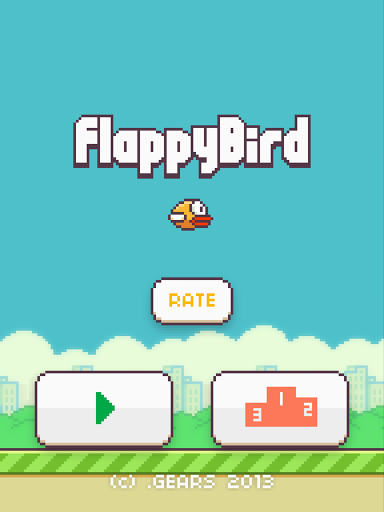
A screenshop of the Flappy Bird appUsually I install an app when I have some time to kill, but after a while, I seem to be wasting far too much time on pointless apps. I took a step back and saw that playing games such as Flappy Bird was just a waste of my time. This article is not asking you to stop using apps, but I do want to make people think.

I want to make people think, much in the same way that I suspect Dong Nguyen wants to make people think. Dong Nguyen was the creator of Flappy Bird and despite the fact that some sources report the game to have been earning around $50,000 per day in ad revenues, he took it down. The game was very addictive and didn’t really add any value to the lives of players. If anything, for many it just caused a lot of stress and aggravation.

Anyone who downloaded the game still has it, but if they uninstall it it is gone forever. Some people are selling their handsets with the game still installed on it, although many manufacturers advise against this on privacy grounds.

What I want to know – in the comments below – is what are your opinions? Was the developer right to remove the game? As a society are we getting more addicted to such games? If so, how are they affecting culture – or are they just a bit of harmless fun?

Oh and folks, please don’t go taking a hammer to your phone. 🙂
Wasted Food

It is estimated that in the USA between 40 and 50% of all food produced is wasted. There are about 320 million people in the US, so we could safely say that this wasted food could feed at least 100 million people.

The European Union fares little better. According to the European Commission about 90 million tonnes of food is wasted annually in Europe alone, with global waste at about 1.3 billion tonnes. In developing countries, over 40% of food losses happen after harvest and during processing, while in industrialized countries, over 40% occurs at retail and consumer level. According to the US Food and Agricultural Organization food waste in Europe alone could feed 200 million people, and that if global waste could be cut down by 25% it would give enough food to feed 870 million hungry people.

Obviously the so-called developed nations are the worst offenders. Per capita waste by consumers is between 95-115 kg a year in Europe and North America, while consumers in sub-Saharan Africa, south and south-eastern Asia, each throw away only 6-11 kg a year.

The main causes of waste are:

  • Lack of awareness, lack of shopping planning, confusion about “best before” and “use by” date labels, lack of knowledge on how to cook with leftovers (households).
  • Standard portion sizes, difficulty to anticipate the number of clients (catering);
  • Stock management inefficiencies, marketing strategies (2 for 1, buy 1 get 1 free), aesthetic issues (retail);
  • Overproduction, product & packaging damage (farmers and food manufacturing);
  • Inadequate storage (whole food chain);
  • Inadequate packaging.

Fortunately the EU offers a free downloadable brochure explaining how as an individual you can cut down on waste, get it here.

But most of the waste comes from industry, with millions of tonnes of food thrown into skips at the back of supermarkets every day. Systematic waste we might call it, but what can be done about it?

Plenty of bread products

Plenty of bread products

Well let me tell you a story, I have a friend who describes himself as a freegan, he only eats free food, and he eats well. He lives in a large housing cooperative in Massachusetts, and he does the shopping for the entire group. He has his rounds, every Wednesday he goes to the orange juice processing plant and gets a few gallons of discarded juice. On Thursday a supermarket, on Friday after the farmer’s market there are boxes of discarded vegetables, if he didn’t have a trailer he would need a truck!

I must warn you though that climbing into the skip outside your local supermarket might be dangerous or illegal. In Germany, England and Wales for example it is theft, although rarely prosecuted. In Italy it is legal, but in the US you may be charged with trespass.

And plenty to drink

And plenty to drink

Here is a great article about what they call in the US dumpster diving, with an interesting shopping list of what was found, and the pictures in this post are taken from the event.

And it is not just rotten old tomatoes here we are talking about. Many things that are close to their sell by date are thrown out. In Cambridge Mass where I live there is what I refer to when speaking to my kids as ‘the expensive coffee shop’. It is good coffee, and the cakes are fantastic, but it is a little on the pricey side. But if you go 10 minutes before closing and buy a coffee they offer you a free cake, and as they are pushing you through the door at closing time you are expected to take scones, cakes and left over bread home, for free. Better than throwing it out they say, and they are right. It does however pose a problem for the economy, with people like me giving their secret away and the place filling up 5 minutes before closing time, although you have to be shameless to go every day (get your friends involved).

One thing that we have lost is the skill of home preserving foods. When we have all of these extra ripe vegetables we eat what we can, but when there are just too many they end up in the bin. Well if we learned to pickle food we could preserve it and avoid all of these problems, there are plenty of pickling lessons on YouTube, you can also freeze almost anything if you know how to do it correctly.

If you are not up for climbing into a skip and you are ever in Copenhagen, why not try the restaurant that serves only waste food? See this report on the BBC, it looks good, and I am glad to see someone is doing something with all of this good valuable nutritious stuff.

And the moral of this weeks story is that people are hungry because of economics, politics and logistics, not because there isn’t enough food to go round. You might like to think about that when the industrial agricultural food companies are touting GM as the answer to global hunger.

The stolen iOS

Apple are great at marketing. Well, Steve Jobs was at least. Apple are also great innovators, although that is more debatable.

A few weeks ago I came across a video of the Steve Jobs introducing the iPhone. I found it quite comical how the audience gasped and clapped at some of the features; the idea that you could use your finger on a screen instead of a stylus, the ‘amazing’ elastic band scrolling effect, and by far the most impressive, the iPhone could handle the web like a computer, not a mobile phone. Steve Jobs even mentioned that Apple planned to make 3G phones in the future.

The fastest network the original iPhone was compatible with was EDGE, which at the time would download at speeds of up to 473.6 kbit/s; that’s about 2,214 times slower than today 4G 1Gbit/s speeds!

%CODEYOUTUBEIPHONEKEYNOTE%

Apple, Google and Yahoo! all working together on one device – I doubt that will ever happen again.

How far Apple has come since it launched the smartphone that changed the world in 2007.

iOS7

The original iPhone was unique. There was nothing like it and it was undoubtedly the best smartphone on the market at the time. iOS7 on the other hand is arguably just a cheap imitation of Android OS. That is the extreme view of course, I would also argue that Apple are only learning from Samsung, see what your competitor does well, then improve it, repackage it and sell it yourself.

iOS 7iOS 7 came with a few bugs and hiccups, but then most new software does so I am not criticising Apple for that. Aesthetically, childish icons, illegible fonts (due to poor colour schemes) and the motion sickness some people complain of because of the whizzy new interface, are all problems that are down to bad design.

In terms of technical problems, the inability to downgrade to iOS6 and the battery issues many users of older devices are facing when they upgrade are also Apple’s fault. Whilst I say they are Apple’s fault, they almost certainly weren’t accidental. If you don’t let people to downgrade, you force them to use to your new OS.

Free Upgrades

Apple now offer free upgrades to the latest iOS which you could argue is good for owners of older iPhones, but not so good for Apple’s bottom line. However if you look at the tests, generally older phones perform better on their original operating system than they do on iOS7; for example the iPhone 4 loads faster on iOS 6 than it does when running iOS 7.

If you have an iPhone 4 running iOS 7 and your friend has an iPhone 5C or 5S and your phone runs like a dog but theirs flies, it kind of makes you want to buy the latest phone.

Free upgrades also give users the perception that sticking with Apple is a good idea, because Apple look after them. Additionally having access to iOS7 will mean more users are familiar with the interface, so buying a new phone isn’t such as big a jump.

Bad Now, Better Later

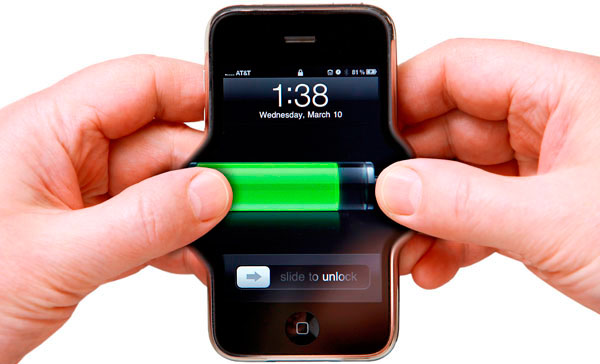
Here’s a thought, why have Apple failed to address the battery problem that plagues all smartphones? Old mobiles used to last for weeks between charges. I still own a Nokia 3510 which was released 12 years ago, yet if I fully charge it and leave it (switched on) it will last for a good few weeks – my S4 Mini can do about 60 hours tops. I believe many smartphone manufacturers are holding things in the bank for future. Better batteries are available, but it is more profitable to release better features gradually than to give consumers one fantastic upgrade every 3 to 4 years.

iPhone battery lifeMaybe Apple want iOS7 to look a little childish and have a few faults, so that when the next iPhone (or the one after that) comes out with a brand new OS, it looks so much better.

Time

When anything first comes out there is a lot of hype about it, sometimes good, sometimes bad, but often a mix of both. Those who ‘love’ the iPhone (or those who have been sucked in by Apple’s marketing) will stick with the phone for a long time to come. Those who are more critical won’t stop viewing things differently either. At the end of the day Apple is just a bunch of people trying to make money for another bunch of people – just like almost every other company.