The Rosetta Space Mission

rosetta

This week I am muscling in on Christopher’s space series with a guest post about comet exploration.

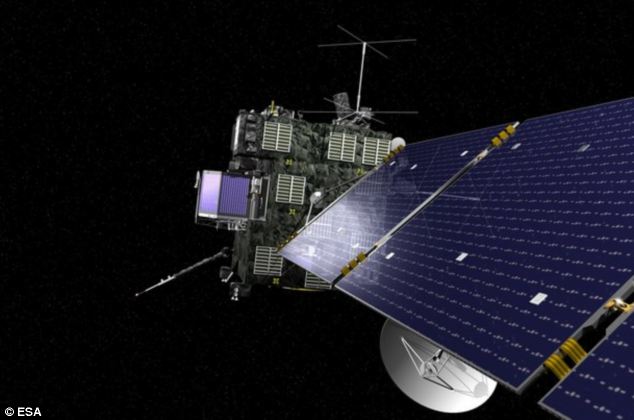
In a couple of weeks (on November 12th to be precise), scientists will try to put a lander on a comet for the first time ever. The mission blasted off 10 years ago, made its rendezvous and began orbiting in August of this year, and is currently being prepared to touch down.

The mission is called Rosetta, and it is operated by the European Space Agency. It is a risky mission though and there are no guarantees that the lander will be able to plant itself safely on the comet. But if all goes well, the lander will stay operational as the comet flies closer and closer to the sun in its elliptical orbit, so that it can study how proximity to the sun changes the elements that make up the comet. The orbiter will follow, and should stay with comet until the end of next year, while the lander will operate until the spring when it will then get too hot to function.

Comets are some of the oldest structures in the solar system, so learning what they are made of and how they undergo change is seen as the closest thing to going back to the formation of the system currently possible. Scientists hope to gather evidence about water and carbon content, to see if the Earth could have got its first water and elements that are needed for the development of life from such bodies.

The Europeans Space agency has an interactive graphic so you can see how Rosetta arrived at its destination, and it is well worth a look. You really get an idea of the task of getting to something that is just a few KM across and traveling at 55 000 Kilometres per hour.

This article in the online journal Science gives lots more information, and there are some great photos here.

The European Space Agency are also running a competition to name the area where the craft is due to touch down. They want the public to propose names and reasons to use them, so that someone has the chance to enter the history books as their name will be immortalized. Why not give it a go, read more here.

Bluetooth Gloves

bluetooth gloves

Life in the Netherlands involves biking. Biking involves getting cold hands in the winter. Getting cold hands in the winter means difficulty operating your mobile phone.

It is typical, you are riding down the cycle-path, it is raining, your hands are cold, you might be wearing gloves. The phone rings. You stumble to the side of the path, take your gloves off if you are wearing them because otherwise you can’t get into the pockets of your jeans, through the waterproof trousers and take out your phone. By this time at the last second the person decides that you are not going to answer and bang… missed call with a withheld number. What was it? You will never know.

And your hands are now even colder, the touch screen does not register and in a nervous moment you drop the phone trying to put it back into your pocket with wet hands. You get off the bike, put the stand down, go to retrieve your phone (the back has come off so you have to reset various things) and the bike falls over because of the weight in the panniers.

This every-day occurrence could become a thing of the past though, thanks to a fine invention. Bluetooth gloves. Yes ladies and gentlemen, gloves that use bluetooth to operate your phone. You just press the answer button on the glove, make the phone with your fingers as you do when you are pretending to make a call or playing with the kids, and speak. The sound comes out of the thumb, and the pinky has a microphone.

Available in black or grey, mens or women’s sizes, but unfortunately only with the phone fitted in the left hand, the gloves can even be worn while operating a touchscreen. They are dry cleanable and charge with a USB.

I know what is going on my list for Santa.

The Size of Space

I’m starting with a fact today; two actually.

FACT

According to astronomer Dr Peter Edwards, if our solar system was a grain of sand, then The Milky Way (our Galaxy) would be 1,000 times the size of Durham Cathedral.

Durham Cathedral from the South

Durham Cathedral

FACT

According to NASA there are hundreds of billions of galaxies in our universe.

Need a more visual representation of that? Well luckily for you, the American Museum of Natural History have spent quite a long time developing a digital universe.

Somewhat mind boggling, isn’t it. Dr Edwards doesn’t think the human mind is really built to understand the enormity of the universe. I think I probably agree with him.

In 2012 the Hubble Space Telescope zoomed in on a seemingly empty area of space. This area of space could be covered up with just a single grain of sand if you were looking at it from Earth. Astronomers didn’t think they would discover much, but if you have a super duper space telescope, why not see what it can find?

This is what that seemingly empty bit of space actually looked like when Hubble zoomed in.

A Hubble Space Telescope picture of millions of galaxy clustersEvery single speck of light you can see is a galaxy. Yes the 100 or so huge ones in the foreground, but also the millions in the background.

Each of those galaxies contains billions of stars. Yes many of them look insignificantly small, but they are very very far away. So the well used fact that there are more stars in the universe than there are grains of sand on Earth is actually true. In fact there are many billions more stars in space than there are grains of sand on the Earth. Each star is in solar systems filled with matter – from specs of dust to moons and planets.

The title of this article suggests that I will try to quantify the size of space. This isn’t really possible, so all we can currently do is describe its size relative to other things. If I had to use one word to describe space, I think it would have to be enormous.

A key question surrounding space is: is it infinite?

That is an existential question which I doubt we will ever know the answer to, but never the less it is still an interesting question, which is worth considering.

The theory that the universe is a sphere – like the Earth – is a popular one, and I can understand the logic in this, if you keep going, eventually the universe will loop you back around to where you started. But then my problem with this theory is we can go beyond the Earth. We can travel around the Earth, but space travel proves that we can move in 3 dimensions, straight and sideways on Earth and then upwards into space. If you got to the very edge of the universe, what would happen if you went upwards? If there isn’t an upwards, what is there?

New Scientist states that from all current data, it seems that the known universe has a diameter of about 93 billion light years. That’s pretty big, but by no means infinite. So if this estimate is correct – which is ridiculously unlikely – what comes after that? A big wall with a no entry sign? Just empty space? Another universe? Who knows…

That’s Your Lot

See you next week for the next in the series.