Is remote working the future for business?

In previous articles I have talked about how technology and business interact, and what the future of technology might hold for the world of business. In this article I am going to explore the idea that in the future, almost all business will be conducted remotely.

The number of people who permanently work at home in the UK, (known as teleworking) was estimated to be 1.3 million in 2010. The working population of the UK at the same time is believed to be around 30 million, therefore around 4.5% of the UK’s population (in 2010) were teleworkers. That said, is is estimated at the same time that 3.7 million UK workers sometimes worked from home, and sometimes went into their place of work. That means that of the working population, around 12.5% were, at some point, working remotely.

The figures are similar for the USA, and other developed nations. More and more firms around the world, are offering their employees the opportunity of working from home, but why?

Cost Advantages

Many people do not realise it, but it is often much cheaper to give employees access to the technology they need to work at home, than it is is to provide them with a workstation in an office unit. Yes that might mean you need to buy every employee a laptop, printer and make sure they have an internet connection, however that is often much cheaper than maintaining a workstation, in a fixed location.

If employees work in an office, then the firm either has to purchase or rent the premises – this can be very costly. Furthermore, an (often very expensive) IT mainframe system needs to be in place, to ensure that the entire building is connected internally, and with the outside world – including offices in other locations. Most employees will need a computer to work at, so why not buy them a laptop, give them their own printer, make sure they are internet connected, and tell them to work from home? It is often much cheaper.

Technological Advancements

Improvements in technology mean that working from home is more viable than ever before. Thanks to online storage systems, which allow simple, easy and effective file sharing among workers, employees are able to connect with each other, and share data from almost anywhere in the world. Outsourcing such tasks is often a much cheaper option for firms, than maintaining their own expensive IT infrastructure.

Advancements in communication technologies have also improved the viability of teleworking. I have previously wrote about QB Robots, robots which are effectively your eyes and ears in the office, which you can remotely control, whilst you are not in the office. These sort of devices mean that you can still connect with other workers, almost as if you were there in the room with them.
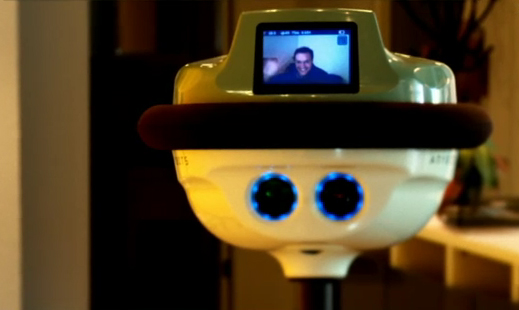
Anybots QB Robot

The head of one of Anybots QB robots – notice the webcam eyes and screen inbuilt into the head – such robots can improve the potential for remote working

You don’t necessarily need a QB robot to stay in communication with others though. Technologies like webcams, and VoIP mean that it is really easy to stay in contact, and in the loop, so you are just as up to date, as you would be, were you in the office.

Service Improvement Through Better Access

Technology has made it easier to work remotely, and it is often cheaper, but another advantage of teleworking, and a reason which I believe will be one which causes further growth in the industry, is the improvements in accessibility that teleworking offers.

In his recent article ‘Five changes in video conferencing for the next decade‘ Rashed wrote about how improvements in connectivity could improve the prospects for services like telemedicine. Being able to connect to people remotely, means that those who live/work in more remote areas, are more likely to be able to become connected.

Improvements in Productivity

Many studies have shown that working from home can actually boost productivity and reduce the time employees take off ill.

British Telecom claims that its teleworkers save it an average of £6,000 per year (per worker) due to the reduction in the costs of having to provide a workstation, the reduction in commuting costs, and through the increases in productivity. BT claims that its teleworkers are 20% more productive and take fewer sick days. This is probably due to the reduced stress associated with working at home, due to employees not needing to deal with the hassles of commuting, and the occasional hassles presented by co-workers, arguments and misunderstandings can cause stress!

In addition to this, the less time employees spend commuting, the more time they have to themselves, and the more time they can spend working. Say an employee spends an hour and a half commuting each day (two 45 minute journeys) then they could spend an  get an extra 45 minutes working, and get an extra 45 minutes to themselves.

In Summary

To conclude, working remotely is often a much cheaper option for both firms and employees, it has been made more viable thanks to technological improvements, it can improve the services that a firm can offer, and also improve the productivity of the workforce. These are some of the reasons, why I believe teleworking will become much more common in the future.

How important is the quality of hosting to online retailers?

This is a sponsored post. To find out more about sponsored content on Technology Bloggers, please visit our Privacy Policy.

With many brick-and-mortar businesses adding an online version of their high-street store to their portfolio, it’s important that firms choose the right web hosting service. With myriad services offering cheap deals, firms ought to be wary regarding offers that appear to be too good to be true – because they usually are.

On the surface, purchasing web hosting that costs £20 a month seems like a steal. In fact, it is a steal. However the only thing that is being nicked is precious uptime for online retailers, as the vast majority of cheap hosts go hand-in-hand with downtime.

Downtime – a retailer’s worst nightmare

For online retailers, downtime is especially important; every second of downtime is potentially a lost sale. Would you rather pay a premium for quality web hosting that is reliable and constantly up, or pay a third of the price for web hosting that keeps going down? In the long-term, it may cost more for firms to pay for cheap, but less reliable hosting.

In addition, utilising the services of a web hosting service in your time zone could be important, especially for smaller firms. Imagine if your store goes down but your hosting service is half-way across the world. This is certainly not ideal for any stores looking to make sales. For example, let’s just say your UK-based store goes down at lunchtime. No amount of calls at 12pm is going to wake a firm located half-way across the world; tucked up in bed at 12am. It’s a nightmare scenario.

SEO

The importance of SEO over the last 10 years has changed the face of the internet. An increasing number of online retailers are producing fresh content in a bid to become a publishing authority in the eyes of search engines.

However, when a cheap hosting company offers dead links, 404 errors and other harmful downtime to a retailer, what are these search engines going to think? Bounced traffic isn’t going to look good in the eyes of Google or Bing.

Technology Bloggers 404 error

Technology Bloggers 404 Page

Eventually, a retailer could slip down the rankings, and get flanked by its competition. It takes a lot of dedication to work up the search rankings, so don’t let a bogus hosting firm ruin your company and its prospects.

Security

In addition, security should be a top priority for online retailers. The amount of hackers roaming cyberspace is vast and make no mistake – they’re ready to capitalise on unprotected websites. By opting for secure web hosting which features STFP and SSL, a business and its clients can feel assured that all sensitive data is kept in safe hands.

As you can see, the quality of web hosting is an absolutely integral part of the foundations of success for online retailers. In an era of cost cutting and tight purse strings, it might be tempting to lump with a cheap web hosting service from the other side of the world, but in the long-term you may end up opening your wallet more often than you think.

Sony use crystal LED display in next generation TVs

Sony, a global leader in gadgets and technology, has managed to stun the world again. This time it has come up with a new Crystal LED TV technology, which it introduced at the Consumer Electronics Show (CES) 2012, which took place this January.

The future technology is being developed to give consumers the best TV watching experience. The company is known for introducing innovative products and the Crystal LED (CLED) technology is just another addition to the growing list.

Crystal LED Display Feature

The company displayed its 55” prototype crystal LED TV, which apparently has about 6 million LEDs to create a complete HD image. These LEDs put together create a superior quality 1080p image. Each RGB color uses 2 million pixels. The technology is something new and different from the other HD TVs.

A Sony televisionThe technology creates high quality images that are brighter as it uses the 6 million micro LEDs as the source of light for the television. The LEDs are mounted on the front of the display and therefore require no extra backlight source, which is why this technology is also referred to as self-emitting display technology.

The TV, according to the Sony, has enhanced features like better response times, more brightness, better scope for contrast and wider range of colours compared to the other TVs. The Crystal LED display is also said to be “ideal for large screens”.

The contrast is said to be 3.5 times higher and the brightness of the TV is said to be over 400cd/m2. Video images have a greater response time that is about 10 times better than the other Sony TV models. The TV has a resolution of 1920X1080 pixels and the angle of viewing is close to 1800.

One more positive of this technology is the amount of power consumed by the TV. According to the company, it consumes less than 70W of power. The TV has an incredibly thin structure that is only about 4mm deep and 7.6mm thick.

The Future of TV

The new technology increases the life of a TV as there are no any organic materials like Organic Light Emitting Diodes (OLEDs) used. The problem of colours fading over time on OLED TVs can be effectively solved by this technology. It ensures that the rich colours of the TV remain intact for a longer time.

The product has already created a buzz and the reviewers have also been kind. Sony has managed to attract eyeballs with this next generation technology. It has been touted to be the next big thing in consumer electronics industry, which means that the plasma and OLED TVs have serious competition.

The company is yet to give out a date of release and the cost of the TV. Since the crystal LED technology is more “stable” and might lead to lesser manufacturing errors, Sony claims that the price of the TV would be lower than OLED TVs. Consumers will just have to wait until the company launches the final version of the TV in the market.