The story of the online auction monopolist eBay

eBay. A firm which in 2011 had a net income of more than 3.2 billion. A website which almost everyone has heard of.

In an article I recently posted which explored whether there is really that much diversity online, I noted how eBay owned four websites in Alexa’s top 100 ranking – eBay.com, eBay.de, eBay.co.uk and PayPal.com.

There is no doubt that eBay holds a monopoly on the online auction market. But how did it get there? On September the 2nd 1995, eBay didn’t exist. One day later on September the 3rd it did, and after just over 3 years and 6 months, the site made its first major acquisition, the auction house Butterfield & Butterfield which it purchased for the price of $260,000,000 USD. A spend of 260 million after less than four years trading? eBay’s rapid early growth set it up to become a global internet phenomenon.

eBay kept buying up smaller firms, but not spending nearly as much as it had on its first purchase until mid-2000 when it forked out 318 million (USD) to buy Half.com. This was an amazing investment at the time, as even today it stands as eBay’s 6th largest ever investment, and it has made hundreds.

PayPal's logoThat said, the purchase of Half.com was to prove small fry to PayPal, which the now giant auctioneer purchased 2 years later in July 2002 for an astounding $1.5 billion. PayPal integration with eBay is (in my opinion) one of its greatest ever business moves. eBay is now able to seamlessly integrate processing credit card payments without having to pay millions every year to third parties. Fees eBay would have lost to PayPal are now extra revenues.

eBay wasn’t done though, going on to make the biggest purchase in its history, by buying Skype Limited for more than $2.5 billion. The auction site purchased the Luxembourg based company in 2005, only to sell 70% of its shares in 2009 for $2 billion – a healthy profit. Later, in May 2011, Microsoft bought Skype in its entirety for $8.5 billion, an investment which I am not sure it will see great returns on in the near future at least.
Skype's LogoeBay started to turn into a Microsoft and a Google. It was fast becoming an internet giant which bought up pretty much anything it could see turning it a bigger profit, or anything which posed a threat – in terms of competition. Just some of its purchases include StumbleUpon, Bill Me Later and Magento, the ecommerce web application.

Many say that eBay is one of the most notable successes the dot-com bubble, and I have to agree. Without the internet, eBay would be nowhere. It got in early and grew from the start, giving its competition very little chance.

Like it or hate it, eBay is an internet phenomenon, and also an internet giant. In my opinion it is successful down to luck: a good idea at the right time. Had it been thought of a year later, eBay might not be what it is today, had the internet not really taken off as it has and still is doing, eBay would again might not be where it is today.

What are your views on eBay? Were you aware of how much it owns and how rich it is? Is its monopoly unfair, or don’t you mind?
Data centers – where would we be without them?

It is hardly a controversial opinion to suggest that data centers are an indispensable part of modern life – it really is impossible to envisage a world without the vast capacity and power that data centers grant the business and information technology sectors – where would we all be without Google, eBay and Facebook? But what exactly are the advantages of a data center that their absence would remove? Let’s take a look…

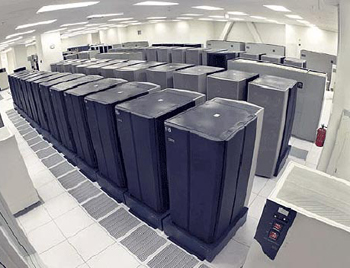
Firstly, the cost to enterprises of running an in-house own data center is increasingly prohibitive, given the growing size requirements of such facilities. As more and more information is transmitted online and more transactions take place online – just as computing power continues to grow – then a data center needs exponentially more power and more hard disk space. Server racks just keep on getting longer and even keeping them cool enough becomes uneconomically costly for most small, medium or even large-sized enterprises.

Server RoomSecurity is the second big issue – in a world where cyber-crime and espionage is constantly growing, there needs to be a very robust response to security. Most enterprises just don’t have the time and resources to police their IT operations to the level required, and a good data center can give them the reassurances they need. Technicians can be on hand throughout the 24-hour cycle, not just to ensure that the server racks keep on functioning perfectly and that any problems are swiftly dealt with, but also to ensure that information is kept safe and secure and that hacking or phishing attempts are roundly thwarted.

So, where would we be without data centers? The answer is that we would have a vastly more limited cyber-world, with businesses forced to keep their computer operations artificially scaled back due to cost considerations, with the knock-on effect of a hobbled e-commerce sector. Social networks would be slow, unsafe and prone to disastrous infiltration, while search engines would also be grindingly slow and frustrating to use – welcome back to the late 1990s.

It’s safe to say that data centers are not only here to stay, but will keep getting bigger and better so long as the computer world leads the way.

How to share a mobile broadband connection

With the increase in mobile broadband technology, many people are increasingly turning to mobile dongles (like the ones here) at home instead of traditional connections, which cuts out the need for a fixed-line. However, with mobile broadband there are certain problems that can arise, the most obvious being that of sharing your internet connection with another device.

An O2 dongle pluged into a laptop

A USB dongle – used to remotely connect to the internet

However, that needn’t be something that you become overly concerned with, as these days there are a variety of ways to share your mobile connection.

Most of the top providers are now offering technology to allow you to do this, such as 3 Mobile’s MiFi. With this you simply purchase the 3 MiFi and you’re away. It works pretty much the same way as a dongle, with one difference.

With a dongle you have to plug it into the machine, with MiFi you don’t, and can therefore connect to multiple devices at the same time. The devices themselves are small and easily portable; however, as is often the case with mobile broadband, internet speeds can be a little slower than hardwiring or even traditional Wi-Fi.

This doesn’t just mean you can connect to another Wi-Fi enabled laptops, games consoles or mobile devices, but also other Wi-Fi enabled devices including cameras, such as the Nikon Coolpix and the Kindle, so with MiFi and similar technologies, you can connect any combination of these, up to five devices. You can follow this link for more information on 3’s MiFi device.

A portable Wi-Fi router is another option for sharing the net. These are now relatively inexpensive and quite straightforward to use. You simply connect to a mobile network and share with other devices. However, do shop around before choosing one, as some are better than others.

Internet connection sharing is another option. By connecting a laptop or PC to the internet, you can then share its connection with other devices. For example if you’re running windows 7 this can be done through the network and Sharing Centre, but can be quite complicated  to carry out so is really only useful for advanced users or those who have the time and patience to hit the forums and get step by step instructions.

With different operating systems it works slightly differently so you may have to look up how to do this on yours too, this can be something of a headache.

If you have a 3G enabled phone, you can connect to the 3G broadband connection and then share with other devices. So as long as you have a signal, you can connect to your laptop or another device. However, download speeds are often reduced and quite often you can’t get unlimited data, so if you are sharing a connection you could quickly reach your limit.

The new iPad will allow you to do the same thing, however, despite the device being initially offered as 4G, this technology isn’t yet available in the UK. 4G uses the old terrestrial TV signal waves and widens the spectrum for mobile broadband.

However, Ofcom will be auctioning off the spectrum later in the year and this should be available in 2013 with the top mobile operators and will give even more options for mobile broadband.