Vintage Computers For Sale

Buoyed by the sale of one of the first and few remaining Apple 1 computers for $650,000 I started thinking about the old machines that were lying in my mum’s garage and wondering if I was sitting on a fortune.

Although I myself was never interested in computers my younger brother was a guru, going on to study computing at University, so we have a real vintage lot just awaiting discovery.

The first Hankins computer was a 1981 Sinclair ZX81. What a machine that was. It was manufactured by the famous watch maker Timex in Scotland, and really represents the movement from mechanical to digital technology. I remember recording programs onto a cassette recorder that were broadcast over the radio as a series of sounds similar to the noise a fax makes. Then you play them into the machine and bang you are off, you could use your 1kB of memory to do almost anything (or nothing).
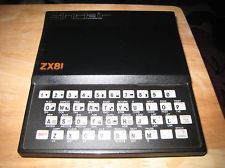
A Sinclair ZX81

A Sinclair ZX81

The keys were part of the machine, like an old cash register, and it is through these that my brother learned the skills of programming in Basic, although I never got to grips with it. Then he moved on to Extended Basic and machine code (whatever that is).

Anyway it will not make me rich, they go from about $2 to $20 on eBay.

But even 1 kB of memory was not enough for us so a couple of years later we (my parents) invested in what was in its day the height of technology, a TI99. This was altogether greatly improved, it had a cartridge system in the front so you could slide in games and use the cursors to maneuver through the asteroid fields.

The TI99 was manufactured by calculator maker Texas Instruments and was the first computer with a 16 bit processor. Texas Instruments were big on voice synthesis and the big use of it for us was during the game Parsec. With 16kB of memory we had moved on considerably, and my brother made the most of learning Extended Basic using their wonderful program.

A TI99 Home Computer

A TI99 Home Computer

Just look at the lines on this beast, a design classic it sold almost 3 million units and with 68 by 48 pixels in colour the picture was a joy to behold when plugged into our TV.

It was high finance though for our family, it cost more than $500 US when newly released but as with all of these things the price fell over the following years to $150, and so the question arises again, am I rich today?

The answer unfortunately is no, you can buy one on eBay for about $20. Could be a great investment though, they have one in a museum in Paris.

Well a couple of years passed and my brother needed a serious computer to take to University. At great expense my parents went for the BBC Microcomputer built by Acorn. This was much more of an educational tool, and its release was followed by a BBC educational series that taught its user (my brother and unfortunately not me) to program, and it was the machine of choice for UK universities and schools.

Our model B had 128 kB of memory, a giant leap that allowed graphics programing and increased complexity of use. It also had a floppy disc for ease of data transferral. It was a beast of a thing though as it sat in my brother’s bedroom, and it is the most expensive machine in the house to date.

A BBC Acorn Computer

A BBC Acorn Computer

Oh how I could pay my mum back if it were now worth the same as the first Apple I thought, but once more eBay broke the spell. From $10 to $150 with all the extra hard and software, so sorry mum the Austin Martin will have to wait.

After University (and post BBC) my brother went to work and we moved into company machinery, laptops, blueberry, blackberry, apples and other fruits of commerce, and I lost touch a bit, but I alone have owned 3 desktops and 3 laptops to date and it is all awaiting disposal, so there certainly isn’t much room in my mum’s garage today (certainly not enough for an Aston Martin anyway).


Mining the Seabed

Last year I wrote about the possibility of sending robots to asteroids to mine them for their metals, and although this might sound a little far fetched there are companies that exist to promote and make the idea possible.

In this posting I would like to draw attention to proposals for mineral mining a little closer to home. The International Seabed Authority (part of the UN) released a report last week about how it intends to manage the extraction of metal rich rock from the seabed.

The sea floor contains gold, copper, manganese, cobalt and other metals, and it now seems that the mining companies have the engineering capability to harvest it. The prices are high for these metals too, so they also have some economic push to help them along.

Licenses to prospect have already been granted, so it seems only a matter of time until companies are given permission to start removing pieces of the sea floor.

A hydrothermal vent under the ocean

A Hydrothermal Vent

What they are interested in are pieces of the chimneys of hydrothermal vents which contain many of these metals in high quantities. Some estimates related to the bed of the Eastern Pacific Ocean give an idea of the amount of materials that are down there, seven billion tonnes of manganese, 340 million tonnes of nickel, 290 million tonnes of copper and 78 million tonnes of cobalt.

This is a completely new field for mining companies though, nobody has experience in this kind of work. But the only way to gain experience is through actually doing the job, so the authorities are in a tricky position. How can they give licenses to a company with no track record in the field? Surely that means accepting a trial and error system that will inevitably lead to accidents and pollution. There are plenty of recent examples of deep sea oil drilling going very wrong, and that is after many years of experience.

And these hydrothermal vents host life that only exists in the unusual conditions that they create, what will happen to those highly developed and particular creatures and plants?

So I ask the possibly false question of sustainability. We all use these minerals, they are in everything we touch but we don’t tend to think about where they come from. Mining is a dirty business in any situation, and by definition it cannot be sustainable as far as I can see because we are dealing with finite quantities of materials that will not reproduce themselves.

But should we or indeed can we draw a line? Asteroids, the seabed, the Antarctic, where next?

Taxing the Smartphone

On Monday a report was released in France that contained the suggestion that a tax should be levied on Internet devices in order to raise money to promote and protect French cultural production.

A Tax Paid Phone

A Tax Paid Phone

For several years France has had a policy of taxing broadcasters and spending the money on supporting its own film and entertainment industries, but revenues are falling. The problem seems to be that many more people are accessing their entertainment via the Internet and therefore not contributing to its production cost.

The Lescure report as it is known suggests a tax of between 1 and 4% on any Internet capable devices (smartphones, eBook readers and games consoles included), but as we might imagine many of the producers of these devices are not happy about the proposal.

Money has to be raised to maintain the entertainment industries, but many of the companies that provide access to this entertainment are not based in France and do not contribute. They probably don’t want to either, and so we come across the same problem that I wrote about last week, collecting national taxes from international corporations based in another state is never easy, and borders are porous.

The proposed tax would replace one already in existence upon storage devices. Currently tax is levied on blank CD’s and memory sticks as well as computers with hard discs.

The manufacturers complain that the price of the devices would rise leading to fewer sales, although the author of the report argues that such a small percentage increase would make little difference, and would not even effect the home job market because most of these devices are assembled overseas. A 1% tax would raise something of the order of 90 million Euro a year.

The problem remains though. As our sources of entertainment move away from pay TV, publicity funded channels and national subscription systems such as the BBC, money is taken away from the producers and associations that represent and fund these industries. Some see the fact that Google and Apple amongst others are operating outside the tax system and are not contributing to the industries that they make their money from as unfair, and hope that this change in tax law will go some way to evening out the field.

The Wall Street Journal goes into a little more depth on the matter in its free online edition.

I wonder if France takes this step if others in the EU will follow. There are many different ways of making money through so called free downloads as we all know, but the money ends up in the pockets of the provider and not the producer and the industries involved are feeling the pinch. Maybe this needs to change.