Somebody is Watching You (Via TV)

Last week my local Congressman Michael Capuano introduced some important legislation into the house regarding privacy and TV.

Like many of us residing in the US, Capuano was astonished and troubled by the revelations that home TV and telephone operator Verizon was required to give the government lots of data about our telephone use. They provide a daily list of all calls, duration and codes to identify mobile devices so that the government can look for terrorists.

Capuano decided to look further into issues of privacy surrounding this particular operator, and his legislation is a result of his findings.

He found that cable TV companies are developing systems that allow the TV set to watch the viewer. The idea is that a box sits in your house and watches you watch the TV so that advertisers can market their wares better.

A woman watching TV in the dark

Watching TV

The systems will be fitted with face recognition software (see this article for an idea of how far this software has come) so that publicity can be tailor made for the consumer.

So if I am watching something the publicity will be aimed at me, and probably cross referenced with data about my interests, life and Google searches. Fast cars, motorbikes and concert tickets.

If my wife is in the room maybe the publicity will also take her presence into account, and offer her shampoo, a fitness package or the likes, or maybe target us both with a cruise or a romantic weekend in the sun for 2 or likewise. If we are sat at opposite ends of the sofa maybe some counselling or a good divorce lawyer, who knows.

I can only imagine that if the watcher is eating a bag of crisps (chips) and drinking a bottle of beer then publicity for pizza and wine would be in order, the right message at the right time if you see what I mean.

What Capuano and his co sponsor are trying to do is to pass legislation to force producers to build and market a version of their cable interface box without the cameras integrated, and that the TV must show the message “I am watching you” when the machine is watching you.

Not too much to ask you might think but in free market led America I await the outcome. Read more about the legislation here.

I was fortunate enough to interview Congressman Capuano for my Bassetti Foundation blog a couple of years ago. We spoke about technology and his responsibility as a politician to society and his electorate. A transcription of the interview is available here.

Just as a sideline the BBC has an article out about hackers taking over webcams to spy on people covertly. Apparently there is a market for access to your computer, although the stated motivations are different and the practice is not legal.

EDITOR NOTE: Don’t forget the post I wrote about keeping Java up to date Jonny; it mentions about webcam hacking too 🙂 – note by Christopher
Carbon Emissions and Aviation

On Sunday I will be lifting off into the wild blue yonder once more for a quick scoot across the Atlantic from Boston to Dublin and on to Milan. This is a rather regular occurrence nowadays. Flying is part of my life and for the kids, who have been on more aircraft than trains.

The environmental impact of all of this folly though is tied up in a rather controversial debate. On the one hand we have those who say that airline carbon and pollution emissions is minimal, others disagree. It seems that between 2 and 5% of possible global warming type emissions come from aviation. Not a lot we might think, when we bear in mind that 10% comes from car use, and about 17% from agricultural food production, but we all eat, we do not all fly.

This year the European Union was to start taxing airlines on their carbon emissions, in line with the way they tax other industry on theirs. This might seem fair to some, not to others, particularly large airlines and countries. Here in the USA a law was passed to state that US airlines could not participate in the scheme, and so could not pay the tax. China, India and others followed, and so the scheme has been postponed.

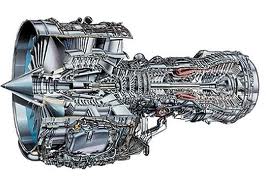
A Modern Jet Engine

A Modern Jet Engine

So back to my flight on Sunday. Between us, I and my family will produce about 12 metric tons of carbon dioxide in our time in the air. The average European produces about 10 a year, Americans more like 19 0r 20 and the average African about 0.3 tons per year.

Oh to put things in perspective the global average is 1.3 metric tons per year per person, and the 1.1 billion people who live on the continent of Africa produces about 7% of the emissions that the 0.6 billion population of North America produce.

So taken in terms of people and not percentages, flying is extremely polluting. But people are not going to stop flying. The aviation industry is ever expanding, even vegetables fly nowadays.

One way that aircraft engineers are trying to cut down on emissions is to design lighter and more fuel efficient engines. Weight is a big problem in flying, and it is our old friend 3D printing who might come to the rescue.

A company called CFM International, a joint venture between GE Aviation and the French company Snecma, has created the LEAP engine — an acronym for “leading edge aviation propulsion” that the company hopes reflects just how innovative the new aircraft component is. LEAP has many futuristic features, including a 3-D-printed nozzle, the part of the plane responsible for burning fuel.

3D printing allows engineers to produce objects in materials that either would be too expensive or impossible to make using conventional techniques, and they can use lightweight materials or ceramics as is the case with the new CFM engine to substitute heavy metal parts. Check out this article in CNN for details.

Over the last couple of weeks an aeroplane has made a trans America flight using solar power, and this is just part of its round the world trip. A whole new concept in low carbon emission flight, although currently a bit slow.

Another possibility is to use organic jet fuel. Although this may seem strange, as long ago as 2009 Air New Zealand conducted a test flight using an organic jet fuel mix that seemed to demonstrate a 60% cut in carbon emissions.

Here is a link to an article in the New York Times about aviation and carbon developments and some more data about carbon emissions in Africa if I have tickled your interest. And as always, I am all ears.

To Die for Science

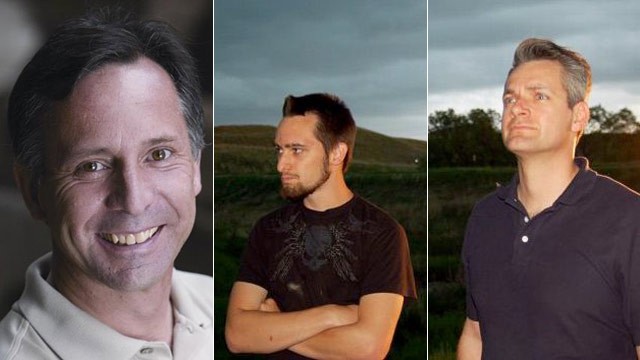
This week the weather has been pretty wild here in the USA, with dozens of people killed by tornados in the Oklahoma area. One of those killed is world renowned scientist Tim Samaras. He was killed alongside his son Paul and research assistant Carl Young as they were doing their rather dangerous job.

The Samaras Team

The Samaras Team, Tim, Paul and Carl Young

Samaras was a Severe Storms researcher, much of his funding coming from the National Geographic magazine. He might have just seemed like a storm geek to some, but his pioneering work has helped us to predict and understand these types of storms a lot better.

He and his team worked for decades on how to predict where and when tornados would form, so that they could race to the spot and leave their battery of measuring and photography equipment inside the storm.

They developed a probe that took measurements within the tornado itself, helping forecasters to determine where storms may form and to give warnings to people living in its path. The new generation of this probe measures pressure drops within tornadoes, the very cause of the high winds that characterize these storms, alongside other data that can be used to determine the destructive capability of the storm.

The team has also pioneered storm photography, devising a high speed series of cameras that can take pictures from different angles inside the storm. His photography work around lightening has helped to push scientific understanding of the phenomena.

These were not some reckless guys driving around looking for danger as some might think, Samaras was a scientist, a meteorologist, an adventurer and an engineer. His team were experts in their field, highly educated and determined, and they will be sadly missed within their community.

Their approach seems to hark back to a day of science pioneers, Marie Curie dying of radiation sickness through her work on radiation therapy, or Jean-Francois De Rozier, the first ever air crash death as his balloon crashed to the ground in 1783.

The fruits of their research live on today though, as will those of Samaras and his team.

For more information about their work look up their TWISTEX Facebook page.