Why Is Cloud Computing So Important?

Cloud computing has a lot of hype surrounding it. More than a few observers have wondered what is so important about this new internet phenomenon. The truth is cloud computing is leading to a rethinking of the internet’s capability. Cloud computing promises to completely delocalise computing power and technology. Users will be able to access and manipulate files, images, videos and other data remotely. Cloud computing promises the ability to keep networks and mobile devices synchronised at all times.

Infrastructure

A bank of sophisticated computers host operating systems and data for hundreds, if not thousands, of customers. internet search engine giant Google pioneered the use of data centers to store clients’ personal data safely. The same principle is being extended to cloud computing. Huge data centers will act as remote desktop computers. These centers will be able to store every file a user would need. All the user needs is a counterpart machine that can be as small as a conventional laptop with much less weight. These so-called “netbooks” serve only to connect the user to the internet so he can access his files.
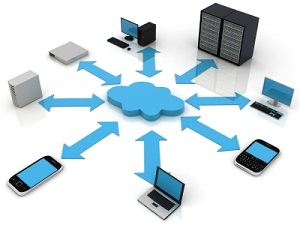
A cloud computing network

An example of how cloud computing works – every device synchronises with the cloud, meaning that your data can be accessed anywhere!

A single data center can offer multiple services and applications. Theoretically, a cloud computing system could perform almost any function or task the user desires. In a typical system, each application will have its own dedicated server combined with multiple iterations to create redundancy and prevent sudden malfunctions. The whole center is managed by a central server that constantly monitors the traffic and load volumes. Balancing the differences between machines, it seeks to maintain the harmony of the system and prevent crashes.

Business Advantages

The advent of cloud computing is actually forcing businesses to change their strategies. Previously, hiring a new employee meant providing him with a desk, computer equipment and various other hardware or software. Cloud computing allows them to reduce these capital expenditures significantly. Now all an employee needs is a computer with an internet connection to access his work data. Desks and office equipment may still be necessary, but the investment in computer hardware can be outsourced to cloud computing companies.

The hardware and software demands on the business’s side decrease dramatically. Labor costs per individual employees go down, enabling a company to hire more workers. Productivity increases, raising the efficiency and profits of the business.

Concerns

The primary reason why cloud computing is getting so much attention is its effect on business strategies. The sheer cost pressure alone is forcing industry after industry to adapt to the new reality. The advantages notwithstanding, several valid concerns about cloud computing exist, namely having to do with privacy and security.

Business owners and executives may hesitate to turn over their sensitive data to a third-party system with good reason. Losing access to their own data or having it compromised is unacceptable in a ruthlessly competitive private sector. One major argument against this fear is the fact that cloud computing companies survive based on their reputations. This gives them a huge incentive not to lose their clients data or compromise accessibility. Despite the power of this incentive, regulations may still be required to ensure safety.

As for privacy, the obvious concern is the connection between the user’s computer and the cloud system. Privacy could easily be compromised by unscrupulous individuals who could access personal information like credit card numbers. A solution to this problem is to use authentication and encryption like regular secure connections.

These practical concerns are somewhat overshadowed by a number of philosophical and legal questions. For instance, who owns the data stored by the cloud computing system? While it is held in the client’s name, a case could conceivably be made that the cloud computing system is the actual owner and therefore has a right to it. These technicalities are still under debate, and no resolution has yet been achieved.

Conclusion

Cloud computing holds great promise for upending things as they are currently done in the business world. The practical effects on information technology jobs will likely be profound. These and other challenges must be met because cloud computing will continue to change the nature of the internet.


Which tablet works best for you?

With the holidays fast approaching, tech companies are readying new products to woo people looking for the latest hot item in the tech industry. Games consoles, flat screens, and smartphones have had their time in the sun as popular holiday purchases, but this year belongs to the tablet.

Apple dominated the tablet market last holiday season with the introduction of their revolutionary iPad, a wild success with consumers. Since then competitors have tried to emulate the magic of the iPad in an effort to cash in on the new tablet market, but to little avail: HP’s tablet failed to impress consumers, while Motorola’s Xoom tablet has struggled to establish a solid consumer base since its release in January.

But Apple now has two serious contenders to face in the tablet arena: Amazon’s Kindle Fire and Barnes & Noble’s Nook Tablet. Amazon and Barnes & Noble, are both wildly successful companies in their own right, are looking to transform the popularity of their digital reading devices into sleek, user-friendly tablets. Now that there are at least three viable tablets to choose from, it’s time to determine which would be the best buy for the holiday season.

Price

We can separate the tablets from each other right from the beginning by looking at their price ranges. The Apple iPad 2 starts at $499, while the Kindle Fire Starts at $199 and the Nook Tablet is priced at $249. Now the disparate prices may be enough to determine a consumer’s purchase; the $300 price gap between the Kindle Fire and iPad 2, for instance, will likely drive many consumers to choose the cheaper tablet.

An iPad 2

An iPad 2 showing off how ‘amazingly thin’ it is

But of course these tablets are priced according to their features. The Kindle Fire and Nook Tablet are much closer in price, and analysts expect that consumers will transfer their digital reader loyalties to the tablets — Kindle users will go to the Kindle Fire and Nook users will likely follow suit with the Nook Tablet. Both tablets will be optimal for digital reading, web browsing, and multimedia functions.

Part of Nook’s more expensive price tag can be attributed to the better hardware: the Nook Tablet has 1GB of RAM and 16GB of storage, compared to the 512MB of RAM and 8GB of storage on the Kindle Fire.

While the iPad 2 stands as the most expensive tablet on the market, it also boasts more attractive components than either other tablet. With a larger screen (9.7 inch), built-in 3G, and access to hundreds of thousands of apps from the Apple store, the iPad 2 certainly offers a host of features that would make any tablet competitor blush. Is it expensive? Yes. Do you get what you pay for? Yes.

Stand-Out Features

There are certainly stand-out features to consider with every tablet. The Kindle Fire may not have the hardware on par with the other two tablets, it will have optimized internet usage through Amazon’s cloud service based browser, Silk. In theory Silk will allow the user to perform multiple functions online at once without overburdening the tablet because part of the computing power will be done via Amazon’s cloud system. The Kindle Fire also has the Amazon name in its favor, one of the most trusted names in online retail.

The Nook Tablet has the distinct advantage of being sold at brick and mortar Barnes & Noble stores. A consumer can walk into a store and purchase a Nook Tablet on a whim, something that the Kindle Fire simply can’t compare to.

Barnes & Noble have also hinted at creating spaces similar to Apple’s genius bar, built solely for the maintaining and assistance for all things Nook related. If there’s any credence to that rumor, it could help jettison the Nook Tablet to the top of the market.

As for the iPad 2, its standout feature is simple: it’s an Apple product. The brand loyalty alone has driven millions to purchase the tablet, regardless of the high price tag. But it remains to be seen if Apple will continue to charm potential tablet users in the face of these newly minted tablets from its competitors.

Broadband speeds – are you getting what you pay for?

The comparison site uSwitch recently did a study into UK broadband speeds, and found that during peak times, internet speeds were on average 35% lower, than in off peak times.

The research was based on two million download tests, concluded that during peak surfing times, which are between 7 and 9 in the evening, speeds were the slowest than at any other time of the day. If you want super fast speeds, it is recommended that you go on between 2 and 3 in the morning.


The time differences were more/less extreme, depending on the region of the country. The average broadband speed in the UK is 6.2mbps at peak times and 9.6mbps in the early hours of the morning. However, this is much more extreme for some regions. For example, the difference in Weston-super-Mare was 64%! At off-peak speeds were around 9.5mbps, whilst at peak times they were just 3.4mbps, a massive difference.

Wadebridge, (Cornwall) saw a 48% difference in speeds, with an average of 4.1mbps at off-peak times and just 2.1mbps during peak times.

Broadband is becoming ever more important in our digital, globalised world, and such variation is seen as unacceptable by many in modern times. Broadband is very important for business, as well as luxuries, such as on-demand TV, and even potentially internet TVs.

Global broadband connections map

A connected world - super fast broadband, brought about by fiber optic connections has revolutionised telecommunications

Ofcom says that on average, UK consumers download around 17 gigabytes of data every month using their home connection. That is a fair amount, and to put the speed differences into context, were this all to be downloaded at off-peak times in Weston-super-Mare, it would take around 4 hours to download that data at off peak times, however it would take around 13 hours to download at peak times, a staggering difference!

Critics have said that consumers are being misled by the maximum speeds that internet service provides love to advertise, even though it is rare that anyone should ever get them. Because of this, as of April 2012, the Committee of Advertising Practice (CAP) will no longer allow firms to advertise maximum speeds unless at lease 10% of their users receive them.

For more information check out this article: Broadband speeds fall 35% at peak times.

This article is about the UK, but I am sure that it is the same all over the world.

What do you think, is this fair, or are we, the consumer, getting ripped off?

If Velcro wasn’t a rip off, broadband certainly is! Sorry, I couldn’t help it 😉