Leap seconds

2012 was a leap year, 2016 will be too, as will 2020 – you get the picture.

Every four years, the Gregorian calendar observers what is known as a leap year, a year with one day extra than the previous three years, or than the next three. This is because the solar year (how long it takes the earth to complete an entire orbit of the sun) is almost 6 hours longer than the standard 365 days calendar year.

Solar vs Gregorian Time

There is however a small issue with leap years. The original rule of adding a leap day every fourth year ever so slightly overcompensates for the time difference, as the solar year is 365.2422 days long. With leap years the average year has 365.25 days, which is 0.0078 days too many! Also, our planets spin is slightly irregular, meaning that some [solar] days are slightly longer [as in milliseconds!] than others, whilst others are slightly shorter.

TimeYou might think that there really isn’t any point in worrying about 0.0078 days, as it would take over 128 years before all those tiny bits of days added up to make an entire day. However if we ignored the 0.0078 days, in 23,376 years we would have lost so much time, the seasons would have completely reversed, as there would be a huge 6 months of time distortion!

To solve the problem, clever scientists have worked out that if we miss out three leap days (omitting three leap years) every 400 years, then the average calendar year becomes 365.2425 days long. However this still leaves a 0.0003 day (or 25.92 second) difference each 400 year cycle – 0.0648 seconds every year. A relatively insignificant amount, but all the same, we want to be accurate, so a solution has been found!

Leap Seconds

Every so often we also get a leap second. Due to the irregularity of the movement of the earth, it is impossible to construct a precise schedule for these seconds.

23:59:60 - a leap secondLeap seconds are added in as and when they are needed, so the Gregorian measure of time should never be more than one second out of sync with the measure of time linked to the earth’s orbit.

Sometimes leap seconds are positive, meaning they add to time, and they can also [in theory] be negative.

Leap seconds are usually added to the end of the day, at the end of a year, or half year period. The most recent leap second was on July the 30th 2012, where one second was added to time, so it didn’t become the 1st of June the second after 23:59:59, it instead became 23:59:60.

Problems With Leap Seconds

Leap seconds are brilliant from a scientific perspective, as they help to keep time and the environment in almost perfect constant sync, year after year. However from a technical perspective, they pose some huge problems!

Remember the huge fuss about the Millennium bug, the problems the turn of the century was [thought] to cause and the money that was thrown at it? Ultimately, nothing major happened. Leap seconds pose a similar sort of technological issue, but the threat much more real.

The most recent leap second, caused major technical issues for firms all around the world. Just before the leap second, there was a solar storm, which disrupted technology, especially websites, needless to say this didn’t help the leap second scenario in the slightest!

One of the most high profile victims of the June 2012 leap second was social network Reddit. Due to the nature of its activates Reddit relies heavily on synchronised operations, as do Foursquare, LinkedIn, Gawker, and StumbleUpon, who were all also affected. When the time on the servers of these services was thrown out of sync by one second with the time Apache Cassandra and Java were displaying, their technical systems went into meltdown!

After a few hours, most of the technical blackout was over, and the majority of services were back up and running.

Six months notice is given prior to a leap second, and for many firms they are not a problem. Measures do need to be put in place, however if they are, there are [usually] no issues.

Should We Abolish The Leap Second?

From a scientific perspective, the leap second is a fantastic idea; it keeps time perfectly synchronised. However from a technical perspective it is a bit of a costly annoyance.

In January 2012, there was a meeting by the ITU, who discussed whether or not to drop the leap second. We could just ignore these time adjustments altogether, or we could add a leap hour every few hundred years. Despite hopes, the ITU were unable to reach a consensus, so have put off making a decision until 2015 – at the earliest.

Careers in the ICT Industry

A lot of University students will be turning their attentions to their long-term futures over the coming months with millions graduating from their courses this summer. As a result the demand for jobs is likely to increase and, as we all know too well, the number of positions available is far outweighed by the number of applicants.

This can cause many job seekers to get disheartened and end up working in fields that have no use for their skills or abilities. The whole three years at Uni can seem like a complete waste of time, while the debt continues to rise making you even more frustrated!

For those completing computer or media-related courses, the opportunities are always on the rise, with more and more brands looking to move into the online space and with those that are there already trying to expand wherever possible. Traditional newspapers and magazines are moving into digital sectors and many companies and brands are looking to develop their existing websites or to create new ones that will help them to grow their brand identity.

This means that even if you had your sights set on a career in PR or journalism, for example, you could be presented with a series of opportunities that are not exactly what you may have wanted or what you had considered previously but could suit you to a T. For instance:

Web Design

You might have been the sort of person who loved coming up with innovative designs and you spent every spare few minutes you had doodling on pieces of scrap paper to stay entertained and develop your skills. The graphic design industry is one that’s difficult to get into, but web design is a sector that is growing rapidly.

As the demand for game-changing websites continues to grow, more and more creative people are needed. If you have knowledge of how websites work as another string to your bow, you might find your true calling in web design.

SEO

Google SEO Ranking Chart

SEO is a rapidly growing industry, and is now a major global employer.

Search engine optimisation has turned from a small acorn into a mighty oak in the past decade or so as a result of technology and websites developing. Site and company owners all want to reach the top of the search engine results for specific terms and phrases so that they get as much business as possible. The higher up the rankings you are, the more likely you are to be seen and that is their target.

To do this, you need experts who are capable of implementing a series of strategies to help find their way to the top. Anyone with knowledge of how sites work, meta descriptions, link building and other forms of “tech wizardry,” can get into SEO a growing and ever-evolving sector.

Touchscreen Problems (Zombie Finger)

iPad zombie finger - Touchscreen ProblemsOver the last couple of weeks I have flown from the USA to Britain, then to Italy, and back finally to the USA. I flew on some lovely new Airbus aircraft, but had a constantly recurring problem with the on-board entertainment systems.

The problem is that in the seat above me there is a fantastic touchscreen entertainments system, but my fingers do not work. My son who was sitting next to me has good fingers, he touches the volume section and can turn the sound up or down, but I cannot because the slider does not seem to recognize my body.

So it must be my screen I think, my son leans over and it works perfectly well for him. We swap places, now mine works for him but I still cannot change the volume, this time on a different machine.

It must be me I conclude, but why? Long ago I gave up using anything touchy for this reason. I try licking my hands, warming them up, cleaning the screen but I do not make any progress. So I started looking around the web for some answers to find that I am not the only one, hurrah. There is even a recognized name for the problem in some fields, Zombie Finger!

Touch screens operate in many different ways. At Walker Mobile you can download a free PDF that explains how the different technologies work, but the vast majority of application that we know use one of two approaches. They can be described as Resistive Touch and Projective Capacitance.

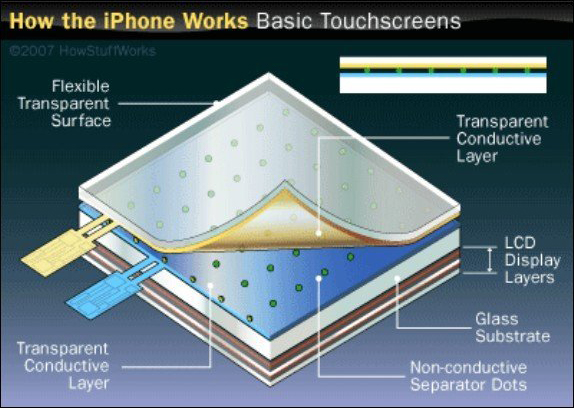
Resistive touch is old school analogue. Two surfaces are together, typically one of glass with a thin film over it. You push down on the film and it makes a circuit using a grid of electrical conductors. The system is cheap but being mechanical liable to damage and wear, and it is thick.

Projective Capacitance has no moving parts however, and some of its advantages mean that it is rapidly taking over the market. It is a system that works on capacitance, which is the thing that gives you a shock when you walk over a synthetic carpet and then touch the brass door handle in the hotel that you are staying in.

iPhone touch screen technology

How iPhone touch screens work.

Again there are two layers, both charged but to a different extent. When you touch the screen some of the charge is released into your finger, and this tiny change can be measured. And here lies a variable, because the nail will not carry a charge, gloves stop the action and so I wonder if even the state of the skin at the end of the fingers might effect usability. Do I type too much? No charge transfer means no volume.

For a fuller explanation of these 2 competing systems see this article, it is short but extremely informative. I would just like to know if anyone else has issues with touch screens, and if so if they have been able to address the issue in some way. As technology advances this interface is becoming the norm, and we wouldn’t want to leave people with particular skin types behind now, would we?