Nanofoods

This week I want to put two of my little pets together. Nanotechnology and food might sound like two very different topics, like a cat and a gerbil to use the pet metaphor, but you would be surprised. Many products in fact have manufactured nanoparticles in them, and we eat them.

Now we might ask if this is safe, and some would say of course it is. Some have great reservations about it, and some point to the fact that there has been little research done into the matter and that it might be better not to eat them anyway.

Friends of the Earth US have recently published a report entitled Tiny Ingredients, Big Risks, and it is free to download here.

To give you a flavour of what is on offer, I just take a few lines from the report:

A ten fold increase in unregulated and unlabeled nanofoods over the last 6 years

Nanomaterials are found in a broad aray of everyday food (cheese, chocolate, breakfast cereals etc)

Major food companies are investing billions in nanofood and packaging

An increasingly large body of peer reviewed evidence indicates that nanomaterials may harm human health and the environment

Nano agrochemicals are now being used on farms so entering the environment

US regulation is wholly inadequate

Public involvement in decision-making regarding these problems is necessary

The products containing unlabeled nano-ingredients range from Kraft American Singles to Hershey’s chocolate. They are made by major companies including Kraft (KRFT), General Mills (GIS), Hershey (HSY), Nestle (NSRGY), Mars, Unilever (UL), Smucker’s (SJM) and Albertsons. But due to a lack of labeling and disclosure, a far greater  number of food products with undisclosed nanomaterials are likely currently on the market.

To give you an idea we are talking about silver, titanium dioxide, zink and zink oxide, silicon and copper, as well as the traditional carbon nano tubes that are found in food packaging and freshness labelling technologies.

The report documents 85 food and beverage products on the market known to contain nanomaterials — including brand name products, and points out that the nanofood industry will soon be worth $20 billion.

This is a detailed report, it lists the products that have been found to contain these materials, the health problems associated with ingestion of such materials in animals and calls for action. It does not make for light reading, but it appears to me to be a technology that is being sneaked in through the back door, and soon like genetic modification will be difficult to avoid.

Take a look back at my food series for more tasty stuff.

I don’t speak Dutch (yet)

Dutch Humour

Ik spreek niet Netherlands.

This week I moved to the Netherlands after 3 years in the USA. It is not the first time I go to live in a country where the population speaks another language however. In 2000 I moved to Italy.

I must admit that I sometimes fail to see my own limitations. I was under the impression that after a year or so I would be able to speak Italian. It would just soak in through the skin, like osmosis, and come out in perfettamentally formed sentences.

Alas after a year I was just about able to order a cappuccino at the bar, so I had to ditch the osmosis strategy.

I enrolled in a school for foreigners wanting to learn Italian. 6 hours a week. I continued for 4 years, and became remarkably good. 3 years in the USA and my Italian is now a little rusty but I can still speak very well, and at least me English ain’t as pour as it were thanks to an American education.

So 3 days in and how is the Dutch learning plan unfolding you may ask. Well experience taught me something, because I tend to only make the same mistake about 50 or 60 times before I learn, so I am not going to try osmosis. I took some lessons in the US before coming, and I was going to enrol on a course.

That was until I discovered Skype and their new toy, the voice translator.

Now this technology may be still under development, but Microsoft CEO Satya Nadella and Gurdeep Pall (the vice president in charge of Skype), demonstrated the technology last week. Watch the video here. There is a demo and an explanation of how the technology learns, including a description of its brain like capacity to relate one language to another, improving both.

It’s quite an incredible demonstration. Until the end of the conversation when a couple of errors creep in to the translation I was sure it was all a fake. Given the fact that so many of us work via computer today, a reality that is sure to expand even more, I think this technology could be a real breakthrough.

Now early stages in technological development means a 15 year history in this case, far longer than my foray into foreign languages. And technology develops quickly, the translator may even be on the market by the end of the year. My brain is not so quick, I will still be on chapter 3 of the first book by the end of the year. And I am sure that within a year of its release the technology will become completely mobile, I will be able to buy a battery operated portable translator and wear it like a fake moustache under my Google Glasses, by next summer I will be fluent!

The development of this technology may however also have the downside that it might help people avoid learning another language, and lead to a reliance on technology that might then make face to face interaction more difficult. Also we may miss out on the great advantages that speaking more than one language brings to an individual, the respect that other people have for you if you learn their language, the ability to appreciate a wider perspective and even more importantly, understanding the Dutch sense of humour.

Telling History Digitally

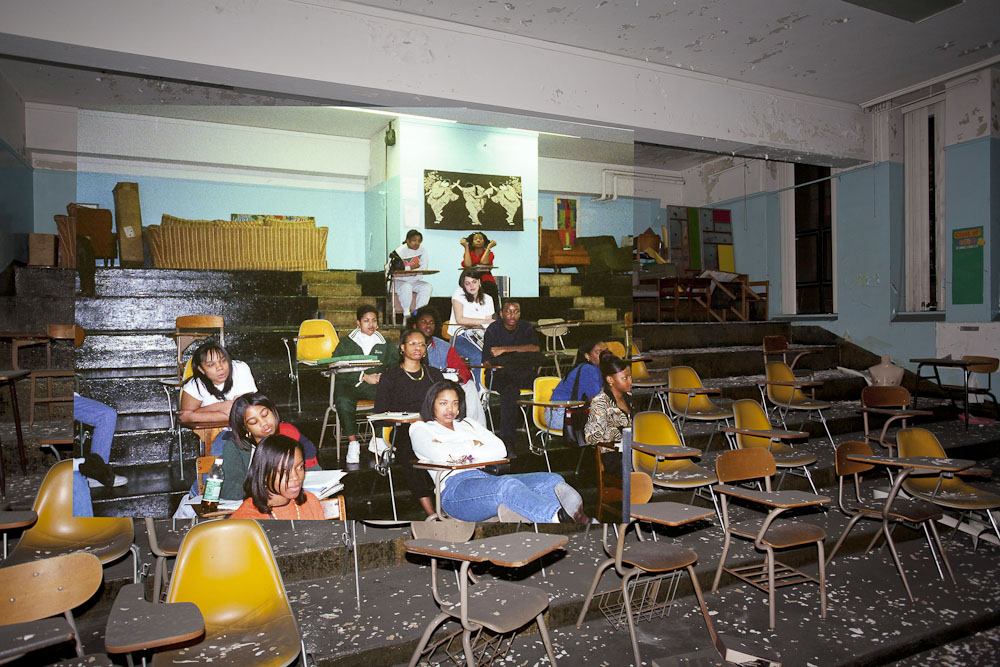
Photo by Detroiturbex.cm

Photo by Detroiturbex.com

Recently I have taken an interest in using digital means to recount history. The thing that has taken me most is the use of old photos that are either cut into or superimposed over new photos. The results really give an insight into the history of our modern urban landscape.

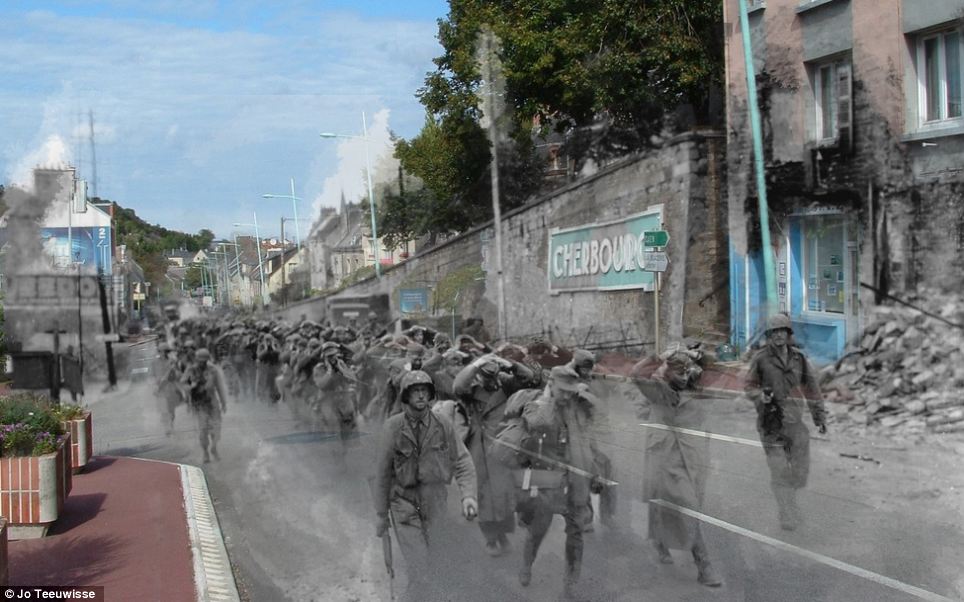
The Mail Online has a fantastic example of how photos from World War 2 can be superimposed upon photos of modern France, the effect really makes you think. This article has one of the original photos, the new photo and then one upon the other. So we see soldiers battling through the rubble of the town of Cherbourg in 1944, followed by the same shot taken today and then the two merged.

The obviously new addition of the cycle paths and modern signs  in some way makes the photos even more dramatic, as it brings to life the reality of how we live today with the ghost of war ever present.

Photo taken from the Mail Online

Photo taken from the Mail Online

There are 11 fully merged photos to follow, and they all tell their own story.

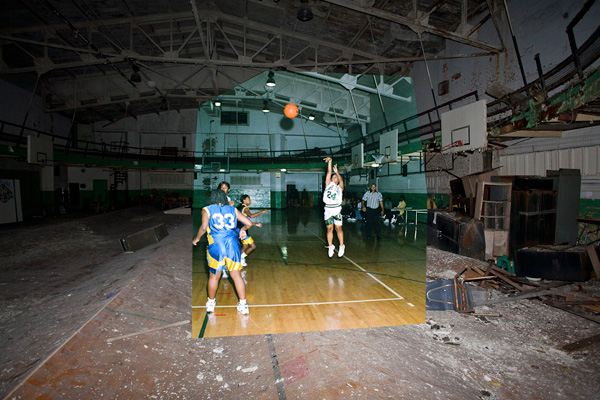
Another site that offers a wealth of photos and an incredible history lesson is called Detroiturbex. The opening photo above is taken from their website.  As we might imagine the project involves documenting the history of Detroit, and features photos of the city throughout its history, with a large section of connected, re-made and superimposed photos that recount the rise and fall of one of Americas largest industrial cities.

To give you an idea of what has happened to this great city in recent history, in 1950 it had almost 2 million inhabitants, but today only a third of that population remains. This means that more than 80,000 buildings lay derelict. The city has been declared bankrupt so there is no money to maintain any of the structures, and the results are there for all to see.

Basketball taken from the website

Basketball taken from the website

This is a big site, but a look at the index will guide you through a fantastic collection of photos, with the Now and Then section offering the matched and superimposed images. It is well worth a half hour to browse them all though, another reality of the American dream.

Flickr has a group called Looking into the Past that contains hundreds of images similar to those described above, which leads me to believe that it must be quite an easy thing to do. They certainly present an interesting historical perspective upon everyday modern life.

A quick search will find you plenty of others, including old postcards held over the original locations, very effective and absolutely DIY for those of us who like the analogue approach to life.