Reports from the INSS Sustainability Meeting

As readers might know this weekend I attended the Integrated Network for Social Sustainability (INSS) Meeting in Charlotte North Carolina. It was a great event, and I met a lot of great and interesting people, and over this week I would like to write a bit about them and what I learned.

The first is Adrienne Brown, a second year at Dickinson College in Carlisle Pennsylvania. She is currently participating in an application competition which involves answering a prompt with a two-hundred word essay and a two minute video. The organization orchestrating the web-based contest is the Arctic Climate Change Emerging Leaders Program Fellowship (ACCEL). This year they will be piloting an internship program with two positions, one in Washington DC and the other in Berlin, where the two student finalists will work on developing creative marketing strategies using media technologies.

The Arctic Today

The Arctic Today

Adrienne believes that there is a growing need to use technology to talk about important social issues, and as the popularity of social media platforms increase many social movements have started to use these technologies to market their cause to a particular audience. That audience tends to be young and motivated and therefore are a resource of human capital just waiting to be tapped.

To get the ACCEL internship students must gather public support for their essay and video responses. Essentially to demonstrate their ability to wield the powerful weapon of the internet to gain support and spread a particular message. Those who are stronger at encouraging people to act will theoretically get the most votes and present themselves as a good candidate for the position with the ACCEL. Once the public voting ends on April 13th the students who have collected the top ten amount of votes will move to the final round and submit a resume during an interview.

Adrienne feels strongly that the environmental field has not done enough with web-based marketing and is really excited for the opportunity to work on developing a public relations strategy for Arctic environmental issues. At the INSS conference she presented her video response and asked the network’s members to vote for her. Take a look at her essay and video and if you like the ideas presented follow the links and vote for her, and check out the other participants.

I will tell more stories about the event and people involved as the week goes on.
Integrated Network for Social Sustainability

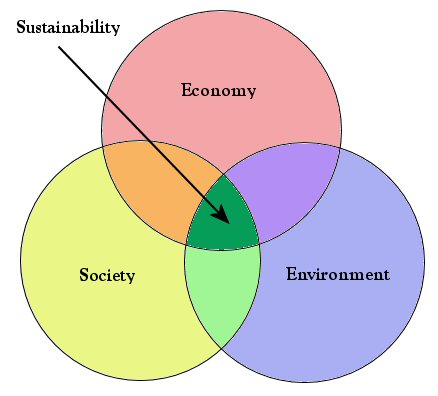
This weekend I am going to the Integrated Network for Social Sustainability Annual Meeting in Charlotte, USA, where I will present a poster co-produced with anthropologist Cristina Grasseni. The poster title is Food Sovereignty and Social Sustainability Through Solidarity Economy Networks, and it fits into a meeting whose focus is to prioritize challenges for social sustainability.

A possible sustainability diagram?

A possible sustainability diagram?

Our poster presents work-in-progress insights into solidarity economies. We are looking at provisioning activism, or different ways people go about sourcing and buying the products they need in their daily lives. If you read my food series you might have seen references to this work, particularly the review of Cristina’s book about Italian food provisioning networks.

Through the poster I will be talking about groups of people who get together and form collectives or food coops, or run urban community gardens or community-supported agriculture. Other projects also include the development of small workers’ cooperatives with ambitious plans to create “green” jobs for marginalized youth in post-industrial wastelands.

These groups are organizing themselves in an attempt to replace supply chain consumerism in many fields with locally controlled networks. Although it was initially limited to food, “provisioning activism” increasingly focuses on clothing, IT, renewable energy, green construction, recycling, mutual insurance, cooperative credit and local currency exchange.

Here in Massachusetts for example we have the town of Worcester that acts as an informal focus point for groups that produce and distribute food, invest in locally owned and produced solar energy and are constructing a bio-fuel plant where they can produce bio-diesel from used vegetable oil collected from local restaurants.

There are other examples in the energy sector, take a look at this post I wrote years ago about a similar plant that opened in the UK. Sundance Renewables is the name.

And this is not just a fringe market. The main energy coop in Worcester takes $1.3 million a year in income, while in Italy a loose network of solidarity buying groups spends about 80 million Euro per annum, mainly on locally produced food.

The meeting also includes a tour of Charlotte’s renewable energy manufacturing base, so I should discover a lot more about this sector of the economy across the USA. I will report back next week.

Changes to our writing structure

Change happens. Often change is neither good or bad, it’s just different.

Technology Bloggers logo (2.0)Here comes some good change.

When I founded Technology Bloggers almost three years ago, the idea was meant to be a blog that was built by a community of people. We did have a good diverse mix of writers, however over time quality started to dip and many writers only wrote one post – which was not the aim. As you may have noticed, it is only really myself and Jonny who post now, as bringing new talent through takes such a long time.

One of the advantages I have now is that I understand blogging a lot better, and this has helped me to step back and look at the system we have to see if it is working. It isn’t. We are getting too many applications and it is becoming hard to keep up with them all. Also, many of the applications are not what we are looking for.

Changes

Today the whole writer landscape changes. We do away with the old system of contributors, authors, editors and admins and move to a new system of guest bloggers, authors and editors. The old Write For Us page has been updated to reflect the changes, and is now called Join Us. Head over there for details on each of the new roles and how to apply.

In brief, guest bloggers are those who write one-off, special posts for the blog. They are already well respected individuals in their field and will only be posting occasionally.

Authors post more frequently and are a more visible part of the community in the long-term. Editors are those who post very regularly and also have additional responsibilities.

Everyone who has recently applied to become a contributor will soon be sent an email informing them of our new structure and asking them to check out our new structure if they want to apply. All current authors and contributors will also be contacted to let them know what we are doing.

Our cluttered Our Writers page has gone, and it has been replaced with a new page to reflect the changes. Here you will be able to find out much more about who writes for us than you could before.

Jonny Hankins Profile

Jonny’s old profile (top) and his new profile (bottom) on our new Our Writers page.

I have more (exciting) changes planned for the very near future, however I would like to know your thoughts too.

Do you feel these new changes are fair and will take us in the direction we need to go? Do you have any more suggestions or comments on anything related to the blog?

Thank you for your time, over and out.