Nanotechnology Regulation

Nanotechnology applications chart

Last week I did not post as I was preparing to chair a session at a plenary for the European Commission in Brussels. Full details are available here, but today I would like to pose a few issues that were raised during the event.

This is not the first time I have spoken at conferences about nanotechnology regulation, nor is it my first Technology bloggers post on the matter. Readers might like to take a look at these posts going back to 2012.

But as an overview my interest is in regulation. And the problems raised 3 years ago are ever more pressing. Nano products are everywhere (see the diagram above, and that is old), they do not have to be labeled, and there are still questions about health and regulation that have never been answered.

Last week’s topic was the Responsible Nano Code, a document drawn up to offer guidance to nanotechnology producers as a guide. It is voluntary, has no legal standing (I will come on to that though) and is a set of principles rather than a regulatory code.

The code can be freely downloaded here.

The principles address issues such as Director Board accountability and involvement, stakeholder involvement, worker health and safety, public health, safety and environmental risks, wider social, health, environmental and ethical implications and impacts, engaging with business partners and transparency and disclosure. And if you read the code you find nothing that anyone wouldn’t agree with.

The preparation was a serious endeavour too, it took several years to come to its final draft, and involved a lot of people. Founders included the Royal Society, Nanotechnologies Industries Association, Nanotechnology Knowledge Transfer Network and Insight Investment.

Upon completion the code was presented across the world. In the USA however several problems were seen due to the nature of the law there. One problem is the risk of being sued. If a company states that they follow a code they become liable to legal action if someone can demonstrate that they did not in fact follow some aspect of the code. So companies are reluctant to state that they follow a code unless it is mandatory.

Also if a code is followed by a group of companies, it becomes the benchmark, so all companies are then judged according to that code, even if they do not participate. So implementation carries some really serious consequences.

In the US, nanomaterials are regulated in the same way as any other materials, and not specifically as nano, which to some seems problematic. Health issues have been raised (see my first nano post through the link above) and never resolved. And we must bear in mind that we are talking about hundreds of thousands of products in all sectors. In order to follow through on the pledges in the code, producers would have to educate and look after not only their own workers, but anyone who deals with these products throughout their entire lifespan. This includes, transport workers, salespeople, shopkeepers, waste collectors and disposal workers, end users, the list goes on.

And if there is a need for regulation, who is going to write it? I can’t write it, so do we need an expert? But can we get a nanotechnology expert who is probably positive about the undoubted advantages of pursuing a technology to write the regulations? Will they be balanced? Or should we ask a member of Greenpeace, or anyone else who might hold serious doubts about the processes and politics involved?

These are open questions, and although I cannot myself offer any answers it is something that we can and should all discuss. And it makes for an interesting line of work!

The cost of sending a Samsung emoji

A few months ago, my Galaxy S4 Mini (click this link to go to my series about it) updated to Android KitKat – from Jelly Bean. KitKat was released in 2013, but because Samsung like to fiddle with Android before they roll it out to users – or as I now like to say, apply their Disney layer – kudos to David – it takes a while for their handsets to get the updates.

Apart from a few minor interface changes – some good and some not so good – I didn’t really notice much of a difference with the KitKat upgrade. Some of my icons changed colour, my screen mirroring functionality seemed to stop working and GPS got renamed Location. There were a few other changes but at this moment they escape me.

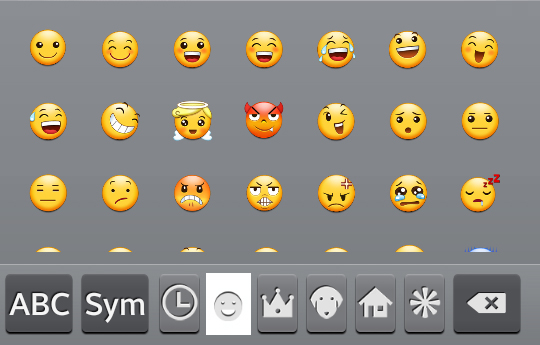
Oh and how could I forget, that annoying emoji/emoticon button! KitKat added a terribly annoying button to my keyboard, a smiling face, which whenever you accidentally click on it, becomes the default extras button; that’s the lovely little button next to the space key that gives you the option of voice typing, pasting, visiting settings, and now also adding an emoji.

Samsung emoji keyboard

The emoji on my Samsung Galaxy S4 Mini keyboard

Now I’m not against emoji, some of them are pretty cool… 🙂

…what I am against is Samsung emoji. The super-duper Samsung upgrade to KitKat may have enabled me to send emoji – yay! – but it came at a cost: MMS. If I want to send an emoji, Samsung very kindly converts my text message (an SMS) into an MMS.

This isn’t a problem if you get a large number of MMS messages included in your contract, but most people (at least here in the UK) don’t. I’m not someone who does either, so when I tried to send a message (no bigger than one standard text message) with an emoji in it, I got charged 33 pence by my provider and worst of all the recipient was unable to receive MMS messages, so they didn’t even get to see my 33p text!

The BBC and Money Saving Expert are just two sites that have recently been warning consumers of the hidden costs linked to emoji usage.

Cue Textra.

Textra SMS

iPhone owners don’t suffer the same fate as I did, because Apple’s default messaging application doesn’t treat emotion icons as images. They may take up more than one character, but you can use them in SMS messages. Not wanting to be outdone, I went on the hunt for a better SMS app.

First I tried Google Hangouts. I have never got along very well with Hangouts, but when I started using it for text messages, I didn’t find it quite so bad. I could send emoji as text messages, and I could type as many characters I liked and it would just send multiple SMS messages; Samsung’s default messaging app converts messages larger than three texts into MMS messages too.

After a week or so, Hangouts’ lack of features and general design started to get on my nerves, so I was out on the hunt again for another alternative. After reviewing a handful of very viable alternatives, I decided to give Textra SMS a try.

Textra SMS quick reply

When you get a new text, Textra SMS enables you to reply quickly, without opening the full app.

To put it simple, Textra is fantastic. You can do pretty much everything you can with Samsung’s standard messaging app, and more. You can customise the look and feel, you can send as may characters as you like without it converting into an MMS, and you can send emoji!

One of the awesome features that got me hooked on Textra is the message preview. Say you are browsing the web and you get a text. Texra has the option of a notification which appears at the top of your screen; the notification is basically a message preview. If you ignore it, it disappears after a few seconds, but if you click on it and it opens a small version of the app over the top of whatever you were doing previously. You can type a reply and then as soon as you click send, it disappears and you are back to what you were doing.

If you are looking for an alternative texting app for Android, I would definitely recommend Textra.

Bacteria, Fungus and Decomposition (and growing new materials)

Maurizio

Bacteria, fungus and decomposition.

Doesn’t sound like a great start for a technology blog. But last week I was fortunate to visit a lab in Utrecht University where rather unsurprisingly I learned a lot about decomposition, fungus and how to grow innovative new materials.

A young Italian designer runs the lab, this is him above, working on the border between art and biology. His name is Maurizio Montalti, founder of the “Officina Corpuscoli” in Amsterdam (2010), whose goal is not only to produce beautiful artifacts, but to stimulate thought about the central aspects of design (above all the use of materials) and to provoke questions about much more. The nature of humans (the relationship between life and death) or the nature of progress and its relationship to the world and its ecosystem.

Materials

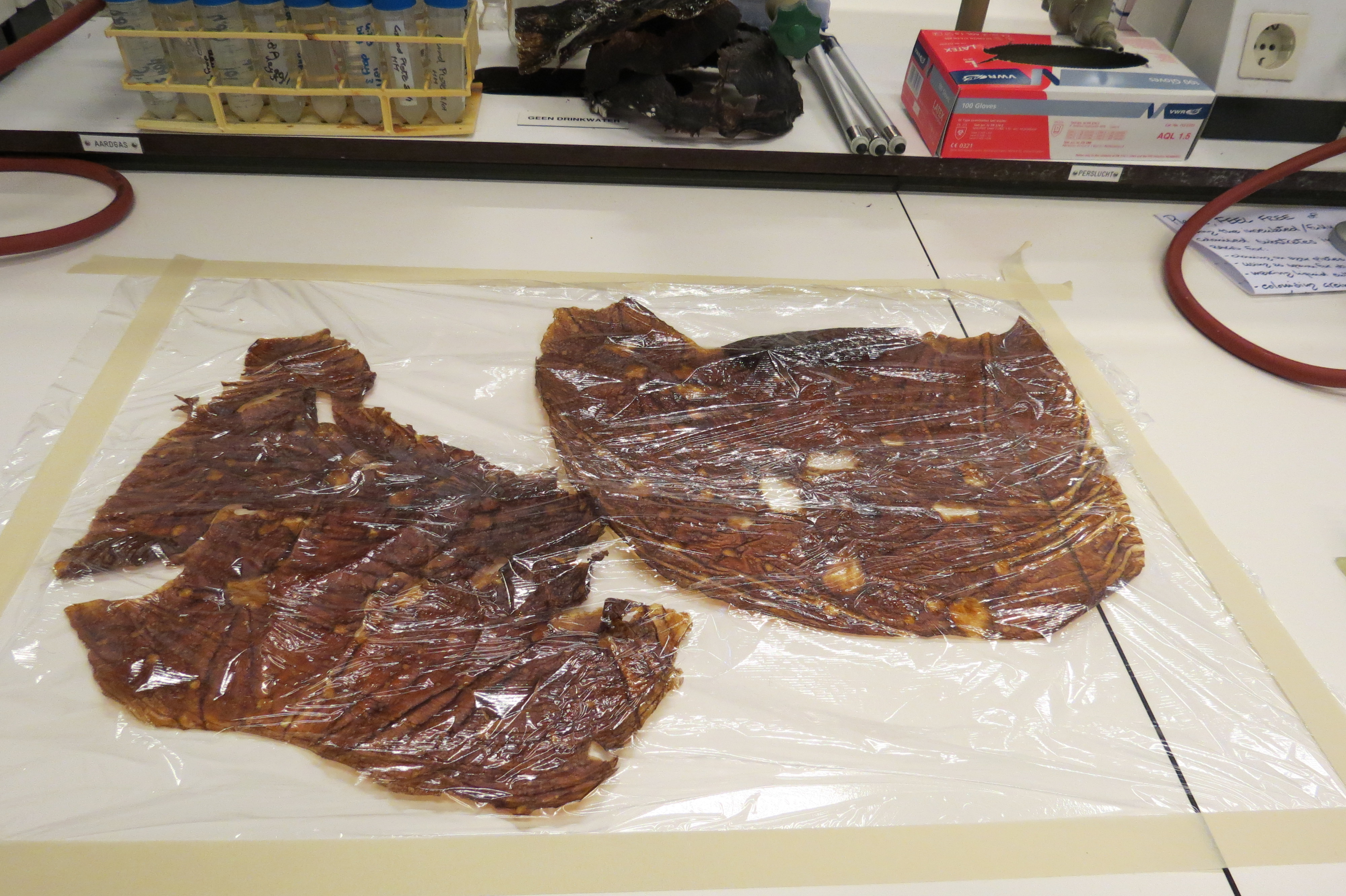
The lab is the point of departure. Here he showed me different materials with different properties, all grown from fungi. Some is like plastic, can be transparent and in sheet form, and others look and feel a bit like skin, some looks like polystyrene.

Grown Pellet

A Grown Pellet

The choice of materials is central to the idea of the project. The materials that are currently favoured in design such as plastic, foam and metals, are produced using industrial processes that are detrimental to the environment. Maurizio wanted to raise this issue for discussion, and so he began his fungus interest.

For the designer the beauty and fascination for fungus lies in its role in nature. He told me that fungi are everywhere, in the soil and in the air, but we associate them with revulsion, disgust and danger, and we minimize their importance, whereas in fact they are fundamental for decomposition, transformation and recycling. He is interested in its role as re-cycler of biological materials.

Synthetic Biology

And the holy grail: the System Synthetics project, turning plastic waste into energy. Maurizio was interested in crossing fungal capacities to degrade with that of yeast Saccharomyces cerevisiae, forcing them into symbiosos, to create a microorganism able to decompose plastic materials and give back energy in liquid form (bioethonol produced by the yeast). It is a synthetic biology program whose objective is to provoke questions about the potentials and implications for this discipline (very much a work in progress, whose aim is to involve a wider public in the synthetic biology debate).

other forms

other forms

I would like to add that Maurizio is part of an informal network of “fungicites”, here find an article of a start up in the USA that is producing bricks from bacteria, cutting out the clay and baking process and making it a much more sustainable product.

Read more about Maurizio here, including photos and an interview.