Situation SHUFFLE – iPhone App Review

Today, I am going to introduce you all to a gaming app thats both fun to play and needs brains! Yup, I recently came across this app, Situation SHUFFLE, in the iTunes store while strolling around as usual and to be honest the puzzles in this game will make you scratch your heads but won’t bore you.

Situation SHUFFLE iPhone app

The Situation SHUFFLE app comes with a big collection of mind-challenging puzzles that focus on reasoning and strategy representing real life situations. To pass these puzzles, you need a keen sense of problem solving skills and a little bit of attention to detail which makes sure your brain gets a complete workout. To start with, the puzzles seem like child’s play, but they need your complete attention and concentration to crack them.

The app has 30 IQ puzzles, 30 extra quizzes and 6 hidden SHUFFLE quizzes. As and when you complete an IQ puzzle you can take up the corresponding extra quiz. Each IQ puzzle consists of 6 slides representing common events and occurrences like a trip to an amusement park, a busy day at work, a birthday celebration, a scene in an elevator etc. The slides have to be arranged in the right sequence and have striking graphics and you get 4 hints for each puzzle. You can zoom into the slides to compare them and make a mental note of minute details. The details may be really subtle at times, but that could make all the difference.
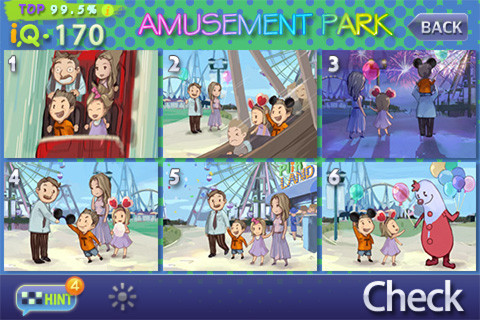
Situation SHUFFLE iPhone app
Once you have arranged the slides in order, you can submit your puzzle by pressing on the Check option. Your scores are calculated based on factors such as the number of hints you’ve used, the number of times you check whether your answer is right etc.
The extra bonus puzzles that come with the app are also of the same type but are a tidbit easier to solve.

The 30 SHUFFLE puzzles get unlocked based on conditions like, the number of IQ & extra puzzles you’ve cleared and your score. These puzzles are quite challenging and your IQ points are determined by the number of combos you score.

The UI of the app is pretty cool and the graphics are pleasant. Moreover, the app is simple to use and you can get started immediately playing the puzzles. But it would have been good if the tutorial had a better video like demonstration for users to easily grasp how the app works. Though there is one present, its just too slow and lacks details.

Also, there is no information as to if additional puzzles will be added. I was hooked on to this game for about a full day and managed to complete almost 75 percent of the puzzles. I think its just wait and see. But if new puzzles are added for additional cots or even if the developers could offer in-app purchases, I will be buying them for sure.

Go try this app and share your feedback in the comments below. The Situation SHUFFLE app is available in the iTunes store for 99 cents.


Daily Deal Market Ripe For Consolidation

According to Yipit, there are 384 daily deal websites operating in North America that it knows about. This number is almost certainly far higher once you consider all the smaller sites that are not able to run deals each and every day.

So is the market too saturated? Is the industry doomed to fail because there are too many competitors competing for an ever shrinking supply of customers?

In 1876 Alexander Graham Bell demonstrated the telephone and one of the biggest communications companies of the time immediately dismissed it with the famous quote:

“This ‘telephone’ has too many shortcomings to be seriously considered as a means of communication. The device is inherently of no value to us.”

That company was Western Union and the lack of foresight for this new technology meant they were never able to compete in the profitable telecommunications industry – an industry which they had previously dominated with their telegram service.

Between 1894 and 1904 over six thousand telephone companies went in to business and from there mergers, acquisitions and closures happened to consolidate the industry to just a handful of companies today.

In 1939 there were 132 railroads in America, today that number is just seven as mergers, acquisitions and closures meant huge consolidation in that industry.

An early 1900's American train

The sort of train that powered America in the early 1900’s

In 2005 there were a huge number of social networks available, Myspace, Orkut, Bebo, Friendster and Classmates to name but a few. Today? We have one site, Facebook as the market consolidated.

In 2007 there was just one daily deal website worth mentioning which was Woot, a hugely popular and profitable website that continues to grow and increase its revenues. After the launch of Groupon it spawned off thousands of clones around the world, over 400 of them in American alone.

Since 2009 there have been 72 acquisitions in the daily deal industry, 44 coming in the last 6 months alone. Groupon have gone for an expansion by acquisition business model with at least 8 buys under its belt, Google too is eyeing up the industry with several acquisitions in the daily deal market to expand its Google Offers programme.

There are plenty of other acquisitions too, LivingSocial have bought at least seven daily deal sites and BuyWithMe have purchased 6 daily deal sites before they too have been purchased.

So just like other new inventions and markets spawned hundreds of clones, it might look like the daily deal market is in decline as the number of sites decreases but there is still a very healthy merger and acquisition process taking place as the deal market looks to consolidate and become profitable.

Why Is Cloud Computing So Important?

Cloud computing has a lot of hype surrounding it. More than a few observers have wondered what is so important about this new internet phenomenon. The truth is cloud computing is leading to a rethinking of the internet’s capability. Cloud computing promises to completely delocalise computing power and technology. Users will be able to access and manipulate files, images, videos and other data remotely. Cloud computing promises the ability to keep networks and mobile devices synchronised at all times.

Infrastructure

A bank of sophisticated computers host operating systems and data for hundreds, if not thousands, of customers. internet search engine giant Google pioneered the use of data centers to store clients’ personal data safely. The same principle is being extended to cloud computing. Huge data centers will act as remote desktop computers. These centers will be able to store every file a user would need. All the user needs is a counterpart machine that can be as small as a conventional laptop with much less weight. These so-called “netbooks” serve only to connect the user to the internet so he can access his files.

A cloud computing network

An example of how cloud computing works – every device synchronises with the cloud, meaning that your data can be accessed anywhere!

A single data center can offer multiple services and applications. Theoretically, a cloud computing system could perform almost any function or task the user desires. In a typical system, each application will have its own dedicated server combined with multiple iterations to create redundancy and prevent sudden malfunctions. The whole center is managed by a central server that constantly monitors the traffic and load volumes. Balancing the differences between machines, it seeks to maintain the harmony of the system and prevent crashes.

Business Advantages

The advent of cloud computing is actually forcing businesses to change their strategies. Previously, hiring a new employee meant providing him with a desk, computer equipment and various other hardware or software. Cloud computing allows them to reduce these capital expenditures significantly. Now all an employee needs is a computer with an internet connection to access his work data. Desks and office equipment may still be necessary, but the investment in computer hardware can be outsourced to cloud computing companies.

The hardware and software demands on the business’s side decrease dramatically. Labor costs per individual employees go down, enabling a company to hire more workers. Productivity increases, raising the efficiency and profits of the business.

Concerns

The primary reason why cloud computing is getting so much attention is its effect on business strategies. The sheer cost pressure alone is forcing industry after industry to adapt to the new reality. The advantages notwithstanding, several valid concerns about cloud computing exist, namely having to do with privacy and security.

Business owners and executives may hesitate to turn over their sensitive data to a third-party system with good reason. Losing access to their own data or having it compromised is unacceptable in a ruthlessly competitive private sector. One major argument against this fear is the fact that cloud computing companies survive based on their reputations. This gives them a huge incentive not to lose their clients data or compromise accessibility. Despite the power of this incentive, regulations may still be required to ensure safety.

As for privacy, the obvious concern is the connection between the user’s computer and the cloud system. Privacy could easily be compromised by unscrupulous individuals who could access personal information like credit card numbers. A solution to this problem is to use authentication and encryption like regular secure connections.

These practical concerns are somewhat overshadowed by a number of philosophical and legal questions. For instance, who owns the data stored by the cloud computing system? While it is held in the client’s name, a case could conceivably be made that the cloud computing system is the actual owner and therefore has a right to it. These technicalities are still under debate, and no resolution has yet been achieved.

Conclusion

Cloud computing holds great promise for upending things as they are currently done in the business world. The practical effects on information technology jobs will likely be profound. These and other challenges must be met because cloud computing will continue to change the nature of the internet.