Are user generated reviews reliable?

The current March to April issue of National Geographic Traveler magazine has an article about user generated reviews that raises some interesting issues. I looked at the commercial invasion of the blogging world in one of my previous posts, but here author Christopher Elliott raises the issue of interested parties posting positive comments about their own businesses and negative ones about others, raising their star status and damaging others.

I was particularly drawn to this article because it addresses a problem faced by frequent travelers, and having spent a couple of years all in all on the road with all of my worldly belongings on my back I can relate to the problem.

Local offering help to lost travellers

Ask a local for advice and he looks it up on his iPhone

When you are out there alone, who better to ask for advice than fellow travelers? Many look to the internet for recommendation, and here lies the problem, lack of competition. There are really only 2 large websites of reference, Yelp and Travel Advisor, so it is relatively easy to either build up a profile or destroy somebody else’s using different user names and computers.

Within the industry an understanding of the problem is widespread, and both companies named above defend their positions stating that they have vetting procedures to catch out the bogus reviewers. It is very telling however that after a British Advertising Standards Agency investigation, Trip Advisor changed its slogan from “reviews you can trust” to “reviews from our community”, the implications are obvious.

The broader implications are vast too, many people read reviews before choosing a dentist or a school for their kids, and a bit of underhand behaviour could easily destroy somebody’s reputation.

My personal opinion is that these problems are representative of wider issues of internet governance. They are essentially born out of monopoly, the democratizing power of the internet and peer to peer communication usurped by business interests and competition. An infiltration of commercial interest into a non commercial ideology, that of offering advice to someone who finds themselves in a position that you were once in, becomes unreliable.
Steps to Take Before Throwing Away Your Old PC

In 2010, the FTC recorded over 250,000 complaints of identity theft in the United States. While many identity thieves still get their information from your paper mail, a stolen purse or wallet, or hacked files online, more and more are starting to glean sensitive information from the hard drives of old computers. If you’re getting ready to toss out your desktop or laptop in favor of a newer model, take these steps to protect yourself from identity theft.

What information might be stored?

Not sure it’s worth all that work to wipe your hard drive? After all, you don’t keep a ton of important information on your computer, so what could a hacker possibly find anyway; and if you’re just donating your computer or selling it for cheap, what are the odds that an identity thief is going to get his hands on it?

The problem with this line of thinking is that often times, your computer has stored information that you don’t even know it has stored.

Common information stored on computers includes account numbers, credit card numbers, passwords, registration keys for software programs that you use, medical information, addresses, and even tax returns – which contain pretty much all the personal information necessary for a someone to apply for a credit card or bank loan in your name!

Keep in mind that many identity thieves will actually buy a used computer – or even steal a donated one – in the hope of gleaning such personal information. This information can be worth thousands of dollars to them and can create a huge headache – and financial problems – for you.

How to get rid of the data

So, before you sell your computer or donate it to your local school system, take these steps to get rid of the data for good:

1. Don’t count of just deleting the files. While you’ll want to delete the files from your computer, this is just the first step to take. Identity thieves are often experts at getting deleted information from hard drives by using specialized software.

2. Save any files you want to keep. Before you wipe your hard drive, you will, of course, want to save any files you want to keep. You can transfer your data to a new computer, burn it to a CD, put it on a USB drive, or put it on an external hard drive – a particularly good option if you need to store a ton of files or information.

3. Use a utility program specifically meant to wipe your hard drive. Local tech stores will sell utility programs meant for this purpose that match up with your specific operating system. The best idea is to get a program that will overwrite or wipe the hard drive several times instead of just once, and you’ll definitely want a program that wipes the entire drive.

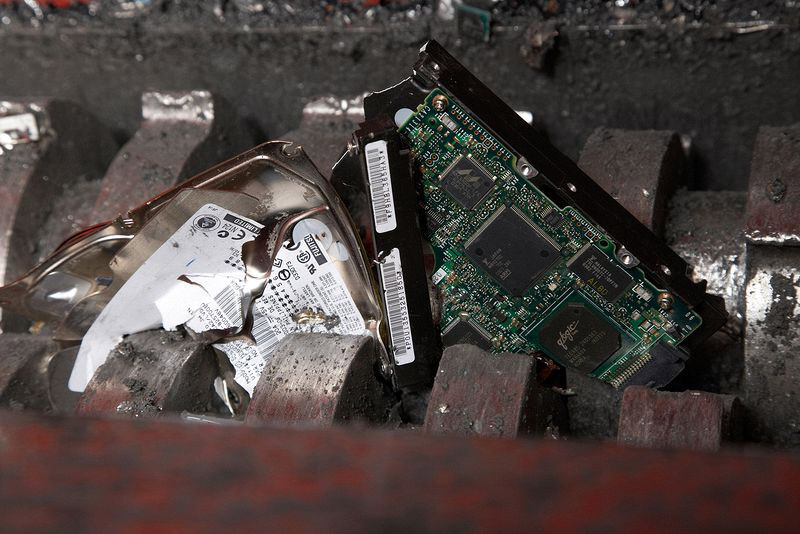
If you know your computer has particularly sensitive information on it and you don’t trust a utility program to get rid of the information, you can always destroy the hard drive physically.

Businesses in particular, often use hard drive shredding services, as their computers tend to have lots of personal information on both employees and customers of the business.

A hard disk shredder

A hard drive being shredded

Once you shred the hard drive, you can simply sell or donate the rest of the computer without it, and the new owner can then completely replace the hard drive.

Watching for identity theft

Even if you are careful to destroy information on your computer before you sell or donate it, it’s a good idea to be wary of potential identity theft.

Check your credit reports regularly to ensure that everything is accurate. Credit reports are normally the first place you’ll see evidence of identity theft when new accounts pop up that you didn’t open. If you do think you’ve been a victim of identity theft, get identity theft assistance as soon as possible.

Report the problem to the credit reporting bureaus, who will place a fraud alert on your account. Then close the new, fraudulent accounts. Finally, report the fraud to the Federal Trade Commission and your local police department.

If you’ve taken steps to protect your personal information from being stolen, you may never have to deal with the problem of identity theft, but it’s always a good idea to be aware of what you should do if your identity should be stolen.

How To Climb Up The Online Business Mountain

If you have ever participate in an outdoor activity, especially mountain hiking, you will agree with me that it has a lot in common with the strategic steps we ought to go through before expecting rewarding online business success.

Just like outdoor activities start from recording a list of the necessary gear to use, succeeding in online business also involves a strategic approach of proper self organization, from getting the required working materials to effective time management.

Even while there is already a lot of fun in working from home, it also comes with some time and self management challenges which often keep most of us from climbing up the online business mountain and achieving total control and freedom.

On top of a snow covered mountain

Climb the mountain to online business success

For an effective approach towards achieving online business success, we have to pay attention to the following:

Effective Time Management

This is the most important factor that determines the level we can reach as online business owners. Ineffective time management can ruin our progress and deter us from achieving the great heights. For effective time management, we need to:

Schedule our time: Doing the dishes, laundry, coking and some other household activities are going to steal your business time, if you don’t schedule them wisely.

It is true that these activities are necessary and have to be done, but you will be more productive both at your family duties and at your online business, if you schedule special periods in the day for everything you need to do in the house and for your online business as well.

Once it is the time for each of them, leave every other thing you are doing and focus on them. This will improve your concentration and ensure you accomplish more.

While these activities are inevitable, there are others, like online chats with friends, online videos and their likes are total time-suckers and should be avoided.

Stop procrastination: Once you have fixed activities for the day, don’t shift one to the next minute. If it is time to get something done, get it done. I learn this the hard way, but it is good you know that every minute of the day comes with some needs. Shifting any activity to the future will pile up with loads of other activities and eventually will overwhelm you.

Working place and passion for your job

It is critical to love your work and be able to do it in a nice and cozy place. For effectiveness in online business we need to:

Create a space and keep it organized: Even though you work from home, getting a separate office for your business will make you take it more seriously and ensure that you accomplish something on daily basis. Also, properly organizing your working space will ensure that it doesn’t repel your interest but instead, lure you to work.

Love what you do and let the others be aware too: Tell your family and friends that even though you stay at home, certain periods of the day are dedicated to your online business. They will respect this fact only when they see how bold and serious you are, and how important this is for you; hence you need to show them that commitment.

Measure your success and reward yourself: Most times, many online business owners lose hope and give up when they feel that nothing is working. Even that period is important, because you have found methods that don’t really work and you just need to concentrate to do things differently. However, find a way to measure your success, even if it is the little things you accomplish in your day, and reward yourself for that by taking yourself out, watching your favorite TV series, etc.

With all these been cleared up, you have built a strategic plan and you’re ready to go. Pack your backpack with all these necessary gear and with determination hit the trail to online business success. The path won’t be easy, but you will be prepared.