An Incubator from Car Parts

One of the most serious issues with using medical equipment in the developing world is breakage. Some statistics state that the average life of a large piece of machinery is about 5 years, and hospitals typically have stockpiles of broken machinery that they cannot use.

The problem is availability of spare parts. In some cases machines are taken out of service for minor problems, even fuse replacement, because the distribution network required to get the part does not service that area.

Here in Cambridge Massachusetts, a design company has produced as prototype of a baby incubator for use in such situations. The machine has all of the necessary functions of the most expensive incubators, but is built using car parts.
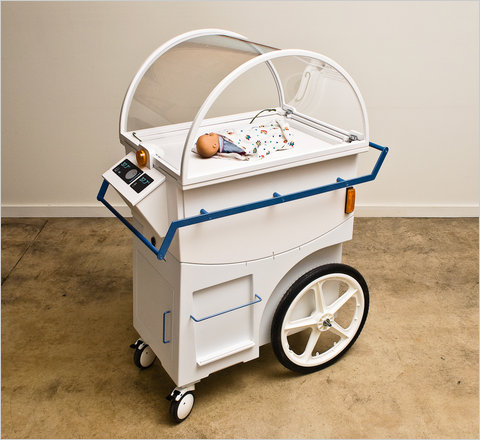
An easily repairable machine

Why car parts you might ask? Cars are found everywhere, and in many cases they are the only things that get regularly repaired. As a result parts are also available practically everywhere, both formal and informal networks serving even the most remote areas, and the designer believes that this makes the prototype product serviceable and repairable wherever it is found.

A simple idea that could have great knock on effects, I hazard to say. The incubator is heated using a pair of car headlights placed under the mattress, the temperature gauge is a car standard, as is the wiring loom and the air intake and filters. The alarm is a door bell and the emergency lights are direction turning indicators. If power is lost a motorbike battery takes over and it can even be run from jump leads.

The Massachusetts General Hospital has one of the prototypes on display in its museum, but unfortunately it looks as if the designers are still looking for a backer in order to put the project into mass production.

Given that millions of babies are born each year and many die on their first day of life, let us hope that somebody offers them some funds.

Sequencing the genome of unborn babies

As a follow on from my post about genetic testing last month, I would just like to point community members towards a story that is just breaking here in the US.

The New York Times carried a story on its front page on 7th June in which it reported that an unborn baby’s DNA was sequenced with 98% accuracy using just the mother’s blood and father’s saliva. The testing was done when the fetus was 18.5 weeks old. The accuracy was tested after the baby was born with a full sequence conducted on blood taken from its cord. A second experiment involving blood taken from a mother much earlier in the pregnancy (8 weeks) showed similar results although slightly less accurate.

non-invasive testing of a fetus now possible

In purely practical terms the authors point out that this system of testing for genetic disease is completely non-invasive, and this will save the lives of many unborn children. Presently amniocentesis or chorionic villus sampling are the preferred means for conducting tests for genetic disorders, but these techniques lead to the loss of the baby in about 1% of all cases as they both require the insertion of a needle.

The ethical implications of such a breakthrough are being widely discussed however. Much of the debate revolves around the idea that parents may choose to abort a fetus because it may not carry the traits they desire, and not only in terms of possible genetic diseases. We all know about the problem of female fetus abortion, and here we are introducing an entire matrix of more or less desirable features. There is also a serious problem of false positives, as some mutations were missed in the experiment and other positives given that at birth were found not to be present.

An argument that recurs involves the identification of diseases that may affect the individual in late life such as dementia. What kinds of decisions are parents of unborn children likely to make if they are told that it carries a mutation in a gene that raises its chance of getting cancer, or dementia or any other typically later life problems?

In this world of information however I imagine that there will soon be a market for such tests in the style of 23andMe, and as the price comes down many people will want to see the probable health future for their unborn children, as well as whether they will be tall or short, blond or brown or have blue eyes. This will have practical consequences for society.

If the model follows the existing 23andme path of offering statistical analysis of the chance of developing diseases in life the problem becomes even more complex. What might the effect be of telling the parents of an unborn child that it has a 40% increased possibility in developing for example Alzheimer’s disease? How can these statistics be analyzed and how will they be interpreted?

And what might the consequences be for an otherwise healthy fetus that finds herself caught up in statistical gambling?

Injections Without Needles

If there is one thing I don’t like it is getting an injection. I have never had a flu shot (but never had the Flu) and part of the reason is the needle effect.

This may all be coming to an end though as scientists here at MIT have devised a way to inject medicine without a needle. See this article for a description.

Needle free injection

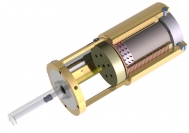
The new MIT developed needle-less system

This is not the first time that such a development has been publicized, but a technological and practical leap forward has been made. The MIT system is new in that it can deliver medicine at different depths. This means that medicines can now be inserted into muscle or fatty tissue at will and with ease.

The system uses magnets to achieve delivery, and this is the breakthrough that makes the system so interesting. Needle-less systems have been available for some years now, but they tend to rely on compressed air and are not flexible in terms of pressure. They medicine enters the body but the depth is not variable.

The MIT device works electrically and the pressure is absolutely flexible, allowing the operator to change the pressure of entry but then also lower it to enable distribution to the surrounding tissue. In other words lower pressure can be used to pass through the skin of a child, a process that does not require the same force as passing through an adult’s skin. The pressure can then be lowered to enable the distribution of the medicine to the surrounding cells once already in the body.

This breakthrough means that medication can be passed through other parts of the body too, for example through the eye tissue and directly into the retina or through the ear drum.

As you can see the importance is not really in my dislike of needles but in the loss of the needle.

Needle injuries are common for health workers, and with this system they are removed from the equation once and for all. No more accidental cross infections!

There are also obvious advantages for people that have to inject themselves daily for example in the case of diabetes.

Several major drugs companies have expressed an interest in developing and marketing the product so it looks like the days of the needle might be numbered.

I don’t know if it still hurts a bit though.