High Technology Sign Language Gloves

The winners have just been announced of the Microsoft Imagine Cup and they have created a very interesting product, worthy of a look I feel and also of the $25000 prize money. The Quad Squad team is a group of students based in Ukraine, and they have designed a pair of gloves that are able to convert sign language into sounded speech.

The gloves are fitted with sensors that can read letters as displayed in sign language. Software then interprets the signs and produces the spoken sound through mobile phone technology.
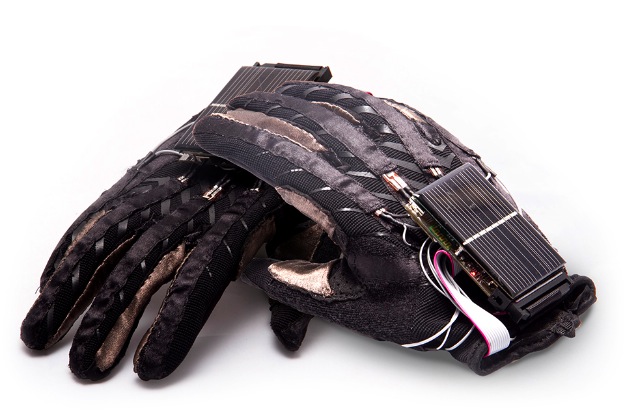
A pair of sign language conversion gloves.

The designers hope that their product will enable communication between someone speaking using sign language and someone who cannot read sign. Incidentally they have small solar panels fitted so they can recharge themselves while in use.

Comments on the Gizmag blog point to limitations, the gloves can only presently recognize letters and not symbols for words, but all agree that the product is definitely a step in the right direction.

If your sign language is not up to scratch you might like to try a pair of Accelagloves. These gloves use a mixture of sensors, software and a video camera attached to your computer to teach the signing of letters. They cost $300 (including software) and are already available from the Institute for Disabilities Research and Training who worked on their development. The Endgadget website offers a demonstration and the author’s verdict on their efficiency in video format.

The gloves are not only designed as a learning tool however, but also as an input for your computer as communication between gloves and computer is two way. Not only do they teach the symbols but they allow the user to input data through sign language, another important use in cases where visual or audio contact is not possible or the input device cannot be easily held (in emergency situations for example).

If your signing is already good you might like to try a pair of Glow Gloves. A simple idea that enables sign language in the dark, they do exactly what it says on the box.

I worked in a school in Italy where sign was taught as a curriculum subject, and now my youngest son is learning it at pre-school, but from my own point of view it remains an underused resource. Maybe this technology could help to spread its use to a larger group of people.

The Future of Paper?

Much has been said and written about the future of paper publications with the arrival of downloadable  books, Kindles and a whole world of other hardware, but maybe a company from Cambridge (UK for a change now I am back in Europe) may be about to cause another revolution.

Many people are not drawn to reading books in digital, they like to thumb the pages etc, but a private company is putting what they describe as the ‘future of paper’ into mass production.

The company called Plastic Logic have designed what we could describe as the closest thing to paper that can show video.

An example of Plastic Logic’s invention

As the name suggests we are talking about a plastic paper-thin sheet that has the ability to display video, It can be used as a Wi-Fi fed screen, with the advantages of being flat, thin, flexible and bigger than your standard reader.

This video on the BBC website describes the product in greater detail, including the production process, and states that it should be in full production next year. The CEO of the company also explains the problems that this technology has faced during development as well as explaining why we might need a screen that we can roll up and carry around. He also describes how the computer and receiver part of the structure could be attached in the form of a handle.

All very interesting stuff, but I think the most important part of this application involves telephones. I have a so-called smart phone but I very rarely use it for internet work because the screen is too small. I cannot read an article on a screen that size. But if I had an A4 size screen rolled up in my bag that could show me the screen on a much larger scale (via Bluetooth) I would be happy to use it. And then I could leave my laptop at home.

Others see it as the future for glossy magazines, or the death of them, but the death of newspapers, radio, books, recorded music and commercial TV has been on the cards for a long time, and they are all still alive and kicking.

I look forward to this new product going into full production and appearing in the shops anyway, and the obvious question…. would you have a use for it?

Second Hand Technology Finds

If you walk round Cambridge in Massachusetts in June, you find the streets filled with discarded belongings. The students are leaving Harvard, MIT, Boston University and all the others institutions and as they leave they abandon the things they cannot take with them by the side of the road. Many stacks of things have a little note or post it attached saying ‘take me’ or ‘free, working’, and it is very much part of the culture to take things.

On my final few days in Cambridge last week I walked the streets with my kids from one park to another, and I collected some interesting things, including some very interesting and expensive pieces of second hand technology.

A common sight on Cambridge Streets

I collected a pair of M Audio AV40 studio speakers, fully functioning and beautiful to listen to. List price $229.99. A few scratches on the top of one but obviously only had light domestic use. Into the back of the bike trailer they went and onward on our hunt.

Further down the road I picked up a large 27 inch LCD computer screen, again lightly used and well looked after. At least $200 if you buy it new, as its previous owner had done probably 9 months before.

I was fortunate enough to pass a young student as she emptied her office into a box on the street, so I collected 6 Moleskin divided folders ($26 each), 200 blank DVD’s and cases, about 60 blank CD’s and 2 nice moleskin notebooks. Into the trailer, the kids can walk.

Last year I saw bags of cables, modems and power units, and as I moved from Europe I took what I needed.

On this trip I also saw a 32inch flat screen TV but I couldn’t carry it, and a standard size LCD TV too but with no remote control. I left that where it was too and will explain why.

The thing about TV’s and monitors is that you have to pay $25 for the city services to pick them up, so many are abandoned. If you pick one up and it doesn’t work you have to pay to dispose of it, or leave it outside again for someone else to do the same. Either way not a great result. I also saw at least 10 old cathode TV’s, only one with the label to demonstrate that it had been paid for.

This started me thinking about the effect that a moving student population must have on the technology market and by extension the development of new products. Practically every student has a laptop, smart-phone, TV and high speed internet at home and these things are all paid for when they move to their university of choice. Producers must see a massive peak in September, and an associated rise in profits.

So this leads to the question of what happens to all of this stuff when they move on. In many cases they take it, but some cannot be transported and is left, either by the side of the road, dumped or left in the house.

As we all know the dumping of technology is extremely damaging, recycling a must but also ethically dubious, so how about something like the Cambridge model?

The model is also used here for cans and bottles. If you buy a beer in a bottle or can, the can or bottle has a value. If you take it back to the shop they recycle it and give you 10c back. I have seen the same model with plastic bottles in Scandinavia. The result of this scheme is that a business has grown up around collecting empty bottles etc from the bins, students in the case of Scandinavia and homeless people here.

Well, for however much you might not like the idea of going through somebody’s recycling bin for returnables, it looks like an extremely efficient form of recycling to me, and revenue for those people that really need it. And although I don’t do bottles you should see my well stocked office and hear my stereo at home!

Waste less!