Why not Write a Book?

Why not publish a book? I had been thinking about self publishing for some time, and so decided to have a try. In January of this year I took my Technology Bloggers “Health of the Planet” series, made it into a booklet and put it on Issuu, so the obvious next step was a book on Amazon.

On 24th October I sent an outline to my boss at the Bassetti Foundation for a book. My aim was to prepare it and get it out for download on Amazon by 27th November to coincide with my trip to Italy and participation in the nanotechnology lecture at the university that I wrote about a couple of weeks ago.

Rather a tall order we might think, but not an opportunity to miss, and I think that many bloggers could and possibly should do the same, after all a book is a book, and it looks good on the CV.

I started to look at what I had already written about nanotechnology, synthetic biology and the other topics that might come up in the discussion. I had a simple strategy, find all of the relevant pieces, put together a coherent collection in groups, write an introduction and conclusion and put it out.

I decided to write the introduction last, once I had a better idea of what the book would look like.

I had to think of a title though, a grand title that would make people want to read it, and also a price. Because I was publishing works that were already in the public domain I could only ask for the 30% royalties option from Amazon. There are 2 options for self publishing, 70% for original works and 30% if they have already appeared, so I had to go for 30. This lead me on to thinking about the price. Amazon are going to take the vast majority of the income, so I should accept the fact that I am not retiring to the Bahamas on the money this book will make. So I should give it away. You can’t give it away though through Amazon, or at least I could not find an option to do it, so I chose the cheapest option, 99 US cents a download.

So back to the title. I wanted to get Responsible Innovation into the title, but that in itself wasn’t a puller. I want students and people interested in innovation and technology to buy it, an overview of a complex scenario. A handbook? Yes A handbook. The Handbook of Responsible innovation? Well that is too grand a title even for me, so “A Handbook For Responsible Innovation” it is.
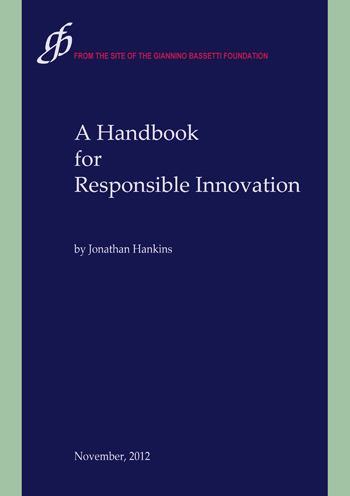
Cover to the Handbook

Handbook Cover

My boss at the Bassetti Foundation agreed to put the book out through the Foundation series, so I sent the title details etc to our man in Milan and he produced a cover as you see above, so now all I had to do was put the contents together.

Chapter 1, an overview. I found some pieces I had written for the Innovation Excellence blog, 3 quite formal posts about responsible innovation. If you decide to do this you have to read them and re-write and delete sections, because in my case they repeated themselves. There was also a lot of updating and putting the correct dates in. For example “last Monday I…” is no good. On (date and year) I….. is better. Also if referring to something that was in the future at the time of writing you should renew the research, so a report that was for publication will now be out, so you have to read it and put something in about the contents. A little bit of cut and paste here and there and a few new pieces and you are done.

I carried on to nanotechnology and did the same, moved on to a section that I titled Bioethics, about DNA testing and medical decision making. Then on to Information and Knowledge, about citizen science and where and how to participate in science and find reliable information, I have written about all of these matters here and in fact there are references to Technology Blogger posts both by myself and Christopher, but I decided not to put in any of my blog posts from Technology Bloggers as articles, only as references. This was a stylistic choice, and something to think about if you follow this idea. A book needs to be coherent, so pitch and register of the arguments should be consistent. This choice also cut out the issue of comments as the articles that I chose either were not set up for comments or had few, so i was not cutting the argument short.

If you were thinking of putting comments in as in the Health of the Planet booklet mentioned earlier it might be an idea to try and weave them into the argument instead of making them look like comments. This would not be easy but I think would give more of a book feel to a finished publication.

The last chapter in the Handbook is a collection of interview transcriptions. I cut out 2 more chapters that had been in the outline about design, as the book was already 150 pages long. In a process such as this I think flexibility is a must.

Then I had to go and put references in instead of links. Fortunately most of these essays had been posted on the Bassetti Foundation website and they have fantastic technicians. They designed the site so that when you download an article in PDF the links automatically come up as references. So I used the same format for all the other articles and in a few hours they were all done. I sent it back to Milan and asked the Scientific Director to write a preface. The preface idea was not my own but it certainly gives a formal feel to the publication, so again well worth thinking about.

So all that was left to write was the introduction and conclusion. The introduction turned out to be just an outline of the book, a page and a half. I feel that in a case like this all that is required is a few lines about the purpose of the book, where the articles are taken from and what is in each chapter. The conclusion is the only thing I had to write from scratch, I included as much as I could of the comments that my fellow workers had made about the book as some of their ideas were difficult to weave into already finished articles. Once I had started to cut and paste articles to insert sections I realized that insertion changes the flow of the writing, so adopted this solution instead.

I translated the preface into English and placed it in, Formatted everything, made a PDF and we were finished with a week to go.

The Foundation opened an account with Amazon and we uploaded the book with cover, all far too easy! A day later I got an email stating that as the material was already available online I had to provide links to each article in every place it was published so that Amazon were sure that my copyright was being respected. This took some time, and once submitted Amazon took a couple of days to come back again.

On the 26th they responded and we were good to go. But looking at the book online and ready to download we saw that the formatting had all changed, centering was gone, blank pages etc. PDF is not the way to do it! Also you need a full Word 2010 to do the summary aspect of it, something I have not got. A Filtered web page in HTML in a zip file is the way to do it. So back to Milan, new upload and wait and see. All of this is explained in a free Kindle download. Oh the beauty of hindsight!

We had 10 copies spiral bound for the lecture so that we could present it. I think a few hard copies are a good investment, people can see a product and thumb through it so it somehow becomes concrete.

A couple of days later we got the OK from Kindle, the status changed from “in revision” to “in publication” and notification of an ASIN number.

On 3rd December it was out, Hurray, a 5 week turnaround! I ordered 5oo business cards from an online printer with the name of the book and reference number to give out at every occasion and started thinking about generating some publicity.

So my thought on this matter is that if I can do it then many other bloggers can do it too. A little organization and filtering is all that is required. I made mistakes and wasted time, I spent ages writing a contents page with page numbers etc to find out that the pages did not correspond after formatting and anyway numbers are a thing of the past. A link takes the reader directly from contents to the section they require.

Everybody gains something from the process though, the author, Amazon, the blogs that host the original articles, and it didn’t cost anything, completely free. If you choose the KDP Select option Amazon have sole distribution rights for 90 days so you cannot put it out on Barnes and Noble or any other platform, but Amazon offer a free lend to their prime members and a free preview to anyone, and it is readable on any computer so Kindle not required.

However many people download the book (feel free, it is here) it is a good result, and you should see my CV now! The next stage will be to put it up in paperback.
Robotic Surgical Techniques

This weekend I had a very interesting experience. I tried out a few million dollar’s worth of robotic surgery equipment.

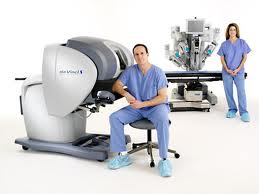
The Davinci Robotic Surgery Machine

The da Vinci Robotic Surgery Machine

The system I tried out was designed and built by da Vinci Surgery, and is in use at the Brigham and Women’s hospital here in Massachusetts. The hospital states that over 600 operations have been carried out since 2007 when the technology was introduced without need for further more invasive interventions or serious damage to any patient.

Imagine that you sit in front of a 3 dimensional image and control robotic arms with your own arm and finger movement. The arms are about as thick as pencils, and as there are 4 arms on each robot two surgeons can work together.

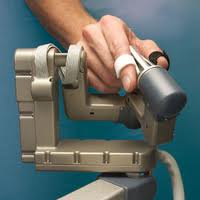
The hand controls feature finger grips

Hand controls

The great advantage is that instead of having to make a large cut so that the doctors can get their hands in, the robot makes 5 tiny cuts for the arms to pass through. There is a camera so the surgeons can see inside and they can proceed at a safe distance.

Healing time is cut down, less blood loss, less possibility of infection, less post operative pain and very little scarring, there are many advantages to this type of approach. The machinery is very easy to use. My 7 year old son could take tiny elastic bands off a test bed and place them round objects about the size of the end of my little finger, at a distance of 3 metres!

One issue is however that some people are dubious about a surgeon operating using this type of machinery, they might feel that a hand is better then a robotic arm. Having used one (not on a patient I grant you) I personally would not have any problem accepting a procedure of this type.

Robotic surgery makes us think of computerized machinery with Kraftwerk type movement and voices, but this machinery is nothing of the sort. It handles like an extension of your own body, the movement is very real and precise and in some ways the robotic arm is easier to manipulate than a human counterpart. It can turn 360 degrees upon itself, has full rotation capability and the magnification makes the process seem easier. I was shocked when I saw how small the area was that we were working on.

A training program was also on display, a series of tests to improve performance and present each operator with a score. A skilled operator can tie a knot in a piece of string or link tiny elastic bands together that would be extremely tricky using human fingers.

Below I have a series of photos and here is a link to a video showing an actual procedure so stop reading here and skip straight to the comments section if you don’t want to see them.

A Dummy Up

A dummy shows entrance

Robotic Surgery

Robotic surgery in action

Report from the Nanotechnology Lecture

Today I would like to look at some of the issues raised at the Nanotechnology lecture that I posted about last week.

The lecture was delivered by Michael Bruch, head of Research and Design of Allianz insurance company. He brought up some interesting points about nanotechnology and its production.

One problem that he raised is that we do not really know how much nanotech we are surrounded by as products containing engineered nano-particles do not have to be labeled.

Many cosmetics, sun creams and sports related products use the technique, but also food manufacturers, so it is really difficult to understand how much exposure we have to these particles. Scratch resistant paint and darkened windscreens are already here, but self repairing paint is also under trial, as is paint that changes colour.

Another problem is that their manufacturing processes are practically unregulated. Most of these materials are produced by small companies that have little or no safety procedures. And it is unclear what type of procedures would be of use.

This is because it is unclear how exposure affects the human body. These particles can enter the body in various ways, and have the capability of passing directly from the blood to the brain. This means that they can be used for medical cures such as in fighting cancer, but also that once in your body they can transfer everywhere.

Nanotechnology Lecture Panel - Jonny Hankins

The panel of speakers

Recent studies have found that exposure to nano carbon tubes does affect the heart in mice however, and similarities are drawn with asbestos as many of the fibres look similar. One complicating factor however is that materials used on a nano scale have different properties, so something that is inert such as gold might be toxic at nano scale or the other way round.

Further problems arise when we think about end of life treatment. Much of the expert knowledge is not passed down the line to those responsible for disposal of these products, so they may not be treated correctly when it comes to recycling or destroying them.

All of the above means that the nanotech industry brings with it an enormous amount of risk. Health risks are easy to see, but also environmental risks. We do not know how much is released into the atmosphere today, nor whether there will be industrial accidents and what their effects might be.

Regulation is difficult to draw up however as terms and definitions have not been agreed upon. Voluntary codes seem to be the only attempt at implementing some form of standardization.

What is safe to say is that this technology is certainly changing our lives, but that as it is developing so quickly little is known about how to treat it or the consequences it might bring.

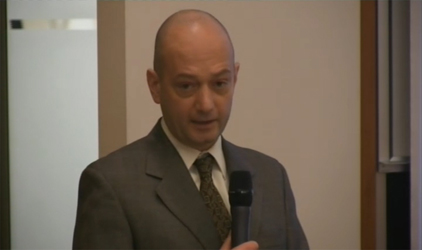
I made a speech myself, the outline of which is below. Thanks to everyone who watched via streaming, the photos were taken from the live stream by Christopher.

Jonny Hankins nanotechnology lecture

Me at the lecture

Comment by J Hankins of the Bassetti Foundation at the Bocconi University in Milan.

I would agree with previous comments that there is definitely a role to play for insurers in innovation.

I would also argue that the lecture Dr Bruch has just delivered is not only about innovation, but also about responsibility and obligation.

Innovation is a complex phenomenon combining science, technology, finance, management, enterprise and organizations to achieve a goal that is not only scientific but also entrepreneurial and political. The ultimate use of any results will be outside science, even though they greatly need the contribution of science, in what is by definition a continuous process.

Taken literally, innovation is something that comes about when an advance in knowledge, which is a result of a discovery, is accompanied by and combined with technology, and the power to put that advancement into practice (capital). It is not simply discovery. It is something more than that. It is part of a new historical situation arising from a combination of knowledge, technology, know-how, and the risks/opportunities developed and implemented by business or other powers. That is, it is something that was not there before and which has come about through a “new” combination of knowledge and power, bringing change into the social world. This change is appropriated, negotiated, lived through, or fought, by people – whether as citizens or as consumers.

Innovation, however, is also creativity, which necessarily implies unforeseeable change. It implies increased risk/opportunity and social power. It leads to unpredictability in the socio-political field (new institutions, types of relationship, of production, of war, and new powers), in the technical and economic realms (new materials, sources of energy, tools and categories of goods), and the cultural-aesthetic field (new styles, fashions, tastes and habits).

If we look at the interest that governments currently show in nanotechnology development this relationship to power becomes easier to see. As an agent of change, risk is intrinsic to all innovation, and I would argue that it should be carried out responsibly.

The development of nanotechnology in some ways exemplifies the problem of responsibility in innovation perfectly. As we have seen in Dr Bruch’s lecture, developments in the medical field offer new treatments for cancer, in engineering we are seeing ever lighter and stronger construction materials, and these advances will continue to ever more change the way we live and our surroundings.

But as stated, these developments are not without risk, and risk requires responsibility to be taken.

It is the entire process of innovation that must be responsible through the actions of all involved in it, in all of their different roles. It would help to have a societal understanding and a political framework in place for collaborative deliberation and for a collective capacity to rethink the fundamentals of our own premises and assumptions as we go along, changing the world we live in.

I would argue that Dr Bruch’s presentation can be seen as a call for responsible innovation in its entirety. In some ways he is saying that a company can only insure you if you play your part, as the innovator you must be transparent and thorough. But the cover is also reliant upon other actors. The consumer must be educated and informed so that when they purchase something they do it knowingly. This requires reliable information on the part of the media as well as an absence of political manoeuvring. The regulator figure is also necessary, as they must inform and orchestrate the communication that underlies their decision making and intervention.

The fact that insurance cover is seen as necessary before investment means that companies that cannot find insurance cover have difficulty securing funding for their products. This puts the insurance companies in an interesting position, as they have a direct influence on the innovation process. In some ways they become the gatekeeper, allowing those that display best practices to pass, and those who may not demonstrate an appreciation of the consequences of their work may find finance difficult.

If we look at the risk analysis in Dr Bruch’s lecture we find that it is necessarily very widely drawn, sometimes even vague as the spectrum of possible effects is large and the time scale immeasurable. This does not mean however that it is not important or should be overlooked however.

If we have no loss history, as in the case of nanotechnology, how can we measure the risk involved? Can we gain foresight? Can we use the experience of the insurance industry to create an algorithm for future risk that is not based on case history. If so could we in fact do the same for responsibility?

The examples of needs and obligations given in Dr Bruch’s lecture are not only applicable to nanotechnology however. The process required for the adequate testing of exposure levels, medical studies, political decisions, the drawing up of regulation and its implementation are present throughout society. We cannot believe that ad-hoc regulation is an answer, because by definition it can only be implemented late on in the innovation process, when the factors that may be foreseeable have been measured, standardized and formalized, and we should remember that many other factors that are more difficult to see will also play their part.

Regulation is necessary, but if we accept that it can only appear late in the innovation process it cannot be the basis for our goal. The innovation process itself must be imbued with responsibility, its design and implementation must try to take implications for the future of present actions into account.

As Dr Bruch mentioned perceptual risk is also an issue that needs to be addressed. Here we move into the political arena, an arena that should certainly not be overlooked given the influence of national, international and global politics in nanotechnology. The management of the perception of risk is as real as the management of risk itself, as perception affects decision-making.

If I could raise some questions to the audience I would like to think more about ‘stewardship’, the responsibility insurance companies hold in granting cover to operators in the nanotech industry and how a premium can be calculated in the face of such uncertainty and indeterminacy.