Can you recondition an old computer?

There are many ways to deal with old computers. One popular way is to get rid of it. This is because old computers have no value, are slow and take lots of physical space.

The other way to deal with them is to sell them for a super low price so that you can buy a new one without paying too much. However, second hand electronic stuff does not really have any value. For instance, you probably ended up selling a graphic card for $50 that you bought for $200-$300 originally.

So why not keep your old computer and make good use of it.

How to rebuild an old PC

1. Format your hard disk to ensure you have completely remove all the data in it – remember that even formatting your disk might not remove all your data.

2. Install an new Operating System. If you are looking at Windows, XP might be a good choice for an old PC, however 7 also handles low spec hardware pretty well, so is also worth considering. There are several reasons why I think Windows XP is no longer the best choice:

  • License rarity – Windows XP is 3 versions behind the current Windows operating system, meaning few firms still stock XP licenses
  • Support has ended – Microsoft have officially announced the termination of the support for Windows XP in 2014
  • Malware issues – Windows XP is prone to more security risks than more current operating systems, simply because it has been around longer; this means you are likely to need a better antivirus software to keep the PC safe

If you don’t want to go down the Windows route, I highly recommend is the Ubuntu, which is a free Linux OS. There are several free Linux operating systems out there but so far, I think Ubuntu is one of the popular Linux distribution and probably easiest to use.

What is the requirement to run Ubuntu? According to the official site, these are the requirements.

  • 700 MHz processor
  • 512MB of RAM
  • 5GB of hard disc space
  • VGA capable of 1024×768 screen resolution
  • Either a CD/DVD drive or a USB port – or both

I bet you have a better PC than Ubuntu requires 😉 Ubuntu

Uses for an old computer running Ubuntu

No matter how old the computer, it always has uses. Here are some of my suggestions:

  1. Use it for regular web browsing. With a lightweight operating system (which won’t suck up your RAM and CPU usage) your old computer can still perform pretty well for simple web browsing
  2. Use it for data backup. You can always transfer all your important stuff into an old computer, and use it as a backup machine, so you can keep your files safe and access them easily
  3. Home surveillance system. If you buy a webcam or two and install them into your house you could use your old computer to run your own home surveillance system!

So now, if you have an old computer lying around or burred in your storeroom why not dig it out and start making good use of it?

If you have any good idea on how to re-use your old computer, why not share with us below?

Global Information Technology report 2013

The World Economic Forum recently released its Global Information Technology Report 2013, and in this post I would like to have a quick look at it.

It is a long document, so I will just try to take a few highlights to give an idea of the findings.

The report has a Network Readiness Index that aims to measure how prepared countries are to adopt and make the most of new technology. Factors such as investment in broadband and other telecommunications fields obviously enter, but so does the quality of the education system and regulatory powers.

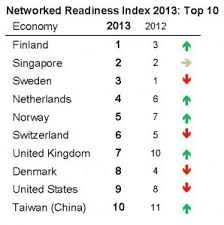
Finland leads the world in embracing technology, followed by Singapore and Sweden. The UK is in 7th place, the USA in 9th and my present home Italy is well down at number 50.

World Economic Forum

The Nordic countries and the so-called Asian Tigers – Singapore, Taiwan (China), South Korea and Hong Kong SAR – dominate this year’s index thanks to their business-friendly approach, highly skilled populations and investments in infrastructure, among other strengths. Finland, which arguably has one of the best educational systems in the world, stands out as a digital innovation hub.

Southern Europe shows a massive lag in fact with the North, and this is a major problem.

The positioning is not only important for so called ‘techies’, but really important for the economy as a whole, and here in Italy (and in Southern Europe on the whole) we are in serious need of economic improvement.

Latin America, the Caribbean and sub-Saharan Africa also suffer from a serious lag despite infrastructure improvements, an expansion of coverage and a push into e-government. Weaknesses in the political and regulatory environment, the existence of large segments of the population with a low skills base and poor development of the innovation system are all factors hindering Latin America’s technological potential. In sub-Saharan Africa, costly access to technology, a low skills base and unfavourable business conditions are among the chief obstacles.

The report demonstrates that economic growth and technological readiness are tightly linked.

Top 10 countries for Network Rediness 2013/2012

A look at the top 10

An analysis by Booz & Company has found that ICT could help lift millions out of poverty.

Digitization has boosted world economic output by US$ 193 billion over the past two years and created 6 million jobs during that period, according to the study. Using a Digitization Index that ranks countries on a scale from zero to 100, Booz & Company found that an increase of 10% in a country’s digitization score fuels a 0.75% growth in its GDP per capita. That same 10% boost in digitization leads to a 1.02% drop in a state’s unemployment rate.

If emerging markets could double the Digitization Index score for their poorest citizens over the next 10 years, the result would be a global US$ 4.4 trillion gain in nominal GDP, according to the study. It would generate an extra US$ 930 billion in the cumulative household income for the poorest, and 64 million new jobs for today’s socially and economically most marginal groups. This would enable 580 million people to climb above the poverty line.

So investment is this area is extremely important, but in many places falling profits due to economic downturn (as is the case in Southern Europe and to some extent the USA) mean that less money is available, and this effects future growth scenarios.

Interestingly 3G growth is more important than general mobile telecommunication growth, we really do live in an information society that is based on Internet connectivity.

Medical care is also another area where benefits are net and easy to measure.

Southern Europe is in a particularly precarious position due to lack of investment capability. Rwanda on the other hand is following many other African countries in investing in expanding its fibre optic network and hopes to become a banking and finance hub, moving to being a knowledge based economy and away from agrarian in the next 7 years.

Colombia, Uruguay and Panama have become champions of e-government and connectivity. In Colombia, Internet connections have tripled to 6.2 million in the last 2.5 years. In Uruguay, small and medium-sized tech enterprises helped lift technology exports from US$ 50 million in 2000 to US$ 225 million in 2010.

Here in Italy there is little investment and a distinct lack in centralized planning, so we will soon be slipping below these countries on the scale and continue to suffer the related threats on economic development that this situation provokes.

The report is free to download here. It is as I said long and detailed, but the rankings are in chapter 1 if you just want to see where your own country sits.

See you in court! The biggest tech lawsuits in history

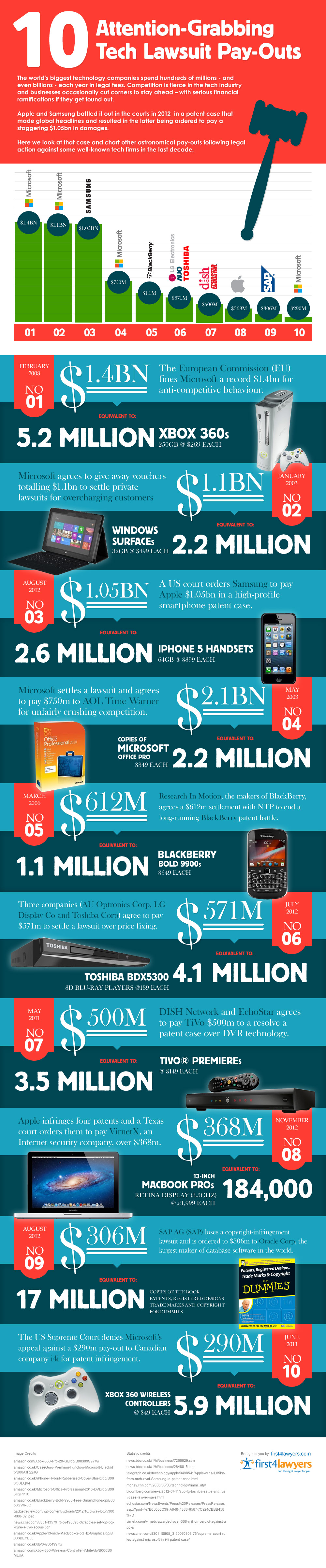
An infographic on technology court cases

Infographic from first4lawyers.

Tech is a very competitive sector of the global economy, with the biggest firms constantly trying to out-muscle each other in order to be top of the technology tree. The likes of Apple, Samsung and Microsoft have tried to pull out all the stops to make sure their latest gadget or console is the most popular with consumers, but when making a wrong turn, they occasionally find themselves in court!

As this infographic by the guys at first4lawyers reveals, when tech giants are summoned to the court for being on the wrong side of each other or the authorities, they can end up paying a huge amount in damages. The most recent of all these cases involved an epic courtroom battle between Apple and Samsung over patent infringement.

Court short

The Korean firm were asked to pay Apple over $1bn, a fee which they have tried to bring down in order to minimise the impact on company profits. Other cases listed here involve firms trying to improve profitability at the expense of the consumer and smaller rivals, something that Microsoft in particular have been accused of.

To stay out of court in the future, the biggest tech firms should try to play fair, while also taking into account the needs of the consumer. The amount of money fined is substantial, so the incentive to stick to the rules is there!