The BOINC Home Network

A few months ago, I wrote about LHC@home 2.0, which is a project that you can get involved in that allows you to use your spare computing capacity to help ‘crunch’ scientific data from the Large Hadron Collider project.

Rather shamefully, at the time of writing the article, I hadn’t actually taken part in the project, however after buying a new PC, I thought that it was my duty to donate my spare processing power to help science!


I started off by going to the SETI@home website, where I worked out that in order to take part in the search for extraterrestrial intelligence (SETI) project, I would need to download the ‘BOINC software’ – so I did. When I installed the software I was amazed with the amount of different projects that I was able to partake in.

The BOINC software is effectively a management tool which lets you choose which projects you want to help crunch data for. Then it sets about downloading, analysing and then uploading the data in the background.

The BIONIC LogoThere are so many great projects that people can get involved in, from looking for extraterrestrial life and the Higgs particle, to projects providing power to those who are doing vital research into malaria, cancers and other important global diseases, and even trying to work out how and why gravity works!

From finding new medicines to helping university students, there really is something for everyone to get involved in.

If you are worried that it may slow down your computer, then don’t be, you can set how much of your processor BIONIC can use, as well as the amount of hard disk space it can take up, and also how it uses your internet.

The BOINC software comes with an easy to follow interface, and gives you announces of important events and discoveries relating to @home projects.

The BOINC Manager Interface

The BOINC Manager Interface

Think where we would be in terms of scientific advancements, if everyone were to give just 10% of their PC to some of BOINC’s @home projects.

You can make a difference, and you can help science! Please go to the BOINC website to download the software today, and get stated with some of the brilliant projects they have on offer! I personally believe that the following projects are really worth a look at:

  • Poem@Home – investigating protein structures, how they determine protein function, how they interact with one another, etc.
  • LHC@home 1.0 – the Large Hadron Collider project – with some extra software, you can also take part in LHC@home 2.0
  • climateprediction.net – attempting to improve climate modelling, and predict the possible effects of climate change
  • Einstein@Home – searching through data from the LIGO detectors for evidence of continuous gravitational-wave sources, as well as searching radio telescope data from the Arecibo Observatory for radio pulsars
  • Cosmology@Home – comparing theoretical models of the universe in order to try to improve future technologies
  • malariacontrol.net – helping in the fight against malaria, via creating simulations and models of the history of Malaria
  • SETI@home – analysing data from outer space, to try and find extraterrestrial life

Unfortunately, I now have to give you a warning. Whilst I am sure that the software and projects are all 100% safe to participate in, some organisations would not want you to install them on their computers. You would be perfectly okay to install such projects on your home PC, however I wouldn’t advise that you do it at work or school, as there have been incidences in the past of firms pressing charges against people for increasing their internet usage and filling up there serves by unauthorised software like BOINC.

That aside, I really do urge you to download the BOINC manager today, any start helping science! If this makes the offer any more attractive, most projects have their own screensavers, many of which look pretty cool!

Install it and leave a comment below to let us know how you are getting on 🙂
Why Is Cloud Computing So Important?

Cloud computing has a lot of hype surrounding it. More than a few observers have wondered what is so important about this new internet phenomenon. The truth is cloud computing is leading to a rethinking of the internet’s capability. Cloud computing promises to completely delocalise computing power and technology. Users will be able to access and manipulate files, images, videos and other data remotely. Cloud computing promises the ability to keep networks and mobile devices synchronised at all times.

Infrastructure

A bank of sophisticated computers host operating systems and data for hundreds, if not thousands, of customers. internet search engine giant Google pioneered the use of data centers to store clients’ personal data safely. The same principle is being extended to cloud computing. Huge data centers will act as remote desktop computers. These centers will be able to store every file a user would need. All the user needs is a counterpart machine that can be as small as a conventional laptop with much less weight. These so-called “netbooks” serve only to connect the user to the internet so he can access his files.

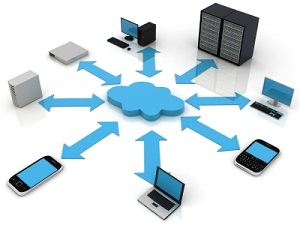
A cloud computing network

An example of how cloud computing works – every device synchronises with the cloud, meaning that your data can be accessed anywhere!

A single data center can offer multiple services and applications. Theoretically, a cloud computing system could perform almost any function or task the user desires. In a typical system, each application will have its own dedicated server combined with multiple iterations to create redundancy and prevent sudden malfunctions. The whole center is managed by a central server that constantly monitors the traffic and load volumes. Balancing the differences between machines, it seeks to maintain the harmony of the system and prevent crashes.

Business Advantages

The advent of cloud computing is actually forcing businesses to change their strategies. Previously, hiring a new employee meant providing him with a desk, computer equipment and various other hardware or software. Cloud computing allows them to reduce these capital expenditures significantly. Now all an employee needs is a computer with an internet connection to access his work data. Desks and office equipment may still be necessary, but the investment in computer hardware can be outsourced to cloud computing companies.

The hardware and software demands on the business’s side decrease dramatically. Labor costs per individual employees go down, enabling a company to hire more workers. Productivity increases, raising the efficiency and profits of the business.

Concerns

The primary reason why cloud computing is getting so much attention is its effect on business strategies. The sheer cost pressure alone is forcing industry after industry to adapt to the new reality. The advantages notwithstanding, several valid concerns about cloud computing exist, namely having to do with privacy and security.

Business owners and executives may hesitate to turn over their sensitive data to a third-party system with good reason. Losing access to their own data or having it compromised is unacceptable in a ruthlessly competitive private sector. One major argument against this fear is the fact that cloud computing companies survive based on their reputations. This gives them a huge incentive not to lose their clients data or compromise accessibility. Despite the power of this incentive, regulations may still be required to ensure safety.

As for privacy, the obvious concern is the connection between the user’s computer and the cloud system. Privacy could easily be compromised by unscrupulous individuals who could access personal information like credit card numbers. A solution to this problem is to use authentication and encryption like regular secure connections.

These practical concerns are somewhat overshadowed by a number of philosophical and legal questions. For instance, who owns the data stored by the cloud computing system? While it is held in the client’s name, a case could conceivably be made that the cloud computing system is the actual owner and therefore has a right to it. These technicalities are still under debate, and no resolution has yet been achieved.

Conclusion

Cloud computing holds great promise for upending things as they are currently done in the business world. The practical effects on information technology jobs will likely be profound. These and other challenges must be met because cloud computing will continue to change the nature of the internet.

Is paying for music a thing of the past?

This is a sponsored post. To find out more about sponsored content on Technology Bloggers, please visit our Privacy Policy.

With the availability of streaming music services like Pandora, Spotify, and Rdio all available for free and unlimited access, there are fewer people than ever actually paying for their music. According to a recent article on TechCrunch, Tom Conrad, the CTO of Pandora, said that about 50 percent of Americans don’t pay anything for music while another 40 percent only pay $15 a year for it.

If you were to walk into a big retail shop ten years ago, one of the biggest sections in the electronic media department would have been a massive collection of compact discs. Today with the likes of iPhone, and Android, CD’s have made technologies like compact discs seem old and obsolete technologies of the past.

The biggest culprit to the recording industry has been the proliferation of bit torrents and peer-to-peer piracy software. According to Torrent Freak, the Canadian Broadband Management Company says that forty percent of all internet traffic in North America comes from either Netflix or Bit Torrent. While the original intention of this sharing software was to make it easier for business to transfer important files, most of the traffic from it today comes from the illegal trade of music, television shows, and movies.

While services like Pandora, Spotify, and Rhapsody have a paid-premium option available, their free services are so convenient that there is no real reason to purchase them. Unless you want a completely advertising-free experience or simply want an unlimited data cap on what you can access per a week, the free versions of these programs work just as well and include almost all of the features. Ironically, the only companies that actually have to purchase these plans are the small retail stores that are selling you the music.

Spotify's LogoThe RIAA is having an abysmal time selling digital copies of singles and albums to consumers. Not only are the versions that are available online cheaper and make less money, they are also much easier to steal, copy, and distribute illegally over the internet. Google is partially to blame for this widespread availability of illegally traded music.

According to an article in the Daily Mail, if you type in your favourite artist into a Google search, several unauthorized and pirated versions of the song will show up available for stream or download. While Google is not implicitly to blame for this, they are turning a blind eye to the practice by ranking them higher in search results.

The person who is most responsible for the digitisation of music is the late Steve Jobs. When the iPod first appeared on the market, Steve spearheaded the movement to make iTunes the ultimate way to purchase music online. In an article in the Inquirer, David Hughes (head of technology at the RIAA) claimed that Steve was a hypocrite for claiming to be a spiritual leader but not putting enough piracy protection on digital downloads.

There is no turning back from the digital way of selling and listening to music. We have come too far in our technological advances and reverting to older methods such as CD’s and cassettes would seriously hamper our tech advances.

The music industry will need to find new ways to make income such as advertising, product placement, and incorporation in order to continue to make a profit… or it could just go away and make music an art form.