Higgs boson find makes time travel “feasible”

Ground-breaking research has emerged this morning, as scientists from the LHC released verified data that proves the existence (and therefore discovery) of the Higgs boson.

CERN's logoThe particle which has been hailed by some as the ‘God particle’ was thought to have been discovered earlier last month, causing euphoria amongst physicists across the globe. This morning CERN have released certified proof of the particles existence.

Late last night cosmologist Carl Sagan and theoretical physicist Stephen Hawking (among other high profile scientists) descended upon Geneva for what was known up until now as a ‘private consultation’. It is now thought that the scientists were being asked to help verify the findings of the LHC’s latest discovery.

At just gone 12am BST (01:03 local time) a spokesman emerged from the centre in Geneva and announced that CERN had “falsifiable proof of the existence of the Higgs boson“.

Time Travel

In the press conference which was held shortly after the announcement, leading physicist Stephen Hawking commented on how due to the structure of the particle, he felt that in the not so distance future there is a “real possibility that time travel could soon become a reality“.

After Hawkins statement, there was an eruption of excitement among the media present, and no doubt across the globe from all those watching the press conference live.

Our Sun

Nuclear fusion (the reaction which happens within the sun) is a technology which we are yet to crack

Later in the conference, after the euphoria had died down slightly, a CERN scientist mentioned that not only did the Higgs boson seem to hold the key to time travel, but also (like previously thought) the origins of the universe.

Furthermore, nuclear fusion now seems to be a viable possibility as a future power source. Nuclear fusion is the reaction that goes on in the sun, and could enable us to create an almost unlimited supply of energy from a very limited amount of resources. Until recently scientists have been struggling to understand how to ‘crack’ the fusion equation, with the Higgs particle seeming to be a key component.

On the 1st of April 2013 we find out that free unlimited power and time travel are just around the corner. What a discovery!

UPDATE: This was an April Fools’ joke!
Goats, Gangnam and the Harlem Shake

For some reason, many of us internet folk seem obsessed with internet memes.

What are internet memes?

Okay, if you don’t know what an internet meme is, then my opening line probably didn’t mean that much to you. Who better to ask than Mr Oxford? A meme is “an element of a culture or system of behaviour passed from one individual to another by imitation or other non-genetic means” – basically something which becomes a phenomenon, usually in a very short space of time.

Recent examples of internet phenomena include music video Gangnam Style, the Harlem Shake dance (and its parodies) and all those songs that have been given the goat treatment.

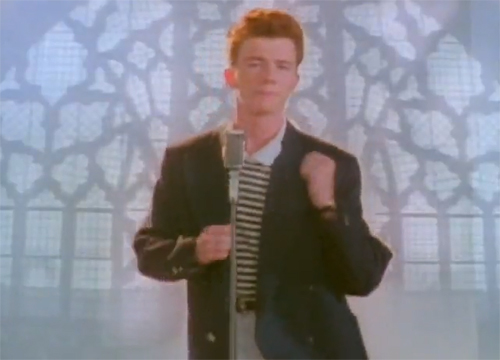
Probably the most well known historical internet meme is Rickrolling. In April 2008 the BBC reported how “an estimated 13 million internet users have been tricked into watching the video for Rick Astley’s Never Gonna Give You Up” in the space of just a few weeks. The number of users online and the size of the internet has grown significantly since then, so when put into perspective, 13 million is a lot of people!

Rickrolling

Rickrolling is when you go to click a link, believing it is going to a certain resource, website etc. when in reality you are diverted to a video of Rick Astley’s Never Gonna Give You Up. Basically, rickrolling is a simple bait-and-switch, which is (usually) just harmless fun.

Rickrolling

Rick Astley dancing in his ‘Never Gonna Give You Up’ music video.

If you find yourself on Rick Astley’s video, (when you didn’t intend to visit it) then you are said to have been rickrolled.

It isn’t thought that Rick Astley attempted to create the internet meme, or in any way endorsed it, however some argue that it the meme played a large part in reviving his musical career!

Some rickrolls were just done in a humorous style, with no harm intended, whilst others would cause more havoc, some making it very difficult for users to turn the video off, and others even using it as a way of installing malicious software on users computers.

Probably the most high profile rickroll was in 2011, when The White House rickrolled followers, adding a link to the video in a reply tweet.

%CODETWEETRICKASTLEY1%

YouTube hits 1 billion active users

I recently tweeted via @TechBloggers how YouTube now has over a billion monthly users.

%CODETWEETTB1%

This is an amazing achievement for the social network/video sharing site. Earlier in the month I reported how PayPal has around 110 million active users, which seemed like quite a lot, but it’s only 11% of YouTube’s figure!

YouTube is [arguably] the biggest beneficiary from internet memes, as more often that not, the memes are video based.

Probably the most famous internet meme that didn’t really involve YouTube was planking. Planking involves taking pictures of people lying face down in unusual places. Flickr and Tumblr benefited from planking much more than YouTube. Planking has a slightly more sinister history than many internet memes however, as there were deaths caused by people planking in dangerous locations.

It is a goat?

Last year Jonny wrote about mistaken identity, and how when something is adopted by the press, or the internet and becomes widespread, then it is hard to stop, even if it is wrong.

One of the current internet phenomenon is giving songs the ‘goat’ treatment. As I am sure you already know, this involves replacing parts of a song with a screaming goat. One of the first songs to be given the goat treatment was Taylor Swifts ‘I Knew You Were Trouble’. Have a watch.

%CODEYOUTUBETAYLORSWIFT%

Humorous right? You can see why there is a goat based internet meme! 🙂 But it isn’t a goat!

The goat treatment

The screaming sheep which features in the videos which have been given the ‘goat treatment’

The animal in Taylor Swifts video – and many of the other videos in the phenomena – is a sheep! One person posts a video, calling it a goat, and everyone else blindly copies. I too was a victim of this mistaken identity, and would talk to people about the goat video, that is until I was corrected by a Animal Behaviour Studies student!

The funny thing is, the original upload of the screaming sheep was named exactly that, ‘The Screaming Sheep (Original Upload)’.

Gangnam Style, the Harlem Shake, The Crazy Nastyass Honey Badger, The New Old Spice Guy ads and LOLcat pics are also all internet memes.

So, what do you think about internet memes. Do they have a purpose? Should we all endorse them as we do? Your thoughts below 🙂

Using White Space for Internet Coverage

Google launched an interesting experiment this week, offering free “super” wi-fi connection to the Internet for several schools in Cape Town South Africa. What is interesting about that you might ask? Well they are using the unused frequencies in the broadcast TV spectrum.

White Space diagram

A diagram of a white space network

The TV broadcasting frequency spectrum is currently divided between many channels, but between each channel there is a gap, a frequency space, often known as “white space’, and the hope is that this space can be used to broadcast high speed wireless Internet access. This experimental system is not without it doubters though, TV companies are not keen because they think there might be interference in their picture, so what better than a small experiment to try it out?

We can all imagine how this experiment might revolutionize Internet use though. In the countryside where infrastructure is lacking but TV is visible the companies could offer a service. In the city where cables are all in use they could do the same. One great advantage is that low frequency signals can travel over long distances, so the coverage potential is massive, and they penetrate buildings and other natural barriers much more efficiently than other frequencies currently in use.

Here in the US many telecommunications carriers have been complaining that there is not enough bandwidth for them to keep up with consumer demand, and so the Federal Communications Commission has been trying to free up spectrum space. They approved rules in 2010 about the use of such white spaces and databases have been set up to monitor spectrum use to see how it can be improved. Google are one of the leaders in this database organization too, as this article explains.

Experiments are being conducted here too, with this article describing how the system is being used in a small North Carolina town, and results reported in the UK claim that the system can deliver 16 megabits per second over 10KM (see Christopher’s comments on this related article for an explanation of what that means), but this is a delivery similar to what we know as 4G.

Potentially great improvements in coverage might be just round the corner through a more efficient use of an already existing infrastructure.