Ads online – you have a choice

The internet is full of ads. There is no escaping that fact that despite it being a free web, the word ‘free’ probably means you will have to put up with an awful lot of adverts. People who work online have to make a living, and ads is one of the most popular ways to do so – fair enough.

Sometimes you have to accept that we need ads to help keep so many free services on the internet running; information on blogs, free emails, forums and search engines just to name a few.

Many people believe that the ads are there, and that is the way it is going to stay. Useless information will get in your way when you are looking for useful content, but that is not entirely correct.

Advertisers advertise, ultimately because they want to boost their or their business or organisations income. Advertisements may drive sales, increase donations, raise awareness, promote a brand, offer freebies, or do a whole number of other things.

Most consumers (that’s people like you and me) think that adverts are an inconvenience, but need they be?

Advertisers are now getting clever, cookies are being used to track what you look at online, and are then used to present you with ads that are relevant to you, which you might actually find interesting.

Many people may find that a daunting prospect. Advertisers are collecting information about me in order to try to ‘improve my ad experience’ and at the end of the day get me to spend more money. Is that right?

Enter AdChoices.

The AdChoices IconThe Digital Advertising Alliance have founded a site called Your AdChoices, which gives you information about the choices you have about the adverts that you see whilst browsing the internet.

Would you rather the ads that you see online were relevant to you, or random? Now, for the first time, you have the ability to choose.

Hundreds of advertising hosts now use AdChoices, to let you personalise the way you view the web. Google, AOL, Adobe, Disney, Kraft, Microsoft, News Corp and Yahoo are just some of the big names that participate in the AdChoices scheme.

Here is an extract from the AdChoices website:

“The Advertising Option Icon gives you transparency and control for
interest-based ads:

  • Find out when information about your online interests is being gathered or used to customize the Web ads you see.
  • Choose whether to continue to allow this type of advertising.”

Still not understanding the concept? See if watching this video helps.

So you have a choice. You can choose to receive personalised ads, which could potentially improve your browsing experience, or you could choose to opt out. Your choice.

For more information, or to opt out, head over to YourAdChoices.com.

Sometimes, Technology Bloggers writers will choose to display an AdSense Ad in there articles. These all have the AdChoices button on them. I rarely add one, but for your interest, look below. Can you see the ‘i’?


What will you do, opt out or stay in? Do you think it is good that we are now offered personalised ads, or is it an invasion of privacy?

With regard to personalised ads I am undecided, but am slowly warming to the idea.
Has Geo-engineering Moved On?

Last year I wrote a series on this blog about the environment entitled ‘Can We Improve the Health of the Planet?’ Read all of the posts and report on the series here through the Bassetti Foundation website. The posts received a lot of comments, and one of the most commented was a post about geo engineering called ‘Engineering a Solution to Global Warming’.

To summarize the argument we are talking about ways of cooling the planet using technological intervention.

One of the modes put forward and that I addressed in the post is to remove carbon from the atmosphere in an attempt to minimize the problem of global warming due to heat retention.

This week in Nature magazine a short article appeared that described an experiment that according to the researchers that conducted it seems to be the first time large amounts of carbon have been removed from the atmosphere and stored.

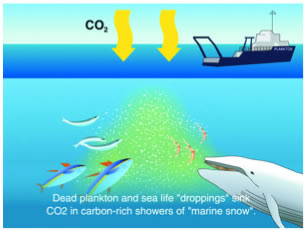
In the case in question scientists have used iron sulphate and the ocean. The iron is dropped into the water which causes a chain if events that pulls the carbon from the atmosphere, hopefully for good.

Ocean Fertilization Technique

The iron in powder form stimulates the growth of algae that lives for about 3 to 4 weeks. Their growth relies on carbon from the air, drawn through photosynthesis. When the algae dies or is eaten and excreted it sinks to the bottom taking all of the carbon with it.

One of the scientists involved in the experiments states that a single atom of iron draws 13000 atoms of carbon from the air, a large proportion of which finds its way to the ocean floor.

Many scientists are skeptical however. The amount of carbon removed is quite literally a drop in the ocean compared to that produced, and critics argue that this insignificant result could open the gates for other geo-engineering experiments, some of which (as my previous post outlined) seem rather unwise.

Could Google’s Project Glass actually work?

Once again science fiction is turning into science fact. This time, it is Phillip K. Dick’s story, “Minority Report,” and the movie that followed. In this story as a person moves around the city, they receive instant advertising and information tailored directly to them.

Google's hi-tech futuristic glassesGoogle has now taken a step in this direction with the Google Glass Project. Using mobile broadband and miniaturized hardware, the Google glasses will allow a wearer to access any information on the fly and have it project in front of their eyes as they move.

The glasses will tie into the GPS system and cell towers so the glasses will always be able to tell the wearer where they are and where they need to go. The glasses will also work as an MP3 player, cell phone, e-mail reader, and personal data assistant, and with no keypad, everything will be accessible by voice command.

Google has released a video demonstrating what their glasses will do and the video is very impressive. Of course the video is no different than the concept cars that every auto company releases in time for the annual shows, and whether or not the glasses actually make it to market is anybody’s guess.

Much of the technology is already available, especially the networking and computational tools. Already all smart phones will tell their users they are and where to needs to go, and the same smart phones have more computing power than a top of the line desktop computer had ten years ago.

As for the voice command technology, as any iPhone user will attest to, most of the capabilities of a smart phone can be accessed with the spoken word alone.

The camera on the Glasses is small, but no smaller than any other phone camera, and the capabilities of those are fully proven as well.

The most likely stumbling block for the glasses will be in the heads-up display technology. HUD, as it is commonly known, is not a new technology, the military has been using it decades now in both planes and tanks. What would be new would be the miniaturization of the equipment. The average HUD a pilot uses is incorporated into both the helmets and the plane itself, and the technology does not work outside of the plane. Google may have overcome these problems, but that will still be a very big hurdle.

Ask anyone who has attempted to use an LCD screen in the bright sun, and they will complain about the difficulty. There is no evidence that that problem has been overcome yet, but perhaps Google has solved that as well.

Finally there is the issue of distracted people. The dangers of texting or phoning and driving are evident, and a quick search on Google will show many videos of people who are unable to walk and text. The Google Glasses will take distraction to another level with people tripping everywhere.

There is no doubt that the Google Glasses or something like them is coming someday, but the question is when. Most technology experts are convinced that the video Google released is just hype and that the glasses are at best two years away and possibly even longer.