The size of the Internet – and the human brain

How many human brains would it take to store the Internet?

Last September I asked if the human brain were a hard drive how much data could it hold?

The human hard drive: the brainI concluded that approximately 300 exabytes (or 300 million terabytes) of data can be stored in the memory of the average person. Interesting stuff right?

Now I know how much computer data the human brain can potentially hold, I want to know how many people’s brains would be needed to store the Internet.

To do this I need to know how big the Internet is. That can’t be too hard to find out, right?

It sounds like a simple question, but it’s almost like asking how big is the Universe!

Eric Schmidt

In 2005, Executive chairman of Google, Eric Schmidt, famously wrote regarding the size of the Internet:

“A study that was done last year indicated roughly five million terabytes. How much is indexable, searchable today? Current estimate: about 170 terabytes.”

So in 2004, the Internet was estimated to be 5 exobytes (or 5,120,000,000,000,000,000 bytes).

The Journal Science

In early 2011, the journal Science calculated that the amount of data in the world in 2007 was equivalent to around 300 exabytes. That’s a lot of data, and most would have been stored in such a way that it was accessible via the Internet – whether publicly accessible or not.

So in 2007, the average memory capacity of just one person, could have stored all the virtual data in the world. Technology has some catching up to do. Mother Nature is walking all over it!

The Impossible Question

In 2013, the size of the Internet is unknown. Without mass global collaboration, I don’t think we will ever know how big it is. The problem is defining what is the Internet and what isn’t. Is a businesses intranet which is accessible from external locations (so an extranet) part of the Internet? Arguably yes, it is.

A graph of the internet

A map of the known and indexed Internet, developed by Ruslan Enikeev using Alexa rank

I could try and work out how many sites there are, and then times this by the average site size. However what’s the average size of a website? YouTube is petabytes in size, whilst my personal website is just kilobytes. How do you average that out?

Part of the graph of the internet

See the red circle? That is pointing at Technology Bloggers! Yes we are on the Internet map.

The Internet is now too big to try and quantify, so I can’t determine it’s size. My best chance is a rough estimate.

How Big Is The Internet?

What is the size of the Internet in 2013? Or to put it another way, how many bytes is the Internet? Well, if in 2004 Google had indexed around 170 terabytes of an estimated 500 million terabyte net, then it had indexed around 0.00000034% of the web at that time.

On Google’s how search works feature, the company boasts how their index is well over 100,000,000 gigabytes. That’s 100,000 terabytes or 100 petabytes. Assuming that Google is getting slightly better at finding and indexing things, and therefore has now indexed around 0.000001% of the web (meaning it’s indexed three times more of the web as a percentage than it had in 2004) then 0.000001% of the web would be 100 petabytes.

100 petabytes times 1,000,000 is equal to 100 zettabytes, meaning 1% of the net is equal to around 100 zettabytes. Times 100 zettabytes by 100 and you get 10 yottabytes, which is (by my calculations) equivalent to the size of the web.

So the Internet is 10 yottabytes! Or 10,000,000,000,000 (ten thousand billion) terabytes.

How Many People Would It Take Memorise The Internet?

If the web is equivalent to 10 yottabytes (or 10,000,000,000,000,000,000,000,000 bytes) and the memory capacity of a person is 0.0003 yottabytes, (0.3 zettabytes) then currently, in 2013, it would take around 33,333 people to store the Internet – in their heads.

A Human Internet

The population of earth is currently 7.09 billion. So if there was a human Internet, whereby all people on earth were connected, how much data could we all hold?

The calculation: 0.0003 yottabytes x 7,090,000,000 = 2,127,000 yottabytes.

A yottabyte is currently the biggest officially recognised unit of data, however the next step (which isn’t currently recognised) is a brontobyte. So if mankind was to max-out its memory, we could store 2,127 brontobytes of data.

I estimated the Internet would take up a tiny 0.00047% of humanities memory capacity.

The conclusion of my post on how much data the human brain can hold was that we won’t ever be able to technically match the amazing feats that nature has achieved. Have I changed my mind? Not really, no.

Taxing the Smartphone

On Monday a report was released in France that contained the suggestion that a tax should be levied on Internet devices in order to raise money to promote and protect French cultural production.

A Tax Paid Phone

A Tax Paid Phone

For several years France has had a policy of taxing broadcasters and spending the money on supporting its own film and entertainment industries, but revenues are falling. The problem seems to be that many more people are accessing their entertainment via the Internet and therefore not contributing to its production cost.

The Lescure report as it is known suggests a tax of between 1 and 4% on any Internet capable devices (smartphones, eBook readers and games consoles included), but as we might imagine many of the producers of these devices are not happy about the proposal.

Money has to be raised to maintain the entertainment industries, but many of the companies that provide access to this entertainment are not based in France and do not contribute. They probably don’t want to either, and so we come across the same problem that I wrote about last week, collecting national taxes from international corporations based in another state is never easy, and borders are porous.

The proposed tax would replace one already in existence upon storage devices. Currently tax is levied on blank CD’s and memory sticks as well as computers with hard discs.

The manufacturers complain that the price of the devices would rise leading to fewer sales, although the author of the report argues that such a small percentage increase would make little difference, and would not even effect the home job market because most of these devices are assembled overseas. A 1% tax would raise something of the order of 90 million Euro a year.

The problem remains though. As our sources of entertainment move away from pay TV, publicity funded channels and national subscription systems such as the BBC, money is taken away from the producers and associations that represent and fund these industries. Some see the fact that Google and Apple amongst others are operating outside the tax system and are not contributing to the industries that they make their money from as unfair, and hope that this change in tax law will go some way to evening out the field.

The Wall Street Journal goes into a little more depth on the matter in its free online edition.

I wonder if France takes this step if others in the EU will follow. There are many different ways of making money through so called free downloads as we all know, but the money ends up in the pockets of the provider and not the producer and the industries involved are feeling the pinch. Maybe this needs to change.

Monitive – 1 year on

Last year the founder of Monitive.com, Lucian Daniliuc, contacted me, asking if we wanted to run a competition to giveaway 10 Monitive licenses; I accepted and we launched our first ever competition.

I was also given a Monitive account, and have been using it for a year now. In this post I am going to review my experience of the service after a years use.

Latency

One of the main things I use Monitive for is to monitor site response times. Latency is very important, and can have a huge effect on traffic, as the longer people have to wait, the more people you loose before the page loads.

With superfast broadband, many of us are becoming incredibly impatient, and if something isn’t responding, we might ditch a site in a matter of milliseconds.

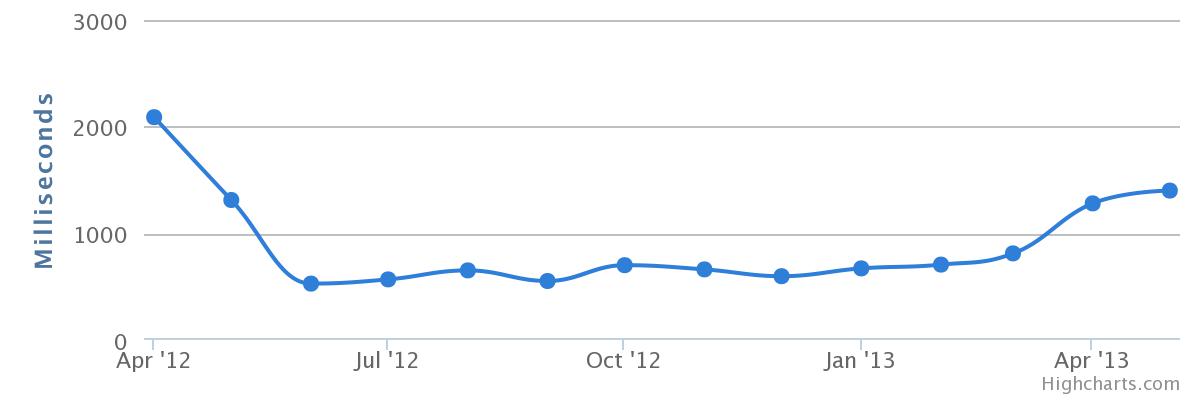
Before using Monitive, I had no idea how long Technology Bloggers took to respond. Monitive allows me to see on a daily basis how long the blog takes to respond, in multiple locations, all around the world. I know that if you live in Liechtenstein or Ireland, the blog on average seems to take around half a second (500 ms) to respond. In the UK it’s about 0.6 seconds, whereas in the USA, it takes just over a second.

This lets me ask the site’s host why the latency varies so much, and ask them what they can do to improve global response times.

Response times Technology Bloggers - April 2012 to April 2013

A chart showing the average global response times of Technology Bloggers.

Uptime

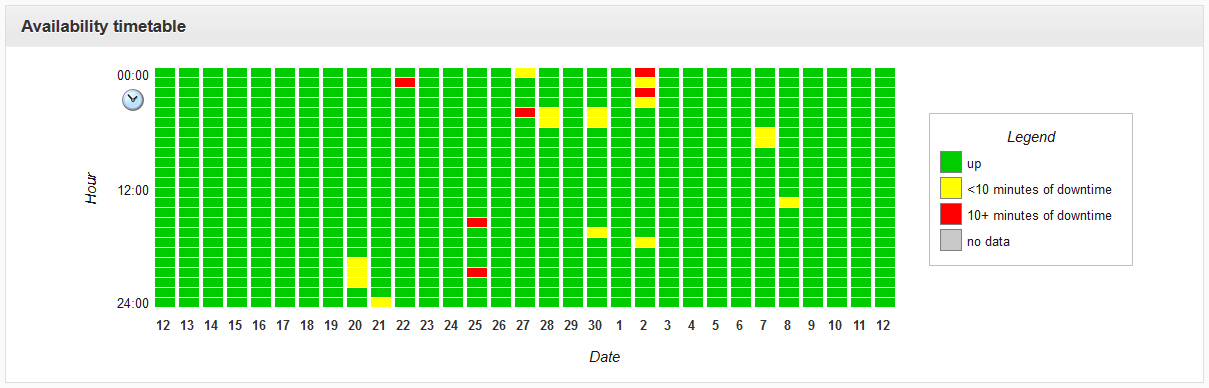
Whilst response time is important, it has no value if your site is offline. Monitive is accessing Technology Bloggers every 5 minutes from hundreds of locations around the world, to ensure that the site is live and accessible. If the blog goes offline for more than 3 minutes, I am sent an email. These are my personal settings, you can make checks/notifications more/less frequent, and can get notified via SMS and Twitter.

Quite disappointingly I report that Technology Bloggers went offline 23 times in the last 30 days. During this period, you couldn’t access the site for more than 10 minutes on 6 occasions. If I wasn’t using Monitive, I would only have spotted one or two of these outages myself. I can now report these to the site’s host, and ask why the site has gone offline so many times.

Uptime graph 2013

A chart of the uptime and downtime Technology Bloggers experienced in April/May 2013.

Unless you pay for load balancing, to mirror your site on various servers across the world, and effectively distribute traffic, to ensure 100% uptime, you should expect some downtime. It is expected that most sites will have some go down at some point, however how frequently this happens, and how long they remain offline for is something to consider.

We have a 99.9% uptime guarantee on the blog, yet this year so far, uptime has been 99.85%, meaning around five hours of downtime has occurred this year already.

Improvements

One thing I don’t like about the service is that it doesn’t allow on demand checks. I think it would be very useful to be able to check the status (including response time) of a site at a desired location, whenever you want; but as of yet, this can’t be done.

As I have set Monitive to check the blog every 5 minutes, and then notify me after 3 minutes of downtime, it can be a while before the system updates. For example, if the site is checked at 13:00 and at 13:01 I check and the site is down, it wont be checked again until 13:05, and I wont be notified until 13:08. In such a situation, being able to check the current status, could be useful.

Chadrack

One of the winners of our Monitive competition was Chadrack Irobogo. I asked him what he thought of the service.

“I can say, it was great because throughout the period I was able to know what was going on with my site. Before then, I really did not know anything about site monitoring. It was during the use of this program I learned when my blog was either down or up. And all of these was done without my doing anything. Unfortunately, I cant really give any details about the program. Only thing I can say is, it is really good.”

I agree with Chadrack on his point about the service being an eye opener to downtime. I really didn’t understand how often sites go down, even if only for very short periods of time.

Like Chadrack, Monitive is the first commercial website monitoring service I have used, so I don’t know how Monitive compares to its competitors. I am however suitable impressed by their services to want to keep using them.

If you are interested in Monitive’s services, do check out their uptime monitoring website. I have found website monitoring very useful, and am thankful to Monitive for my license, and for giving us prizes for our competition last year.