Wasted Food

It is estimated that in the USA between 40 and 50% of all food produced is wasted. There are about 320 million people in the US, so we could safely say that this wasted food could feed at least 100 million people.

The European Union fares little better. According to the European Commission about 90 million tonnes of food is wasted annually in Europe alone, with global waste at about 1.3 billion tonnes. In developing countries, over 40% of food losses happen after harvest and during processing, while in industrialized countries, over 40% occurs at retail and consumer level. According to the US Food and Agricultural Organization food waste in Europe alone could feed 200 million people, and that if global waste could be cut down by 25% it would give enough food to feed 870 million hungry people.

Obviously the so-called developed nations are the worst offenders. Per capita waste by consumers is between 95-115 kg a year in Europe and North America, while consumers in sub-Saharan Africa, south and south-eastern Asia, each throw away only 6-11 kg a year.

The main causes of waste are:

  • Lack of awareness, lack of shopping planning, confusion about “best before” and “use by” date labels, lack of knowledge on how to cook with leftovers (households).
  • Standard portion sizes, difficulty to anticipate the number of clients (catering);
  • Stock management inefficiencies, marketing strategies (2 for 1, buy 1 get 1 free), aesthetic issues (retail);
  • Overproduction, product & packaging damage (farmers and food manufacturing);
  • Inadequate storage (whole food chain);
  • Inadequate packaging.

Fortunately the EU offers a free downloadable brochure explaining how as an individual you can cut down on waste, get it here.

But most of the waste comes from industry, with millions of tonnes of food thrown into skips at the back of supermarkets every day. Systematic waste we might call it, but what can be done about it?
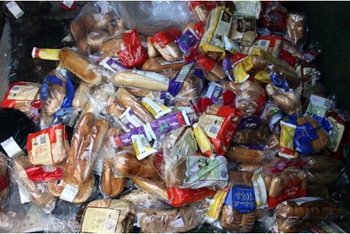
Plenty of bread products

Plenty of bread products

Well let me tell you a story, I have a friend who describes himself as a freegan, he only eats free food, and he eats well. He lives in a large housing cooperative in Massachusetts, and he does the shopping for the entire group. He has his rounds, every Wednesday he goes to the orange juice processing plant and gets a few gallons of discarded juice. On Thursday a supermarket, on Friday after the farmer’s market there are boxes of discarded vegetables, if he didn’t have a trailer he would need a truck!

I must warn you though that climbing into the skip outside your local supermarket might be dangerous or illegal. In Germany, England and Wales for example it is theft, although rarely prosecuted. In Italy it is legal, but in the US you may be charged with trespass.

And plenty to drink

And plenty to drink

Here is a great article about what they call in the US dumpster diving, with an interesting shopping list of what was found, and the pictures in this post are taken from the event.

And it is not just rotten old tomatoes here we are talking about. Many things that are close to their sell by date are thrown out. In Cambridge Mass where I live there is what I refer to when speaking to my kids as ‘the expensive coffee shop’. It is good coffee, and the cakes are fantastic, but it is a little on the pricey side. But if you go 10 minutes before closing and buy a coffee they offer you a free cake, and as they are pushing you through the door at closing time you are expected to take scones, cakes and left over bread home, for free. Better than throwing it out they say, and they are right. It does however pose a problem for the economy, with people like me giving their secret away and the place filling up 5 minutes before closing time, although you have to be shameless to go every day (get your friends involved).

One thing that we have lost is the skill of home preserving foods. When we have all of these extra ripe vegetables we eat what we can, but when there are just too many they end up in the bin. Well if we learned to pickle food we could preserve it and avoid all of these problems, there are plenty of pickling lessons on YouTube, you can also freeze almost anything if you know how to do it correctly.

If you are not up for climbing into a skip and you are ever in Copenhagen, why not try the restaurant that serves only waste food? See this report on the BBC, it looks good, and I am glad to see someone is doing something with all of this good valuable nutritious stuff.

And the moral of this weeks story is that people are hungry because of economics, politics and logistics, not because there isn’t enough food to go round. You might like to think about that when the industrial agricultural food companies are touting GM as the answer to global hunger.

GM, Blowing in the Wind

The Sciencemag website has an article that will lead me into today’s post, about an organic farmer in Australia who has taken his neighbour to court over GM contamination. The organic farm has traces of GM materials that have apparently blown in from the neighbouring farm, leaving authorities no choice than to take away the farm’s organic certification.

This has of course led to a loss of income, and so the owner is suing for $85,000 to recoup his losses.

Now although there are standards about leaving space between GM and non GM plantation, it has become increasingly clear that contamination is somewhat inevitable, and this is reflected in regulations.

In the US a farm can have organic status even in 5% of its produce is found to be GM (presumably from air borne contamination). In the EU 0.9% is allowed, reflecting a tougher stance but demonstrating the impracticalities of a total ban.

In Australia though they do have a zero tolerance standard, so any traces of GM lead to the loss of license.

100% Organic

100% Organic

We might wonder if the organic farmer will win his court case, because how can the GM farm stop their materials blowing in the wind? Can it possibly be the GM farmer’s fault? Well precedence suggests that it might well be, because in a reverse situation contamination has been dealt with.

Just a month ago the US supreme court upheld biotech giant Monsanto’s claims on genetically-engineered seed patents and the company’s ability to sue farmers whose fields are inadvertently contaminated with Monsanto materials.

The high court left intact Monday a federal appeals court decision that threw out a 2011 lawsuit from the Organic Seed Growers and Trade Association and over 80 other plaintiffs against Monsanto that sought to challenge the agrochemical company’s claims on patents of genetically-modified seeds. The suit also aimed to curb Monsanto from suing anyone whose field is contaminated by such seeds.

The case is Organic Seed Growers and Trade Association, et al., v. Monsanto Company, et al. Supreme Court Case No. 13-303 if you would like to look it up, and as I say above one of the aims was to take away the possibility of a farmer being sued for inadvertent contamination, but this aim was not reached. Monsanto state that they have never sued anyone in this position and would not sue any farmer whose farm was found to have less than 1% contamination, and some interpretations suggest that the ruling seems to have made this binding.

It does look as though the contamination issue is causing some headaches for all parties involved.

Now I would like to think about how these rulings intact with other. Let’s take the Australian court case. If the organic farmer wins, other GM farmers will start to worry about their own liability and worry about planting their crops. This might lead to a slow down of the spread of the crops, to the cheer of the organic communities. But it will not help bring about a peaceful co-existence, which is a reality today, so might lead to regulators deciding that their zero policy approach needs a rethink. So maybe they will decide to enact a more US or European stance, and allow a percentage within organic certification, thus relieving the stress from the situation, leading to a more manageable co-existance and possibly aiding the spread of GM products, (probably not the organic farmer’s intended result).

On the other hand, the GM farmer might win, relieving the burden from other GM producers, leading to a more manageable co-existence and possibly also aiding the spread of GM foods.

Alternative Food Provisioning Networks

As a continuation of my food series, I would like to take a look at alternative food provisioning networks, via a review of Italian anthropologist Cristina Grasseni’s new book ‘Beyond Alternative Food Networks’. The book describes strategies used by groups to avoid interaction with the industrialized food mechanism, much of which I have debated in the other posts in the series.

Beyond Alternative Food Networks

Beyond Alternative Food Networks

Grasseni’s book gives an account of the inner workings of Italy’s solidarity purchase groups. These groups are informal collections of families, working together to procure food and other products from mainly local producers in order to reclaim sovereignty over their purchasing.

The model is extremely innovative, both in terms of its positive health and social benefits and financial implications. Groups make agreements with local farmers to buy their produce in return for guarantees regarding production processes (organic, tax paid, worker’s rights etc). The producer benefits because they can sell their produce directly to the consumer, and so is not held hostage by distributors and retailers. The consumer gains because they know who has produced their product, how, where and under which conditions. Group members can buy hygiene and baby products, detergents and a range of household goods through the network, offering a source of income to specialist socially and environmentally friendly producers.

Although this system might sound like a Utopian fringe, Grasseni points out that the groups spend about 80 million Euro a year in Italy alone (about $110 million), in effect moving this sum from the regular economy into this more direct exchange. The number of groups is in rapid expansion and has led to the creation of networks of groups, national conferences and organizations and even the creation of ‘districts of solidarity economies’.

The book argues that this alternative economics structure is trust based, with all parties within the transaction knowing and directly relating with the others. Several organizations work entirely within the structure providing goods only for the groups. The following examples of the dairy and the shoemaker really show the potential of the model.

In 2009 a local dairy farmer converted to organic production in order to supply these groups. This involved downsizing and specialization, but several years later the farm found itself in financial difficulty. Members of the groups ran an email campaign and in about a month raised 150 000 Euro (more than $200 000) to bail the dairy out. The money was passed on, the dairy survived and now produces milk and cheese for the very same groups that saved it. With the banks no longer involved, the farmer can sell the produce at retail prices directly to the groups and make enough money to live and repay the initial bailout loan.

The story of the shoemaker is similar. After being forced into downsizing the shoemaker was left with capability but little market. He withdrew from the mainstream economy and now provides made to measure shoes through the network. There is a traveling catalog, so once found you can choose a style and size and order your new shoes that then arrive through the post. They are also sold through a network of non profit organizations that have relationships with the groups.

This book certainly leads the reader into a new way of thinking about food production. The cover contains a quote from Peter Utting, Deputy Director of the united Nations Research Institute for Social Development. He states that “Grasseni provides fascinating insights into how alternative approaches to food provisioning can transform social and economic relationships in ways that bode well for contemporary global challenges of sustainability, social justice and rebuilding human relations built on trust”.

If you would like to learn more about these alternative approaches, take a look at the following links:

Rete Gas is the Italian national GAS network.

The Food Alergy and Anaphylaxis Network has a dedicated page.

The Grassroots Innovation website also has plenty of information.

Beyond Alternative Food Networks by Cristina Grasseni is published by Bloomsbury and available through Amazon via the link above.

I would like to add that although this review is not paid, I do know the author very well. I am also a GAS member.