The Online GM Foods Debate

gm-picGM Experiences

A few weeks ago I was invited to Vienna to participate in a 2 day workshop on Responsible Research and Innovation in the Context of GMO. Obviously, these two topics being my main interests in life, I accepted, and off I went with my extremely stylish new laptop/overnight bag to an equally stylish country hotel.

It was a really interesting weekend. The other participants were scientists, members of regulatory bodies and governmental institutions, professors and other professionals from across Europe. I should say that this weekend was part of a much larger project called RES-AGORA, which is funded by the European Commission. You can read all about it here.

If that tickles your fancy here is the 60 page long Stakeholders Report.

But anyway back to the experience of a Luddite blogger in a posh hotel. I learned a lot about genetic modification, legislation, the problems of getting seeds to test, companies not making life easy for those testing or reporting, property rights and their effects over publication possibilities, loopholes in laws in different countries that allow people to legally buy seeds without a contract with the manufacturers (oh don’t get me started), and it got me thinking about writing an article.

So I did, and got it published here, in an Italian online academic journal.

Writing Skills

Now why is this of interest to you I hear you ask. Well I wrote this article basing much of it on the food series that I wrote here  on Technology Bloggers last year. In writing the series I unearthed a real underbelly of food production, and a little organization and rewriting, updating, selecting and expanding, and I had an academic article. You can download it for free here if you like.

The article raises the issue of how the GM debate is played out online. The problem it seems (to me) is that there is no forum for constructive debate about GM, and this leads to a polarization of positions. So we can imagine a scenario in which website “A” points out as many problems as the author can think of, ethical issues, exploitation, altering nature, global takeover of seed production, and other nasties. In the same scenario website “B” is glossy and tells us that only GM will be able to produce enough food to feed an ever growing population, that it is all safe, that they are spending money on research just to help us out….

The problem is that in all scenarios website C is the same as website A, and D is the same as B and so on. There is little room for debate about GM in organic fuel production, or any other possible uses. It is the goodies against the baddies, and the baddies have more money, friends and power. The goodies however don’t seem to have a broad enough base to attack from.

Now the article looks nothing like the blog series I grant you, nor does this 2 paragraph description above, and I have to say that a lot of work went into the article. But having done all of the research for the series gave me a really good grounding. Now I am sure that many readers have written blogs that follow long and intricate lines of argument, but I wonder how many have thought about writing an article for a journal, newspaper or magazine and submitting it? It certainly broadens your writing capabilities, and if you feel you have something important to say it gives access to different readerships.

And it looks good in the portfolio and on the CV!

Dinosaur Developments

boston museum

Dinosaurs

Like many Bostonians a great deal of my time in that fair city was spent in the Museum of Science. It is a fine museum, well suited to children. They have some incredible lightening making machines, a bed of nails that you can try out yourself, and lots of dinosaurs.

And outside the front door they have a model of a T Rex, you can see it in the photo. This model T Rex was built and placed in 1972, and here lies a story. We might feel that this great beast has been part of our culture for many years, it was first described in 1905, but the first almost full skeleton was only found in 1990 in South Dakota.

Now if you look at the model you see an upstanding T Rex, but the model is not a good replica. These dinosaurs did not stand erect like that, they were much more laid back in their posture due to their size and a considerable tail.

Here below we see the reconstruction of Sue, the first almost complete skeleton brought to life in 1990 and mentioned above. Now Sue is well balanced, looks even more ferocious, and somewhat resembles a flightless bird. Just think how quickly science is developing!

Meet Sue

Meet Sue

Birds and chickens

So here I get to the meat on the bones. Birds seem to have evolved from dinosaurs, some dinosaurs even had feathers, and recently scientists have managed to create a chicken embryo with a dinosaur-like snout and palate, similar to that of small feathered dinosaurs like Velociraptor. The results are published in the journal Evolution. You can read the abstract here.

They did not hatch the embryo, but manipulated genes that deal with facial development in birds, until the beak started to look more like a dinosour or aligator mouth. See the photo below taken from the BBC article on this story.

From Beak to Snout

From Beak to Snout

This is an interesting line of research. I am not worried about a Jurassic Park scenario, but it does seem to open a world of opportunities , and I am not sure that all of them have been explored. I wonder how far it could go?

Experiences of an Online Conference

adobe

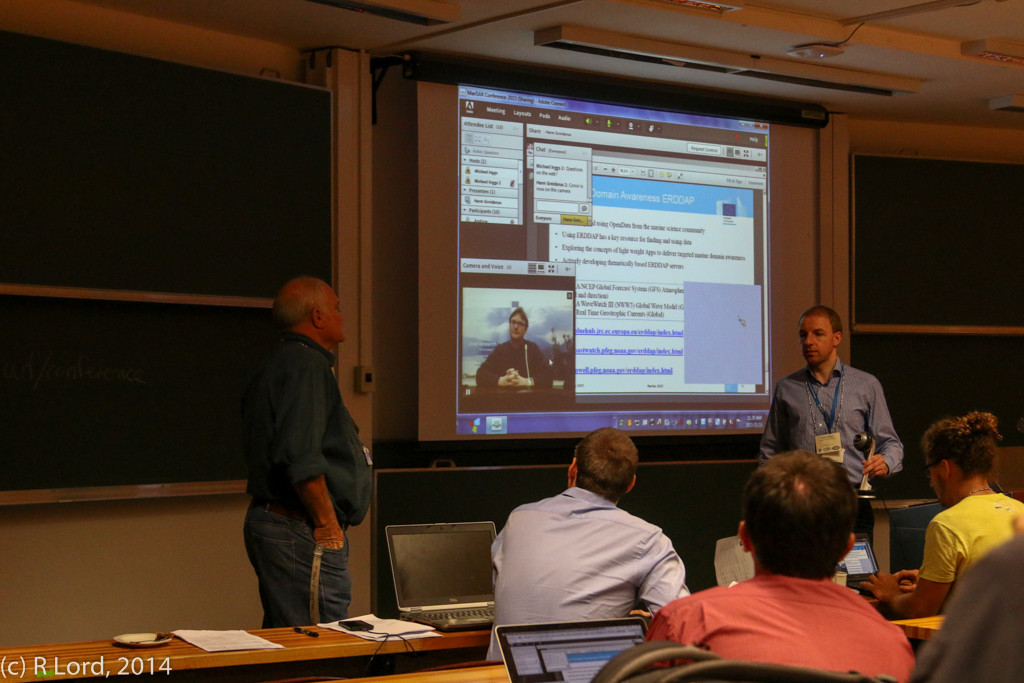
Online Conference

Last month I attended a conference with a difference, The INSS annual meeting was held in 5 different cities at the same time, as well as online, in an attempt to cut down on travel for participants. I attended the London site and was one of only 2 people to fly to the event. This is remarkable considering that last year we all met in North Carolina and dozens of people flew internal and trans continental legs.

The physical Conference was held at UNC Charlotte in North Carolina, Oregon State university, Arizona State University, Michigan State University and University College London.

Very much an experiment, the practicalities of conducting a conference over several different time zones posed some issues, with early starts for those on the US West Coast and late finishes for those in Europe. The technology worked incredibly well, with very few glitches over the days’ events. Participants were able to ask questions, follow seminars in any of the sites they chose, and interact with the poster and key note presenters using online media.

The event was run out of North Carolina, and the web management was all taken care of from that site. I must say that I was rather skeptical at the beginning, having lived with Skype developments over the years, but how wrong could I be?

Communication Technology

The communication was taken care of using Adobe Connect, so anyone could participate through their own computer or by visiting any of the sites. We in London lost the last 5 minutes of a discussion after one of the lectures, but for the rest it all worked perfectly.

Now as someone who travels to a lot of these kinds of things I can only marvel at the progress made. Each site shared some seminars and papers, but all had different agendas. The London agenda included a day of field trips, as well as as a panel during which presenters discussed their experiences of building the Engineering Exchange, a university lead action group whose aim is to bridge the gap between communities and planners preparing urban regeneration projects. Read the abstract here.

We also toured some of the capital’s largest redevelopment projects, including a visit to Crossrail, a huge rail link and urban regeneration project that cuts through central London. A guided tour of the Elephant and Castle redevelopment area with the interest group “Social Life” followed, a context of urban regeneration that has caused many locals to question both existing and future plans in that area.

The context was also helped by the involvement of a member of a local interest group that aims to support people whose houses are under threat, and promote the idea of refitting houses to maintain communities, rather than rehousing and rebuilding. There is a lot more to think about in urban regeneration that you might imagine.

The Network

The closing panel was hosted in Charlotte and entitled Social Sustainability Initiatives in Planning and engineering Organization. Full details of all the participating site agendas can be found on the INSS website.

The network is open to all interested in participating, so keep an eye on the website for further information. We volunteer our time, we learn a lot, we try to raise social sustainability issues, and we always have a bit of a social at every event. I must say that the multi-site format was a worthy experiment that worked extremely well, and I think could offer a model for future events. Is the era of the online conference coming to life? Looks like it to me.