Apple and some bad press

This week I would just like to do a short follow up on Christopher’s article entitled Why do we stick by Google and Apple but not Microsoft?

I will start with a little story about my 6 year old boy. He loves making things and last week he made a laptop computer from cardboard. It has keys with letters on it, a mouse and a black screen with icons. When it was finished he showed it to me, pointing out the detail, and said “I am not going to put the apple here on the top though, because they don’t all have apples”.

This is the power of branding. In a few years when he wants a laptop of his own what will he want? The one with the apple?

My kind of branding

My kind of branding

Recently though here in the US I have met a few people that do not use Apple products in principle. The reason I think is the bad press that their working practices have received in US newspapers.

I am not in any way endorsing these reports, but I feel that they are worthy of analyzing in a bit of detail, both for their content and their political or ethical standpoint.

The New York Times ran an entire series in which it looked at the human costs of the iPad and apple revolution, and you can read it here (not too long).

The opening lines speak of an explosion in which 2 people were killed as they polished iPad cases. This is not the only reported explosion either, and there are plenty of cases of people being burnt as they use chemicals without proper safety procedures, excessively long days spent entirely stood up and child labour.

It is not just Apple though that use these manufacturing plants however, and the scale of the operations is incredible. One of the names often cited for criticism is Foxconn, and they do a lot of Apple’s assembly. They have 1.2 million employees in China, some plants have more than 100 000 workers, they operate 24 hours a day, can call upon their work force at any time and start production within minutes of receiving orders. This is what the technology of today requires and produces.

Apple do have a code of conduct within its supply chain, drawn up and expanded upon since 2005. Audits are conducted and violations unearthed and they say that this is a sign of their commitments to improvement, but some say that the fact that they problem is continuous points to a toleration of non compliance.

Last year they found 4 deaths and 77 injuries within their production system, and several suicides. Now one death or injury is too many, but with a workforce of well over a million accidents will happen, and some might even see this as a good record. Apple state that they train their workforce and explain their rights to them.

One thing is for sure, the stakes are high and there is a lot of money to be made but Apple is a demanding company. And they are not the only ones with dodgy working practices, but seem to be singled out for criticism.

Why might that be I wonder? Maybe it is because as Christopher hinted they inspire such loyalty amongst their users, and some circles do not like that.
E-Waste and Computer Recycling

I am by no means a ‘techie’ as Christopher calls himself, but a quick look round my house reveals a quite astounding history. In various cupboards I find an HP desktop computer from about 10 years ago, very rarely if ever used, another obsolete Hitachi desktop from 15 years ago, my last Chinese laptop (the lid broke off), an IBM Thinkpad, an HP laptop, an old Vaio and even an Ollivetti laptop from 20 years ago.

I have never thrown them out for various reasons, one being security, another being that one day I might need my undergraduate dissertation for something and the third being that I want to know what happens to them when they are taken away.

Recently I have learned that all is not quite what it seems with recycling of computers too, and this makes my quandary all the more difficult.

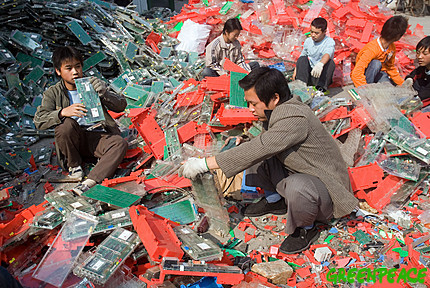
Chinese workers take apart electronic trash on the street in Guiyu, China.

Several companies offer to recycle your old computer for you, and an enormous industry has grown up around the trade in old technology. In China entire cities have been born that specialize in taking our old stuff, but I feel that recycling is a bit of a big word to use for the ensuing process, as it has positive connotations. The computers are dismantled and all of the re usable pieces taken away, then the rest is dumped in a large pile. People from the surrounding areas scratch a living by doing a bit of home made scavenging, be that boiling components on their cooker at home or dipping cables in acid baths to extract the tiny bits of semi precious metals that they contain. Obviously this is done without regulation, and the results are often poisoning for those involved and the surrounding areas. See this photo essay about the city of Guiyu pictured above, probably the largest e-dumping ground on Earth today, and where a large portion of the products in question end up.

Another possibility is that the computers are shipped as donations to the Third World. These donations come in containers, not packaged in cardboard however but just thrown in, so although some do work, the majority don’t. The recipients have to unload them and try each one to see if it is usable. Those that don’t have to be dumped, and can be found piled up in heaps or abandoned by the roadside outside the larger African Cities, again to poison the ground etc.

This video from Ghana goes into greater detail.

India has some recycling sites and used to import waste for processing but now the problem is that the country itself is now a major producer of waste as it becomes one of the most technology saturated countries on the planet. And India is not alone, consumer societies all over the ex developing world are hungry for new technology, and obsolescence is just round the corner. This short article in Time expands upon the argument.

Large sums of money are involved as we would imagine, but the industry is practically non-regulated in real terms. Government regulation does exist but with the majority of the work carried out in the informal economy it is not adhered to, and dirty job as it may be it provides income for hundreds of thousands of poor migrant labourers.

And we are speaking about a problem that can only get worse. I personally don’t think it has to or should be like this however, it is not fair and it is exploitation, and so my question is ‘what can be done about it?’ Or more correctly ‘what can we do about it?’ We are the guilty party after all.

Sony use crystal LED display in next generation TVs

Sony, a global leader in gadgets and technology, has managed to stun the world again. This time it has come up with a new Crystal LED TV technology, which it introduced at the Consumer Electronics Show (CES) 2012, which took place this January.

The future technology is being developed to give consumers the best TV watching experience. The company is known for introducing innovative products and the Crystal LED (CLED) technology is just another addition to the growing list.

Crystal LED Display Feature

The company displayed its 55” prototype crystal LED TV, which apparently has about 6 million LEDs to create a complete HD image. These LEDs put together create a superior quality 1080p image. Each RGB color uses 2 million pixels. The technology is something new and different from the other HD TVs.

A Sony televisionThe technology creates high quality images that are brighter as it uses the 6 million micro LEDs as the source of light for the television. The LEDs are mounted on the front of the display and therefore require no extra backlight source, which is why this technology is also referred to as self-emitting display technology.

The TV, according to the Sony, has enhanced features like better response times, more brightness, better scope for contrast and wider range of colours compared to the other TVs. The Crystal LED display is also said to be “ideal for large screens”.

The contrast is said to be 3.5 times higher and the brightness of the TV is said to be over 400cd/m2. Video images have a greater response time that is about 10 times better than the other Sony TV models. The TV has a resolution of 1920X1080 pixels and the angle of viewing is close to 1800.

One more positive of this technology is the amount of power consumed by the TV. According to the company, it consumes less than 70W of power. The TV has an incredibly thin structure that is only about 4mm deep and 7.6mm thick.

The Future of TV

The new technology increases the life of a TV as there are no any organic materials like Organic Light Emitting Diodes (OLEDs) used. The problem of colours fading over time on OLED TVs can be effectively solved by this technology. It ensures that the rich colours of the TV remain intact for a longer time.

The product has already created a buzz and the reviewers have also been kind. Sony has managed to attract eyeballs with this next generation technology. It has been touted to be the next big thing in consumer electronics industry, which means that the plasma and OLED TVs have serious competition.

The company is yet to give out a date of release and the cost of the TV. Since the crystal LED technology is more “stable” and might lead to lesser manufacturing errors, Sony claims that the price of the TV would be lower than OLED TVs. Consumers will just have to wait until the company launches the final version of the TV in the market.