To Die for Science

This week the weather has been pretty wild here in the USA, with dozens of people killed by tornados in the Oklahoma area. One of those killed is world renowned scientist Tim Samaras. He was killed alongside his son Paul and research assistant Carl Young as they were doing their rather dangerous job.

The Samaras Team

The Samaras Team, Tim, Paul and Carl Young

Samaras was a Severe Storms researcher, much of his funding coming from the National Geographic magazine. He might have just seemed like a storm geek to some, but his pioneering work has helped us to predict and understand these types of storms a lot better.

He and his team worked for decades on how to predict where and when tornados would form, so that they could race to the spot and leave their battery of measuring and photography equipment inside the storm.

They developed a probe that took measurements within the tornado itself, helping forecasters to determine where storms may form and to give warnings to people living in its path. The new generation of this probe measures pressure drops within tornadoes, the very cause of the high winds that characterize these storms, alongside other data that can be used to determine the destructive capability of the storm.

The team has also pioneered storm photography, devising a high speed series of cameras that can take pictures from different angles inside the storm. His photography work around lightening has helped to push scientific understanding of the phenomena.

These were not some reckless guys driving around looking for danger as some might think, Samaras was a scientist, a meteorologist, an adventurer and an engineer. His team were experts in their field, highly educated and determined, and they will be sadly missed within their community.

Their approach seems to hark back to a day of science pioneers, Marie Curie dying of radiation sickness through her work on radiation therapy, or Jean-Francois De Rozier, the first ever air crash death as his balloon crashed to the ground in 1783.

The fruits of their research live on today though, as will those of Samaras and his team.

For more information about their work look up their TWISTEX Facebook page.

The size of the Internet – and the human brain

How many human brains would it take to store the Internet?

Last September I asked if the human brain were a hard drive how much data could it hold?

The human hard drive: the brainI concluded that approximately 300 exabytes (or 300 million terabytes) of data can be stored in the memory of the average person. Interesting stuff right?

Now I know how much computer data the human brain can potentially hold, I want to know how many people’s brains would be needed to store the Internet.

To do this I need to know how big the Internet is. That can’t be too hard to find out, right?

It sounds like a simple question, but it’s almost like asking how big is the Universe!

Eric Schmidt

In 2005, Executive chairman of Google, Eric Schmidt, famously wrote regarding the size of the Internet:

“A study that was done last year indicated roughly five million terabytes. How much is indexable, searchable today? Current estimate: about 170 terabytes.”

So in 2004, the Internet was estimated to be 5 exobytes (or 5,120,000,000,000,000,000 bytes).

The Journal Science

In early 2011, the journal Science calculated that the amount of data in the world in 2007 was equivalent to around 300 exabytes. That’s a lot of data, and most would have been stored in such a way that it was accessible via the Internet – whether publicly accessible or not.

So in 2007, the average memory capacity of just one person, could have stored all the virtual data in the world. Technology has some catching up to do. Mother Nature is walking all over it!

The Impossible Question

In 2013, the size of the Internet is unknown. Without mass global collaboration, I don’t think we will ever know how big it is. The problem is defining what is the Internet and what isn’t. Is a businesses intranet which is accessible from external locations (so an extranet) part of the Internet? Arguably yes, it is.

A graph of the internet

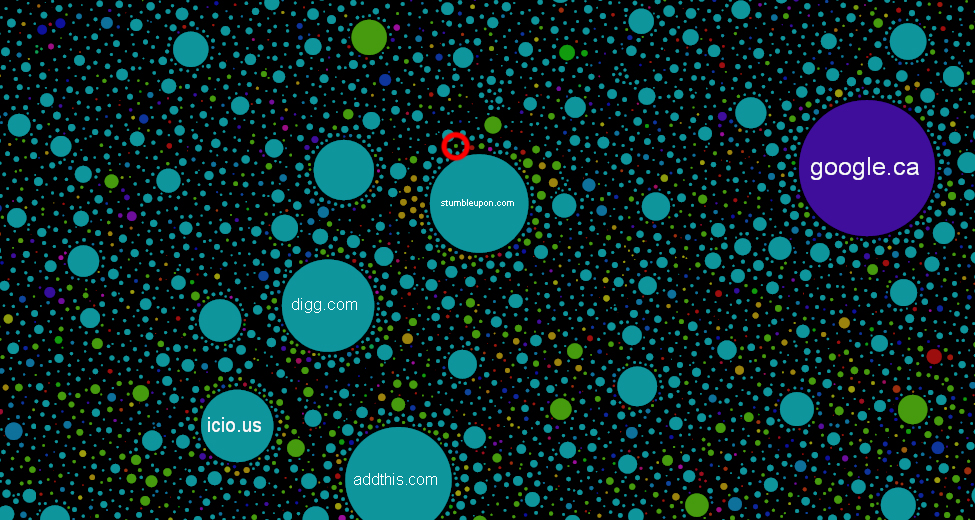
A map of the known and indexed Internet, developed by Ruslan Enikeev using Alexa rank

I could try and work out how many sites there are, and then times this by the average site size. However what’s the average size of a website? YouTube is petabytes in size, whilst my personal website is just kilobytes. How do you average that out?
Part of the graph of the internet

See the red circle? That is pointing at Technology Bloggers! Yes we are on the Internet map.

The Internet is now too big to try and quantify, so I can’t determine it’s size. My best chance is a rough estimate.

How Big Is The Internet?

What is the size of the Internet in 2013? Or to put it another way, how many bytes is the Internet? Well, if in 2004 Google had indexed around 170 terabytes of an estimated 500 million terabyte net, then it had indexed around 0.00000034% of the web at that time.

On Google’s how search works feature, the company boasts how their index is well over 100,000,000 gigabytes. That’s 100,000 terabytes or 100 petabytes. Assuming that Google is getting slightly better at finding and indexing things, and therefore has now indexed around 0.000001% of the web (meaning it’s indexed three times more of the web as a percentage than it had in 2004) then 0.000001% of the web would be 100 petabytes.

100 petabytes times 1,000,000 is equal to 100 zettabytes, meaning 1% of the net is equal to around 100 zettabytes. Times 100 zettabytes by 100 and you get 10 yottabytes, which is (by my calculations) equivalent to the size of the web.

So the Internet is 10 yottabytes! Or 10,000,000,000,000 (ten thousand billion) terabytes.

How Many People Would It Take Memorise The Internet?

If the web is equivalent to 10 yottabytes (or 10,000,000,000,000,000,000,000,000 bytes) and the memory capacity of a person is 0.0003 yottabytes, (0.3 zettabytes) then currently, in 2013, it would take around 33,333 people to store the Internet – in their heads.

A Human Internet

The population of earth is currently 7.09 billion. So if there was a human Internet, whereby all people on earth were connected, how much data could we all hold?

The calculation: 0.0003 yottabytes x 7,090,000,000 = 2,127,000 yottabytes.

A yottabyte is currently the biggest officially recognised unit of data, however the next step (which isn’t currently recognised) is a brontobyte. So if mankind was to max-out its memory, we could store 2,127 brontobytes of data.

I estimated the Internet would take up a tiny 0.00047% of humanities memory capacity.

The conclusion of my post on how much data the human brain can hold was that we won’t ever be able to technically match the amazing feats that nature has achieved. Have I changed my mind? Not really, no.


Mining the Seabed

Last year I wrote about the possibility of sending robots to asteroids to mine them for their metals, and although this might sound a little far fetched there are companies that exist to promote and make the idea possible.

In this posting I would like to draw attention to proposals for mineral mining a little closer to home. The International Seabed Authority (part of the UN) released a report last week about how it intends to manage the extraction of metal rich rock from the seabed.

The sea floor contains gold, copper, manganese, cobalt and other metals, and it now seems that the mining companies have the engineering capability to harvest it. The prices are high for these metals too, so they also have some economic push to help them along.

Licenses to prospect have already been granted, so it seems only a matter of time until companies are given permission to start removing pieces of the sea floor.

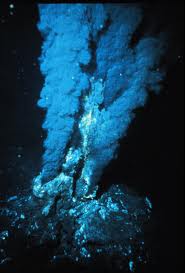
A hydrothermal vent under the ocean

A Hydrothermal Vent

What they are interested in are pieces of the chimneys of hydrothermal vents which contain many of these metals in high quantities. Some estimates related to the bed of the Eastern Pacific Ocean give an idea of the amount of materials that are down there, seven billion tonnes of manganese, 340 million tonnes of nickel, 290 million tonnes of copper and 78 million tonnes of cobalt.

This is a completely new field for mining companies though, nobody has experience in this kind of work. But the only way to gain experience is through actually doing the job, so the authorities are in a tricky position. How can they give licenses to a company with no track record in the field? Surely that means accepting a trial and error system that will inevitably lead to accidents and pollution. There are plenty of recent examples of deep sea oil drilling going very wrong, and that is after many years of experience.

And these hydrothermal vents host life that only exists in the unusual conditions that they create, what will happen to those highly developed and particular creatures and plants?

So I ask the possibly false question of sustainability. We all use these minerals, they are in everything we touch but we don’t tend to think about where they come from. Mining is a dirty business in any situation, and by definition it cannot be sustainable as far as I can see because we are dealing with finite quantities of materials that will not reproduce themselves.

But should we or indeed can we draw a line? Asteroids, the seabed, the Antarctic, where next?