Today I would like to look at some of the issues raised at the Nanotechnology lecture that I posted about last week.
The lecture was delivered by Michael Bruch, head of Research and Design of Allianz insurance company. He brought up some interesting points about nanotechnology and its production.
One problem that he raised is that we do not really know how much nanotech we are surrounded by as products containing engineered nano-particles do not have to be labeled.
Many cosmetics, sun creams and sports related products use the technique, but also food manufacturers, so it is really difficult to understand how much exposure we have to these particles. Scratch resistant paint and darkened windscreens are already here, but self repairing paint is also under trial, as is paint that changes colour.
Another problem is that their manufacturing processes are practically unregulated. Most of these materials are produced by small companies that have little or no safety procedures. And it is unclear what type of procedures would be of use.
This is because it is unclear how exposure affects the human body. These particles can enter the body in various ways, and have the capability of passing directly from the blood to the brain. This means that they can be used for medical cures such as in fighting cancer, but also that once in your body they can transfer everywhere.

The panel of speakers
Recent studies have found that exposure to nano carbon tubes does affect the heart in mice however, and similarities are drawn with asbestos as many of the fibres look similar. One complicating factor however is that materials used on a nano scale have different properties, so something that is inert such as gold might be toxic at nano scale or the other way round.
Further problems arise when we think about end of life treatment. Much of the expert knowledge is not passed down the line to those responsible for disposal of these products, so they may not be treated correctly when it comes to recycling or destroying them.
All of the above means that the nanotech industry brings with it an enormous amount of risk. Health risks are easy to see, but also environmental risks. We do not know how much is released into the atmosphere today, nor whether there will be industrial accidents and what their effects might be.
Regulation is difficult to draw up however as terms and definitions have not been agreed upon. Voluntary codes seem to be the only attempt at implementing some form of standardization.
What is safe to say is that this technology is certainly changing our lives, but that as it is developing so quickly little is known about how to treat it or the consequences it might bring.
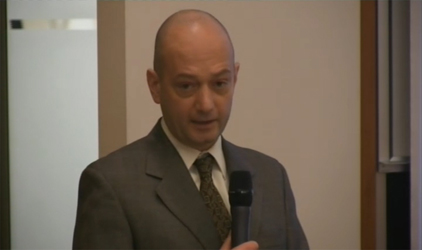
I made a speech myself, the outline of which is below. Thanks to everyone who watched via streaming, the photos were taken from the live stream by Christopher.

Me at the lecture
Comment by J Hankins of the Bassetti Foundation at the Bocconi University in Milan.
I would agree with previous comments that there is definitely a role to play for insurers in innovation.
I would also argue that the lecture Dr Bruch has just delivered is not only about innovation, but also about responsibility and obligation.
Innovation is a complex phenomenon combining science, technology, finance, management, enterprise and organizations to achieve a goal that is not only scientific but also entrepreneurial and political. The ultimate use of any results will be outside science, even though they greatly need the contribution of science, in what is by definition a continuous process.
Taken literally, innovation is something that comes about when an advance in knowledge, which is a result of a discovery, is accompanied by and combined with technology, and the power to put that advancement into practice (capital). It is not simply discovery. It is something more than that. It is part of a new historical situation arising from a combination of knowledge, technology, know-how, and the risks/opportunities developed and implemented by business or other powers. That is, it is something that was not there before and which has come about through a “new” combination of knowledge and power, bringing change into the social world. This change is appropriated, negotiated, lived through, or fought, by people – whether as citizens or as consumers.
Innovation, however, is also creativity, which necessarily implies unforeseeable change. It implies increased risk/opportunity and social power. It leads to unpredictability in the socio-political field (new institutions, types of relationship, of production, of war, and new powers), in the technical and economic realms (new materials, sources of energy, tools and categories of goods), and the cultural-aesthetic field (new styles, fashions, tastes and habits).
If we look at the interest that governments currently show in nanotechnology development this relationship to power becomes easier to see. As an agent of change, risk is intrinsic to all innovation, and I would argue that it should be carried out responsibly.
The development of nanotechnology in some ways exemplifies the problem of responsibility in innovation perfectly. As we have seen in Dr Bruch’s lecture, developments in the medical field offer new treatments for cancer, in engineering we are seeing ever lighter and stronger construction materials, and these advances will continue to ever more change the way we live and our surroundings.
But as stated, these developments are not without risk, and risk requires responsibility to be taken.
It is the entire process of innovation that must be responsible through the actions of all involved in it, in all of their different roles. It would help to have a societal understanding and a political framework in place for collaborative deliberation and for a collective capacity to rethink the fundamentals of our own premises and assumptions as we go along, changing the world we live in.
I would argue that Dr Bruch’s presentation can be seen as a call for responsible innovation in its entirety. In some ways he is saying that a company can only insure you if you play your part, as the innovator you must be transparent and thorough. But the cover is also reliant upon other actors. The consumer must be educated and informed so that when they purchase something they do it knowingly. This requires reliable information on the part of the media as well as an absence of political manoeuvring. The regulator figure is also necessary, as they must inform and orchestrate the communication that underlies their decision making and intervention.
The fact that insurance cover is seen as necessary before investment means that companies that cannot find insurance cover have difficulty securing funding for their products. This puts the insurance companies in an interesting position, as they have a direct influence on the innovation process. In some ways they become the gatekeeper, allowing those that display best practices to pass, and those who may not demonstrate an appreciation of the consequences of their work may find finance difficult.
If we look at the risk analysis in Dr Bruch’s lecture we find that it is necessarily very widely drawn, sometimes even vague as the spectrum of possible effects is large and the time scale immeasurable. This does not mean however that it is not important or should be overlooked however.
If we have no loss history, as in the case of nanotechnology, how can we measure the risk involved? Can we gain foresight? Can we use the experience of the insurance industry to create an algorithm for future risk that is not based on case history. If so could we in fact do the same for responsibility?
The examples of needs and obligations given in Dr Bruch’s lecture are not only applicable to nanotechnology however. The process required for the adequate testing of exposure levels, medical studies, political decisions, the drawing up of regulation and its implementation are present throughout society. We cannot believe that ad-hoc regulation is an answer, because by definition it can only be implemented late on in the innovation process, when the factors that may be foreseeable have been measured, standardized and formalized, and we should remember that many other factors that are more difficult to see will also play their part.
Regulation is necessary, but if we accept that it can only appear late in the innovation process it cannot be the basis for our goal. The innovation process itself must be imbued with responsibility, its design and implementation must try to take implications for the future of present actions into account.
As Dr Bruch mentioned perceptual risk is also an issue that needs to be addressed. Here we move into the political arena, an arena that should certainly not be overlooked given the influence of national, international and global politics in nanotechnology. The management of the perception of risk is as real as the management of risk itself, as perception affects decision-making.
If I could raise some questions to the audience I would like to think more about ‘stewardship’, the responsibility insurance companies hold in granting cover to operators in the nanotech industry and how a premium can be calculated in the face of such uncertainty and indeterminacy.