Global Information Technology report 2013

The World Economic Forum recently released its Global Information Technology Report 2013, and in this post I would like to have a quick look at it.

It is a long document, so I will just try to take a few highlights to give an idea of the findings.

The report has a Network Readiness Index that aims to measure how prepared countries are to adopt and make the most of new technology. Factors such as investment in broadband and other telecommunications fields obviously enter, but so does the quality of the education system and regulatory powers.

Finland leads the world in embracing technology, followed by Singapore and Sweden. The UK is in 7th place, the USA in 9th and my present home Italy is well down at number 50.

World Economic Forum

The Nordic countries and the so-called Asian Tigers – Singapore, Taiwan (China), South Korea and Hong Kong SAR – dominate this year’s index thanks to their business-friendly approach, highly skilled populations and investments in infrastructure, among other strengths. Finland, which arguably has one of the best educational systems in the world, stands out as a digital innovation hub.

Southern Europe shows a massive lag in fact with the North, and this is a major problem.

The positioning is not only important for so called ‘techies’, but really important for the economy as a whole, and here in Italy (and in Southern Europe on the whole) we are in serious need of economic improvement.

Latin America, the Caribbean and sub-Saharan Africa also suffer from a serious lag despite infrastructure improvements, an expansion of coverage and a push into e-government. Weaknesses in the political and regulatory environment, the existence of large segments of the population with a low skills base and poor development of the innovation system are all factors hindering Latin America’s technological potential. In sub-Saharan Africa, costly access to technology, a low skills base and unfavourable business conditions are among the chief obstacles.

The report demonstrates that economic growth and technological readiness are tightly linked.
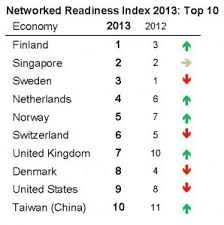
Top 10 countries for Network Rediness 2013/2012

A look at the top 10

An analysis by Booz & Company has found that ICT could help lift millions out of poverty.

Digitization has boosted world economic output by US$ 193 billion over the past two years and created 6 million jobs during that period, according to the study. Using a Digitization Index that ranks countries on a scale from zero to 100, Booz & Company found that an increase of 10% in a country’s digitization score fuels a 0.75% growth in its GDP per capita. That same 10% boost in digitization leads to a 1.02% drop in a state’s unemployment rate.

If emerging markets could double the Digitization Index score for their poorest citizens over the next 10 years, the result would be a global US$ 4.4 trillion gain in nominal GDP, according to the study. It would generate an extra US$ 930 billion in the cumulative household income for the poorest, and 64 million new jobs for today’s socially and economically most marginal groups. This would enable 580 million people to climb above the poverty line.

So investment is this area is extremely important, but in many places falling profits due to economic downturn (as is the case in Southern Europe and to some extent the USA) mean that less money is available, and this effects future growth scenarios.

Interestingly 3G growth is more important than general mobile telecommunication growth, we really do live in an information society that is based on Internet connectivity.

Medical care is also another area where benefits are net and easy to measure.

Southern Europe is in a particularly precarious position due to lack of investment capability. Rwanda on the other hand is following many other African countries in investing in expanding its fibre optic network and hopes to become a banking and finance hub, moving to being a knowledge based economy and away from agrarian in the next 7 years.

Colombia, Uruguay and Panama have become champions of e-government and connectivity. In Colombia, Internet connections have tripled to 6.2 million in the last 2.5 years. In Uruguay, small and medium-sized tech enterprises helped lift technology exports from US$ 50 million in 2000 to US$ 225 million in 2010.

Here in Italy there is little investment and a distinct lack in centralized planning, so we will soon be slipping below these countries on the scale and continue to suffer the related threats on economic development that this situation provokes.

The report is free to download here. It is as I said long and detailed, but the rankings are in chapter 1 if you just want to see where your own country sits.


The Third Industrial Revolution

Recently there has been a lot of talk about a third industrial revolution in the making. It is of course that involving 3D printing. Take a look at the other articles on the website for an overview.

The thing about these machines is that they can produce individual tailor made objects at low cost, something that was not really possible in the days of mass production, when multiples were cheap but individual one off projects very expensive.

It is a contentious technology though for several reason, the first being its versatility. A few months ago we had the first fully printed gun, the plans were put online for free before being removed but only after more than 100 000 people downloaded them.100 000 more unlicensed guns in the world possibly. Check out this article.

Another reason is that these machines will completely change manufacturing. The old days of heavy machinery in production lines might be numbered, and this means that the power and financial strength that the organizations that have control of these systems currently posess is about to be lost.

So where should somewhere like MIT here in Cambridge MA stand? They have to support new technology, it is their job, but in doing so they might be undermining their own foundations, rooted as they are in large scale US industry.

3D Printed Prosthetic Hand

3D Printed Prosthetic Hand

As well as the printable gun though there are obviously a million good uses for this technology. Two weeks ago I mentioned an engineering company that is testing an aeroplane engine that uses printed parts, and in case of dire need you can now print a prosthetic hand for about $150 through an open source website. Read the article here.

Last week the Bassetti Foundation sponsored a series of events in San Francisco based around these problems. One of the main speakers was Chris Anderson, ex editor of Wired magazine and author of the book Makers, he is a leader in thinking on these matters. There is plenty of information on the website for interested readers, including videos of the symposium about the political and social implications of a move towards 3D printed manufacture.

3D Printed Motorbike

3D Printed Motorbike

Check out the photos too, here is a printed motorbike. They can produce far more than you imagine.

Somebody is Watching You (Via TV)

Last week my local Congressman Michael Capuano introduced some important legislation into the house regarding privacy and TV.

Like many of us residing in the US, Capuano was astonished and troubled by the revelations that home TV and telephone operator Verizon was required to give the government lots of data about our telephone use. They provide a daily list of all calls, duration and codes to identify mobile devices so that the government can look for terrorists.

Capuano decided to look further into issues of privacy surrounding this particular operator, and his legislation is a result of his findings.

He found that cable TV companies are developing systems that allow the TV set to watch the viewer. The idea is that a box sits in your house and watches you watch the TV so that advertisers can market their wares better.

A woman watching TV in the dark

Watching TV

The systems will be fitted with face recognition software (see this article for an idea of how far this software has come) so that publicity can be tailor made for the consumer.

So if I am watching something the publicity will be aimed at me, and probably cross referenced with data about my interests, life and Google searches. Fast cars, motorbikes and concert tickets.

If my wife is in the room maybe the publicity will also take her presence into account, and offer her shampoo, a fitness package or the likes, or maybe target us both with a cruise or a romantic weekend in the sun for 2 or likewise. If we are sat at opposite ends of the sofa maybe some counselling or a good divorce lawyer, who knows.

I can only imagine that if the watcher is eating a bag of crisps (chips) and drinking a bottle of beer then publicity for pizza and wine would be in order, the right message at the right time if you see what I mean.

What Capuano and his co sponsor are trying to do is to pass legislation to force producers to build and market a version of their cable interface box without the cameras integrated, and that the TV must show the message “I am watching you” when the machine is watching you.

Not too much to ask you might think but in free market led America I await the outcome. Read more about the legislation here.

I was fortunate enough to interview Congressman Capuano for my Bassetti Foundation blog a couple of years ago. We spoke about technology and his responsibility as a politician to society and his electorate. A transcription of the interview is available here.

Just as a sideline the BBC has an article out about hackers taking over webcams to spy on people covertly. Apparently there is a market for access to your computer, although the stated motivations are different and the practice is not legal.

EDITOR NOTE: Don’t forget the post I wrote about keeping Java up to date Jonny; it mentions about webcam hacking too 🙂 – note by Christopher