Are broadband speeds on the rise?

Many providers will be increasing their broadband speeds from 100Mbps to 120Mbps at the start of 2012, with an estimated completion date in mid-2013. The increase will be really good for customers in the UK, who are looking for faster internet speeds for both personal and business use. Faster speeds could boost the economy, as well as change the way households and businesses use the internet.

Giving access to a super-fast internet is all part of building a newer and improved economy in the UK. The government alone has set goals to expand broadband speeds within the next three years. By the end of 2015, investors predict fibre optic broadband will be available to two-thirds of the UK. Many providers are doing their part to support the economy, understanding that the internet is such an essential part of the everyday lives of their consumers. People are using the web to assist them in every aspect of their lives these days, so having a fast and reliable internet connection is important now more than ever.

Investors will be bringing even faster speeds to the UK. It is thought that around 300Mbps speeds will become available in limited locations within the next few years. Currently, many providers are trying to keep up with these investors by doubling their speeds, allowing customers to upgrade from 10 Mbps to 20Mbps. Those who subscribe to their highest speeds of 30Mbps will be upgraded to 60Mbps. Some providers aim to roll out the changes free of charge, so customers may be pleasantly surprised by the change in their broadband speed! Users will be able to benefit from streaming television, movies and music twice as fast as before.

An example of some optical fibre internet cablesThe increase is good news for the UK, which currently ranks somewhere between 10th and 40th globally in terms of average broadband speeds – depending upon where you get your figures. Once upgrades are complete, the average UK broadband speed could increase to around 16.46Mbps, a massive download speed increase!

Consumers will be gaining this speed boost at the most opportune time, since the highly popular Netflix, this week launched its service in the UK. Such services require high bandwidth speeds and will undoubtedly attract large numbers of costumers, all of whom will need super-fast internet to watch their favourite movies and television shows.

Google prunes some of its branches

It is that time again at Google when it has to prune some of its various branches. Since Google co-founder Larry Page took over the reins as CEO in April last year, Google has been reducing and trimming its projects to renew and regain focus.

Google has come under investor scrutiny as it is facing increasing competition from both Apple and Facebook.

This spring cleaning is part of the various cost cutting and refocusing efforts. In the latest cleaning exercise announced a few weeks ago, Google will be pulling the plug on seven of its projects.

1. Google Knol

Google launched Knol in 2007 to help improve web content and as a challenge to Wikipedia that enabled experts to collaborate on in-depth articles. Knol will be available till April 30, 2012, to enable users to download their Knols to a file and/or migrate them to the WordPress platform. After that till October 1, 2012, Knols cannot be viewed but users will be able to download and export content. After October 2012, the Knol content will no longer be available.

2. Google Gears

Google has closed the Gears browser extension for creating offline web applications and stopped supporting new browsers in March this year. From December 1, 2011, Gears-based Gmail and Calendar offline will not work across all browsers, and Gears will not be available for download from late December this year. Google announced that this is part of their effort to help incorporate offline capabilities into HTML5. Users can access Gmail, Calendar and Docs offline in Chrome.

3. Renewable Energy

Google has abandoned its ambitious plans to make renewable energy cheaper than coal. Google had started this project in 2007 as a means on driving down the price of renewable energy with a strong focus on solar power. Google announced that the head of the project, Bill Weihl (William E. Weihl) has left the company and it believes that other organizations were in a better position to take its efforts to the next level.

4. Google Wave

Google has earlier stopped further development on Google Wave. Now it has announced that as of January 31, 2012, Wave will be available as only a read-only version and users won’t be able to create new ones. This will be completed closed on April 30, 2012. Users can transfer individual waves using the existing PDF export feature.

5. Google Search Timeline

Google will be removing this feature that displays a historical graph of results for a search query. Users will now be able to restrict any search to particular time periods using the refinement tools on the left-hand side of the search page. Uses who wish to view graphs with historical trends for a web search can use Google Trends or Google Insights for data since 2004. If you need more historical data, the “Ngram Viewer” in Google Books offers the same information.

The Google Trends Product Logo

6. Google Friend Connect

Google Friend Connect, which is a social feature, will be discontinued from March, this is because Google wants people to start using the Google Plus social network instead.

7. Google Bookmarks

The feature will become unavailable from December 19, 2011. This enabled users to share bookmarks and collaborate with friends. The existing bookmark Lists will be retained and labelled to make it easier to identify. The other features of the Google Bookmarks will keep on functioning. The change won’t affect the non-English users as it was an English only feature.

This spring cleaning is only a sign that Google knows that it currently faces big competition, so it needs to make sure that it discontinues disused/inefficient services it provides.

Google Christmas crackers!

Google always strike me as a fun and playful global giant, which always tries to be a little bit eccentric and different. This year in the run up to Christmas, I have so far found three of Google’s ‘Easter egg’ – which is basically another way of saying hidden, but findable jokes.

The first of the Easter eggs I have found is some Christmas lights. These come up underneath the search box when you search for the word ‘Christmas’ or many different phrases with the world ‘Christmas’ in them, like ‘Merry Christmas’. It’s not much, but it is festive 🙂

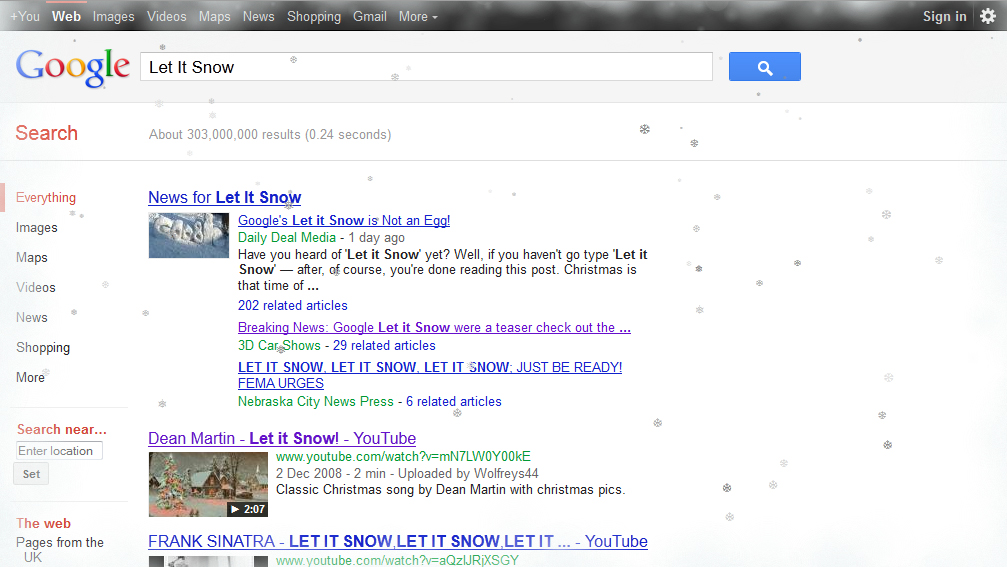
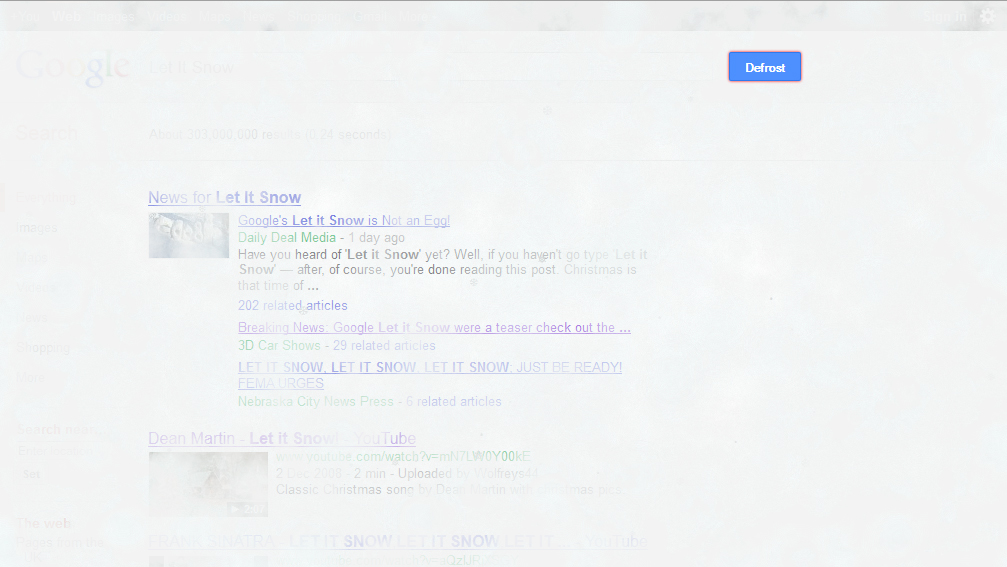
Google's Easter Egg Christmas LightsThe second Easter egg is much more exciting! When you search for the words ‘Let It Snow’ Google will take you to the search result, and everything will seem normal – for a second or two. Then all of a sudden, snowflakes will start to fall from the top of your browser, and the screen will start to mist up! You can then demist your browser either by clicking ‘Defrost’ or by using your mouse – although you still need to click the button to start using Google again. Its a really good touch by Google, really gets you in the holiday spirit!

Snow falling on a Google search page

When you type 'Let It Snow' into Google, it starts snowing in your browser!

Google Frosted/Misted Up

After a few seconds of snow, Google becomes very frosty!

The final Easter egg I have found is with the Google owned site YouTube. On some videos – I still haven’t found a link – a snowflake icon comes up on the bottom bar of the video, which if you click, gives you falling snow over the video, which you can control with your mouse.

After a bit of research I have found one more Easter egg! If you type in ‘Hanukkah’ you get some special decorations, which appear like the Christmas lights, underneath the search box.

Finally, something that isn’t actually hidden, but worth mentioning is Google’s message from Santa. SendACallFromSanta.com is courtesy of Gmail, and lets you design a personalised message which Santa can either phone home with, (if you live in the USA or Canada) or create an animated video which can be sent via email. It is totally free and can be used for Children and Adults alike, due to the various serious and humorous options.

Google seem to want to get us in the festive spirit, so now give you my festive wishes 🙂

Merry Christmas Everyone!