How to get the most from your fibre optic broadband

While fibre optic internet coverage continues to grow, internet prices are continuing to decrease, meaning it’s never been a better time to upgrade your internet. That being said, if you intend on shelling out on fibre optic, its best you consider how you can ensure you make the most of what you pay for.

Upgrade your wireless router

If your internet supplier has not already provided you with a new wireless router, you may find the need to upgrade to make the most of your new high speed internet. Older routers on the whole tend to be around 50% slower than newer models, meaning investment is paramount if you want to make the most of your fibre optic connection. There is a huge array of routers on the market, with many different features. It’s advised that you go for a dual band router if you have many devices on your network as it will ensure a better connection that is less prone to interference.

Use an Ethernet cable

If you’re after the highest internet and data transferral speeds, connecting via an Ethernet cable is by far your best option. Wireless data is transmitted at a snail pace when compared to a cabled connection, which now has speeds of up to one gigabit on some routers, so really cuts down on the benefit of fibre optic broadband. Though far from practical, having a wired connection will enable you to really make the most of your internet connection.
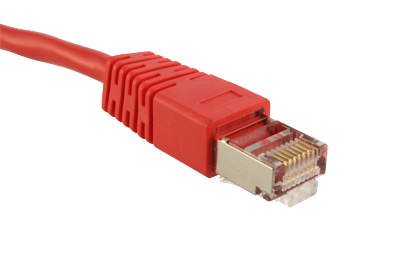
The end of an Ethernet cable

The end of a red Ethernet cable – the colour has no significance, red just makes for a more vibrant image!

If you own a desktop, setup your router nearby so you can always have a wired connection for your PC. If not consider hiding cables in the wall throughout your home so you can have high speed connectivity throughout your home. If done right, it can even make your home more attractive when it comes to selling it!

Set up a media server

Modern hard drives now have functions which enable them to be used and accessed over your network, meaning you don’t need it to be plugged directly into your computer for it to work. Not only is this highly practical, it also allows multiple users to access information at the same time, without the need of cables.

Splash out on modern technology

Many modern devices now have some form of use for wireless internet, so splashing out on the latest devices will mean you can really make the most of your fibre optic connection. Many consoles such as the Xbox 360 or the PlayStation 3 will allow users to stream content from the internet or computer onto the TV. With a high speed connection, you can have many devices operating at full pelt without feeling like your connection is being throttled.

The story of the online auction monopolist eBay

eBay. A firm which in 2011 had a net income of more than 3.2 billion. A website which almost everyone has heard of.

In an article I recently posted which explored whether there is really that much diversity online, I noted how eBay owned four websites in Alexa’s top 100 ranking – eBay.com, eBay.de, eBay.co.uk and PayPal.com.

There is no doubt that eBay holds a monopoly on the online auction market. But how did it get there? On September the 2nd 1995, eBay didn’t exist. One day later on September the 3rd it did, and after just over 3 years and 6 months, the site made its first major acquisition, the auction house Butterfield & Butterfield which it purchased for the price of $260,000,000 USD. A spend of 260 million after less than four years trading? eBay’s rapid early growth set it up to become a global internet phenomenon.

eBay kept buying up smaller firms, but not spending nearly as much as it had on its first purchase until mid-2000 when it forked out 318 million (USD) to buy Half.com. This was an amazing investment at the time, as even today it stands as eBay’s 6th largest ever investment, and it has made hundreds.

PayPal's logoThat said, the purchase of Half.com was to prove small fry to PayPal, which the now giant auctioneer purchased 2 years later in July 2002 for an astounding $1.5 billion. PayPal integration with eBay is (in my opinion) one of its greatest ever business moves. eBay is now able to seamlessly integrate processing credit card payments without having to pay millions every year to third parties. Fees eBay would have lost to PayPal are now extra revenues.

eBay wasn’t done though, going on to make the biggest purchase in its history, by buying Skype Limited for more than $2.5 billion. The auction site purchased the Luxembourg based company in 2005, only to sell 70% of its shares in 2009 for $2 billion – a healthy profit. Later, in May 2011, Microsoft bought Skype in its entirety for $8.5 billion, an investment which I am not sure it will see great returns on in the near future at least.

Skype's LogoeBay started to turn into a Microsoft and a Google. It was fast becoming an internet giant which bought up pretty much anything it could see turning it a bigger profit, or anything which posed a threat – in terms of competition. Just some of its purchases include StumbleUpon, Bill Me Later and Magento, the ecommerce web application.

Many say that eBay is one of the most notable successes the dot-com bubble, and I have to agree. Without the internet, eBay would be nowhere. It got in early and grew from the start, giving its competition very little chance.

Like it or hate it, eBay is an internet phenomenon, and also an internet giant. In my opinion it is successful down to luck: a good idea at the right time. Had it been thought of a year later, eBay might not be what it is today, had the internet not really taken off as it has and still is doing, eBay would again might not be where it is today.

What are your views on eBay? Were you aware of how much it owns and how rich it is? Is its monopoly unfair, or don’t you mind?

Data centers – where would we be without them?

It is hardly a controversial opinion to suggest that data centers are an indispensable part of modern life – it really is impossible to envisage a world without the vast capacity and power that data centers grant the business and information technology sectors – where would we all be without Google, eBay and Facebook? But what exactly are the advantages of a data center that their absence would remove? Let’s take a look…

Firstly, the cost to enterprises of running an in-house own data center is increasingly prohibitive, given the growing size requirements of such facilities. As more and more information is transmitted online and more transactions take place online – just as computing power continues to grow – then a data center needs exponentially more power and more hard disk space. Server racks just keep on getting longer and even keeping them cool enough becomes uneconomically costly for most small, medium or even large-sized enterprises.

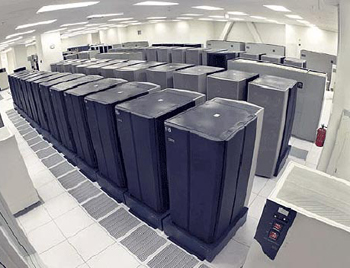
Server RoomSecurity is the second big issue – in a world where cyber-crime and espionage is constantly growing, there needs to be a very robust response to security. Most enterprises just don’t have the time and resources to police their IT operations to the level required, and a good data center can give them the reassurances they need. Technicians can be on hand throughout the 24-hour cycle, not just to ensure that the server racks keep on functioning perfectly and that any problems are swiftly dealt with, but also to ensure that information is kept safe and secure and that hacking or phishing attempts are roundly thwarted.

So, where would we be without data centers? The answer is that we would have a vastly more limited cyber-world, with businesses forced to keep their computer operations artificially scaled back due to cost considerations, with the knock-on effect of a hobbled e-commerce sector. Social networks would be slow, unsafe and prone to disastrous infiltration, while search engines would also be grindingly slow and frustrating to use – welcome back to the late 1990s.

It’s safe to say that data centers are not only here to stay, but will keep getting bigger and better so long as the computer world leads the way.