Bodybook – Because Facebook owns your face

Facebook owns the word Face. No, it really does. In the United States, Facebook owns the trademarks to the words ‘Face’, ‘Book’, ‘Wall’ and ‘Facepile’ as well as the aberration ‘FB’. It also has the rights to be the only company to use a single letter ‘F’ as their logo. Check out section 5.6 of their terms and conditions for the proof.

Cheers Facebook, there goes my plan of publishing my book ‘A book about my face on the wall’ in the US. Guess I will have to rename it ‘Pages of text about the front of my head on the structural divider.’ Only joking, I don’t plan on re-publishing it in the US.

Facebook Owns Your Content

As Jonny mentioned a while back, Instagram has the right to sell your pictures, and no doubt Facebook will soon too. Any picture you post on Facebook the social network already owns anyway. Check out section 2.1 of the terms I link to above:

“For content that is covered by intellectual property rights, like photos and videos, you specifically give us the following permission… …you grant us a non-exclusive, transferable, sub-licensable, royalty-free, worldwide license to use any IP content that you post on or in connection with Facebook…”

So Facebook owns your pictures, your videos and your statuses. Don’t worry, if you delete them, usually most of the rights will transfer back to you, however so long as they remain live on Facebook, it can use them how it wants, as well as share them with its ‘partners’. This means that you could very easily become a victim of mistaken identity.

Terms of Service; Didn’t Read note how “Facebook automatically shares your information with Bing, Pandora, TripAdvisor, Yelp, Rotten Tomatoes, Clicker, Scribd, and Docs, unless you manually opt-out.” how lovely of them to share your stuff for you!

Terms of Service; Didn't Read logoRemember my 7th ever post on Technology Bloggers? Of course you do! 😉 I questioned whether or not Facebook was exploiting users by using status information to provide tailored advertising – without asking.

Facebook Own Your Face

Facebook has taken targeted advertising a step further since then. It has been using the names and pictures of around 150 million people in ‘Sponsored Stories’ without their permission and as a result sent out an email checking that this was okay. Those who responded to Facebook’s message will receive a $15 USD payment as compensation. Is that really all it costs to buy your identity? Did you get an email? Did you ignore it?
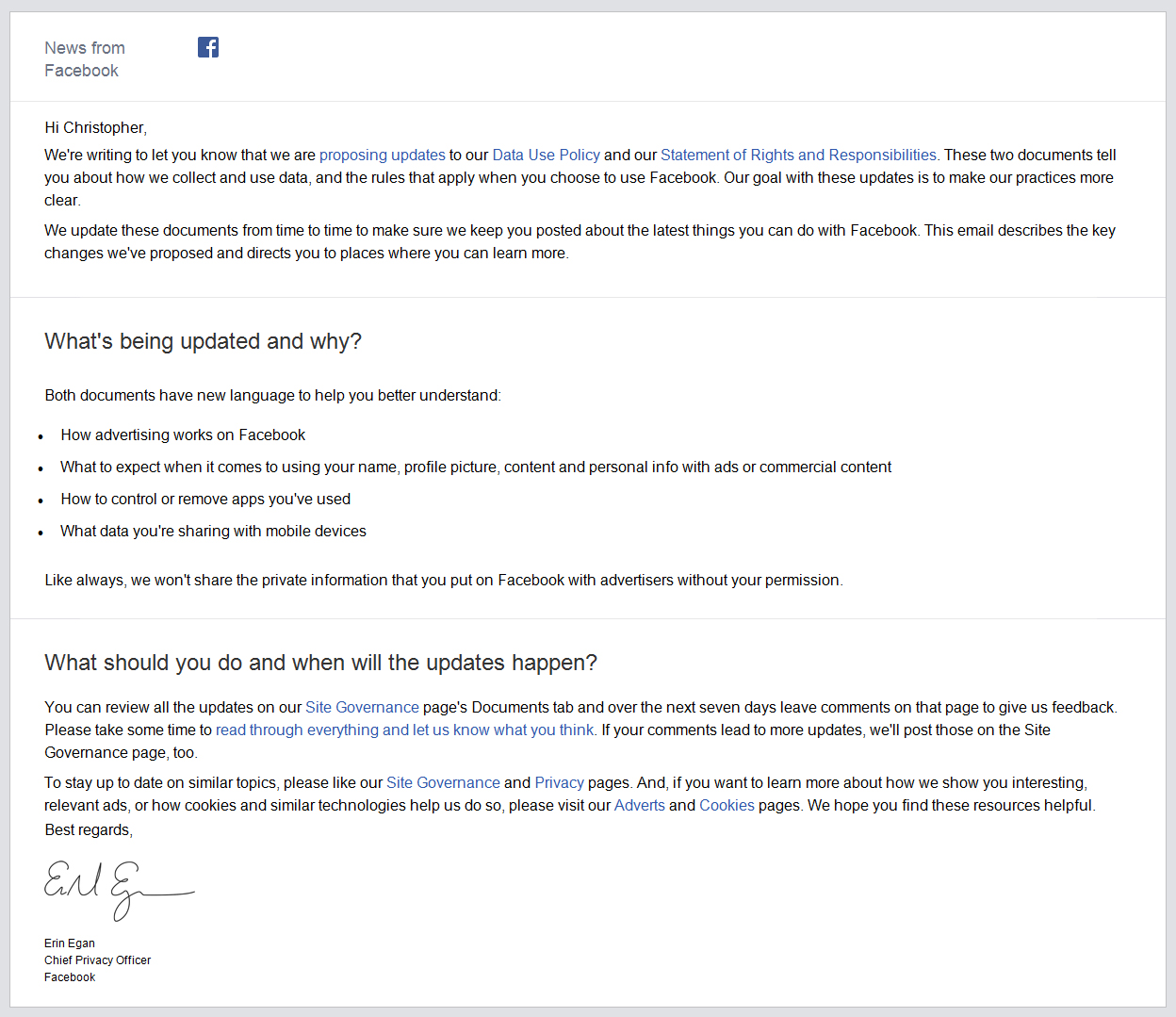
Facebooks email to users about updating its privacy policy

The email Facebook sent to me letting me know it was updating its privacy policy.

Anyhow, Facebook don’t like having to pay for your permission, so they have recently changed their terms and conditions. If you have a Facebook account, you will have been sent an email on the 30th of August about this change. If you deleted it, you can find an image of my email to the right.

The new terms state that Facebook can now use your face to claim you endorse its advertisers products. You know that face you are wearing, you no longer own the exclusive rights to it. Facebook legally part-owns your face.

Will everyone remove pictures of their faces and just have shots of their body? Or maybe people will use pictures of their pets. Then again, who wants Facebook to own their pets face…

Bodybook

I doubt many people will pay any attention to Facebook’s latest changes.

Will this spark the rise of a new Facebook, a Bodybook? Probably not, as most people seem to trust Facebook with their privacy… oh, and Facebook also owns the word book, so it would need to be Bodyjournal, which sounds like a totally different thing.

Christopher Roberts with no head

Which do you think should be my new profile picture, the one on the left or the one on the right?

Oh and don’t forget, there is a strong correlation with Facebook addiction and depression

Facebook Addiction?

Do you ever feel that Facebook has got the better of you? That it has some kind of force that draws you in every time you go near your computer? Well if so you should know that you are not alone.

Two researchers here at MIT have conducted some experiments to see if they could halt their addiction in its tracks. The researchers put some code into their machines that monitors the sites they visit through their browser. When they visit Facebook too often an electric shock is sent through a peripheral device to their keyboard, and they get a jolt.

Now if you have ever spent any time with cows you will know that they respect electric fences because they hurt, and the researchers think that this system might deter them from too much use. They call it Pavlov’s Poke.

And surely enough after a few shocks the boys used Facebook a little less.

Thumbs down.

Thumbs down to Facebook overuse.

There is also the story of a young man who hired a woman through our local newspaper to help him avoid Internet distraction. She sat next to him in his office and slapped him in the face when he lost the thread of his searches. Probably a little cumbersome as a solution though, not to mention pricey. Read the story here.

So the boys came up with an automated version that posts a job request through Amazon’s Mechanical Turk service when the quota is reached. The job requires a person to call and abuse you reading from a script, simple and a much better use of human resources I would think.

And we might really be talking about addiction here. A study cited in Forbes by the University of Chicago claims that Facebook is more addictive than cigarettes or alcohol, with the average user spending 400 minutes a month on the site.

Another report from the University of Utah shows that people who use Facebook a lot are led to believe that other people’s lives are better than theirs.

This is an easy conclusion to come to when you look at photos of your friends (and people you don’t really know or never really speak to face to face) while they are on holiday, having fun in clubs, meeting new people and going to music festivals, while you are sitting at home in front of your computer feeling miserable. Photos of arguing with your partner or the kids waking up at 4 in the morning are rarer.

Researchers at the University of Michigan came to the same conclusion. Read their report in full here. This is a brand new piece of research.

The truth is that these social media sites are designed to be both addictive and necessary. They make you feel better in some ways, people of course like you, but they distort views of real life and can lead to distraction and unhappiness.

They make money by selling, so they need as many online presences as they can get and for as long and often as possible. They are (as they openly admit) marketplaces, designed to sell access to their users for publicity purposes. They are not apolitical and have goals, and their success makes or breaks their share price.

On a personal note I recently applied for a job in the USA as a freelance journalist. Although I have lots of experience, good qualifications and a measurable reader base, I got no further than the application form. The employers wanted details of my social network, Facebook, Google plus etc, not my writing.

I had nothing to offer them.

Goodbye CommentLuv

“…blogging has changed, and the blog itself is no-longer where many people read and interact. Read in the feed and comment on social media. Blogging is still there, but I think comments are slowly dying…

A feed and social profile were luxuries years ago, however now it seems they are part of blogging itself – if you don’t have them do you have a blog at all?”

That is a quote from a comment I left in June this year.

Digital media explorer Ari Herzog has noted how blog comments are evolving, and he now offers his readers the ability to leave a comment via the standard (vanilla) WordPress commenting system, as well as via Facebook and Google Plus.

Blogging is still very much alive, however as my opening quote suggests, the way authors go about publishing content and how readers then go abut digesting and debating this, has changed significantly in recent times.

CommentLuv

Just over two years ago I wrote a post detailing why you should use the CommentLuv plugin. Today very few 0f the reasons I state still hold true.

I have now deactivated CommentLuv on Technology Bloggers for these simple reasons:

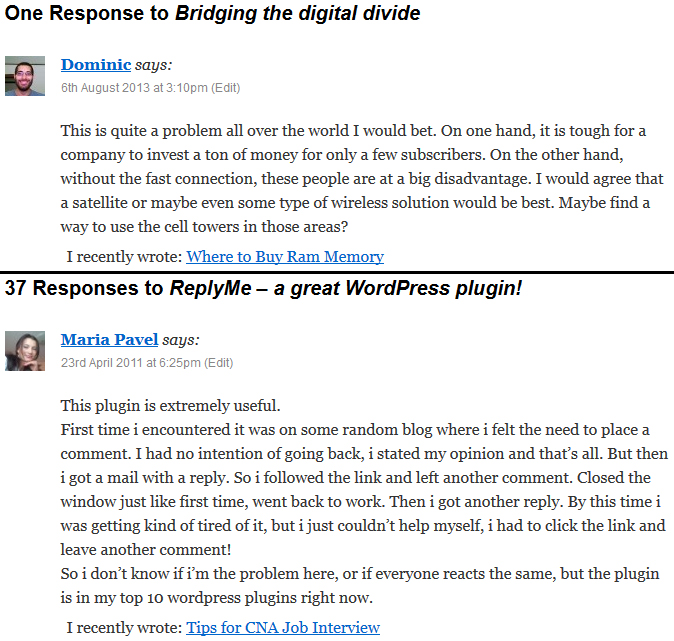
Two comments with CommentLuv links

Two great comments with irrelevant CommentLuv links.

  • CommentLuv looks messy – take a look at the two comments to the right. They are both great comments, but they are followed by an untidy, irrelevant link. If someone is interesting in your site, they will check it out anyway.
  • CommentLuv promotes spam – having looked through our comments, very few of our genuine visitors actually take advantage of CommentLuv, yet almost all the spam comments we get include a CommentLuv link.
  • CommentLuv increases load time – you know how obsessed I am with speed, so much so, any plugin which significantly impacts load time is now under scrutiny. CommentLuv is quite a heavy plugin which I have found has a big impact on page load time, and that extra lag isn’t justifiable for what it offers.
  • CommentLuv is bad for SEO – one of the key things Google has been clamping down on of late is irrelevant links. If you run a site about lawnmowers, and you have a large number of links coming from a technology website, it probably doesn’t do you any favours. Similarly, if I have written an article on something tech related, comments with random links introducing irrelevant keywords, dilute the content and probably don’t do my article any favours.
Google SEO chart

CommentLuv is arguable bad for SEO.

CommentLuv was once a great plugin, but its time has passed. The web is changing, blogging more so than ever, so it is time to say goodbye to CommentLuv.